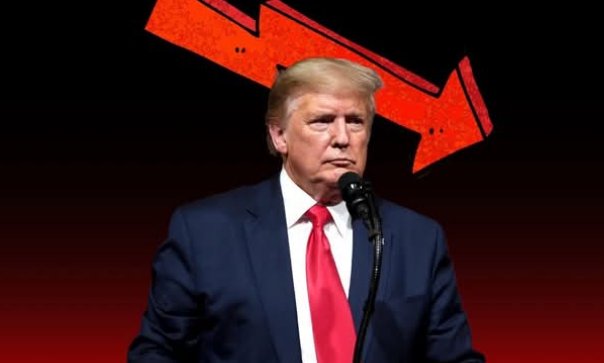
Washington, April 29 : President Donald Trump’s first 100 days in office were the worst of any new president for the S&P 500 index since the Watergate scandal in 1973 during President Richard Nixon’s second term.
The S&P 500’s 7.9% drop from January 20 through the April 25 close marked the second-worst first 100-day performance, going back to the beginning of President Richard Nixon’s second term in 1973 when the S&P 500 tumbled 9.9%.
The S&P 500 took a nosedive in April, losing 10% in just two days and briefly entering bear market territory following Trump’s ‘reciprocal’ tariff announcement. The S&P 500 reached a closing high of 6.144K on February 19 and closed on April 25 at 5.525K, erasing all post-election gains from November.
However, Trump has one more trading day to cut his losses since his first 100 days technically end on Tuesday. He could, therefore, get close to the third worst start—the 6.9% decline during the first 100 days of George W. Bush in 2001 if the S&P 500 rallies this week.
According to CFRA’s data, the S&P 500 climbed 3.7% from Election Day to Inauguration Day before the rally sputtered and then dove sharply as Trump used his early days in office to push forth other campaign promises that investors took less seriously.
Global stock markets plunged in the wake of Trump’s “Liberation Day” tariffs on April 2, wiping $8.6 trillion (£6.4 trillion) off the value of indices worldwide. The loss reduced to about $1 trillion since Trump announced a 90-day suspension on most of his tariffs on April 9.
Meanwhile, Bank of America strategists warned on Friday that the conditions for a sustained stock market rebound were missing and encouraged investors to sell into the most recent rebound in U.S. equities and the dollar. Foreign investors have already received the memo and have been dumping American shares since the start of March.
David Lefkowitz, head of US equities at UBS’s global wealth management arm, said he expects profits for S&P 500 companies to be flat this year. He added that a tariff-induced slowdown in economic activity and the associated higher costs will crimp earnings growth.