





The United Arab Emirates has unveiled an ambitious $1 billion investment initiative aimed at revolutionizing artificial intelligence infrastructure and AI-enabled services across the African continent, marking one of the most significant technology-focused development commitments to Africa in recent years.
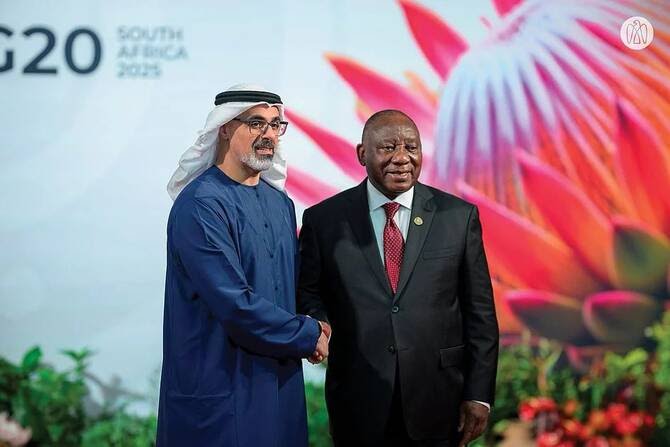
The groundbreaking initiative, officially titled “AI for Development,” was announced on Saturday by UAE Minister of State Saeed Bin Mubarak Al Hajeri during the G20 Leaders’ Summit held in Johannesburg, South Africa.
According to Minister Al Hajeri’s presentation at the summit, the $1 billion investment will strategically channel advanced AI technologies and tools into critical priority sectors that form the backbone of sustainable development across African nations.
These sectors include education, healthcare delivery systems, and climate adaptation strategies, representing areas where AI applications can generate immediate and measurable impact on quality of life and economic productivity.
In education, the initiative is expected to support the deployment of AI-powered learning platforms, personalized education systems, and digital literacy programs that can help bridge the significant educational gaps that exist across many African countries. These technologies can enable adaptive learning experiences tailored to individual student needs, provide access to quality educational resources in remote areas, and support teacher training programs with AI-assisted tools.
Within the healthcare sector, AI applications funded through this initiative could revolutionize medical diagnostics, disease surveillance, drug discovery, and healthcare delivery in regions with acute shortages of medical professionals and infrastructure. AI-powered diagnostic tools have already demonstrated remarkable accuracy in detecting diseases from medical imaging, while predictive analytics can help health authorities anticipate and respond to disease outbreaks more effectively.
For climate adaptation—a critical concern for many African nations facing severe impacts from climate change—AI technologies can enhance weather prediction systems, optimize agricultural practices, improve water resource management, and support early warning systems for natural disasters. These applications are particularly valuable for countries whose economies depend heavily on climate-sensitive sectors like agriculture.
“We consider AI not just as a future industry but a cornerstone of humanity’s future,” Minister Al Hajeri emphasized during his address. “My country is actively accelerating innovation to enhance productivity and drive significant advancements in the global economy, with a strong commitment to developing responsible and inclusive AI for the benefit of everyone.”
This statement reflects the UAE’s philosophical approach to artificial intelligence as a foundational technology that transcends conventional industry boundaries and represents a fundamental shift in how societies organize economic activity, deliver services, and solve complex challenges. The emphasis on “responsible and inclusive AI” also signals awareness of the ethical considerations and potential risks associated with AI deployment, particularly in developing country contexts where regulatory frameworks may still be evolving.
The AI investment initiative builds upon the UAE’s already substantial and rapidly growing economic presence throughout the African continent. The Emirates has methodically positioned itself as one of Africa’s largest and most active foreign investors, pursuing a diversified strategy that spans infrastructure development, energy projects, telecommunications, ports, financial services, and now advanced technology sectors.
Recent data reveals the impressive scale of this economic engagement. In 2024 alone, bilateral trade between the UAE and African nations reached approximately $107 billion, representing a remarkable 28% increase from the previous year. This substantial year-over-year growth rate demonstrates both the deepening economic integration between the UAE and Africa and the expanding diversity of trade relationships across different sectors and countries.
Even more striking is the cumulative investment figure over recent years. Between 2020 and 2024, the UAE channeled more than $118 billion in direct investments into African economies, according to official government statistics and trade ministry reports. This five-year investment total exceeds the GDP of many individual African nations and represents a sustained, strategic commitment rather than opportunistic or sporadic engagement.
These investments have been distributed across the continent, though with concentration in key strategic markets including Egypt, South Africa, Kenya, Nigeria, Ethiopia, and Morocco. The investment portfolio encompasses diverse sectors: renewable energy installations and conventional power generation, port infrastructure and logistics facilities, telecommunications networks, real estate developments, agricultural projects, and financial services platforms.
The economic relationship between the UAE and Africa extends beyond pure commercial interests, incorporating elements of development cooperation, technical assistance, and capacity building. UAE-based companies and government entities have frequently paired investment commitments with knowledge transfer programs, training initiatives, and technology deployment that support local skill development and institutional strengthening.
Strategic Positioning in the Global AI Race
The AI for Development initiative reflects the UAE’s dual strategic approach to artificial intelligence: simultaneously building domestic AI capabilities while establishing the country as a key enabler of AI adoption in emerging markets. This two-pronged strategy aligns perfectly with the UAE’s broader economic diversification agenda and its ambition to transition from a hydrocarbon-dependent economy to a knowledge-based, innovation-driven economy anchored in cutting-edge technologies.
At the domestic level, Abu Dhabi and Dubai are investing heavily in establishing world-class AI research institutions, attracting international AI talent, and building the physical and digital infrastructure necessary to support advanced AI development and deployment. The UAE government has established specialized AI entities, launched AI-focused free zones with favorable regulatory environments, and created substantial venture capital funds dedicated to AI startups.
A centerpiece of this domestic AI strategy involves plans to construct one of the world’s largest and most sophisticated data center hubs, utilizing cutting-edge technology from American partners including NVIDIA and other semiconductor companies. These massive data centers will provide the computational infrastructure essential for training large AI models, processing vast datasets, and delivering AI services at scale—capabilities that position the UAE as a regional AI powerhouse.
The country has also been developing its own large language models and AI systems tailored to Arabic language and regional cultural contexts, addressing a significant gap in AI technologies that have historically been dominated by English-language training data and Western cultural perspectives. These efforts include projects like Falcon, an open-source large language model developed by the UAE’s Technology Innovation Institute.
Simultaneously, the UAE is exporting its AI development model through partnerships and investments in emerging markets, particularly across Africa where digital infrastructure gaps create both challenges and opportunities. This external dimension of the strategy serves multiple purposes: it establishes the UAE as a thought leader and enabler in global AI governance and deployment; it creates commercial opportunities for UAE-based AI companies and service providers; and it strengthens diplomatic and economic ties with strategically important regions.
Analysts observing this strategy note that it positions the UAE distinctively in the global AI landscape—neither as a pure technology consumer dependent on Western or Chinese AI platforms, nor as a fully independent AI superpower, but rather as a strategic intermediary that can facilitate AI adoption in regions where major technology powers face political, economic, or cultural barriers to entry.
Africa’s Digital Potential and Demographic Advantage
The UAE’s substantial investment in African AI infrastructure reflects a sophisticated understanding of the continent’s unique position in global demographic and economic trends. Africa currently hosts the world’s youngest and fastest-growing population, with a median age of approximately 19 years compared to global median age of 30 years. By 2050, Africa’s population is projected to reach approximately 2.5 billion people, representing more than a quarter of humanity.
This demographic profile creates both urgent development challenges and extraordinary economic opportunities. On one hand, African governments must rapidly expand education systems, healthcare infrastructure, employment opportunities, and basic services to meet the needs of burgeoning young populations. On the other hand, this young, digitally native generation represents an enormous potential workforce, consumer market, and innovation ecosystem—if properly supported with education, technology access, and economic opportunities.
The digital economy presents particular promise for African development. Mobile phone penetration has increased dramatically across the continent, reaching over 80% in many countries, while internet connectivity continues to expand through satellite, fiber optic, and mobile network investments. This growing digital infrastructure creates a foundation for AI applications that can leapfrog traditional development pathways, much as mobile money services like M-Pesa transformed financial services in East Africa without requiring extensive traditional banking infrastructure.
African countries also possess substantial natural resources, agricultural potential, and renewable energy capacity that could support AI-intensive industries including data centers, AI development, and technology services exports. Several African nations have begun positioning themselves as technology hubs, with countries like Kenya, Nigeria, South Africa, Rwanda, and Egypt developing vibrant startup ecosystems and attracting significant venture capital investment.
However, significant obstacles remain. Many African countries face infrastructure deficits in electricity, internet connectivity, and education systems that constrain technology adoption. Digital literacy levels vary widely, while regulatory frameworks for data protection, AI governance, and technology services remain underdeveloped in many jurisdictions. Access to capital, technical expertise, and global technology markets presents ongoing challenges for African entrepreneurs and governments seeking to participate fully in the AI revolution.
Framework and Sector-Specific Applications
While the UAE announcement provided high-level details about the $1 billion AI for Development initiative, the specific implementation mechanisms, partner selection processes, and project timelines will likely be elaborated in subsequent announcements and bilateral agreements with individual African governments and regional organizations.
Based on the UAE’s previous development cooperation approaches and the nature of AI technology deployment, the initiative will likely employ multiple implementation channels:
Direct Government Partnerships: Bilateral agreements with African governments to establish AI research centers, deploy specific AI applications in public services, and build capacity within government institutions to utilize AI technologies effectively. These partnerships might include secondment of UAE technical experts, training programs for African government officials, and co-development of AI strategies tailored to national priorities.
Public-Private Partnerships: Collaboration between UAE government entities, private sector companies, and African partners to deploy commercial AI applications in sectors like telecommunications, financial services, agriculture, and logistics. These arrangements could blend public sector funding for foundational infrastructure with private sector expertise and operational capabilities.
Multilateral Cooperation: Coordination with international organizations including the African Union, African Development Bank, regional economic communities, and UN agencies to ensure alignment with existing development initiatives and to leverage complementary resources and expertise.
Academic and Research Collaborations: Support for establishing or expanding AI research centers at African universities, funding scholarship programs for African students to study AI disciplines, and creating research partnerships between UAE and African institutions to address continent-specific AI challenges.
In education, specific applications might include AI-powered tutoring systems that provide personalized instruction in subjects where teacher shortages are acute, language learning platforms that support multilingual education in Africa’s linguistically diverse societies, and educational assessment tools that help identify students requiring additional support. AI systems could also assist in educational administration, optimizing resource allocation, teacher assignment, and curriculum development based on learning outcome data.
Healthcare applications could encompass AI diagnostic tools that help frontline health workers in rural areas identify diseases from symptoms, images, or simple tests; predictive models that forecast disease outbreaks and optimize vaccine distribution; telemedicine platforms incorporating AI to extend specialist medical expertise to underserved areas; and drug discovery initiatives focused on diseases that disproportionately affect African populations but receive insufficient research attention from global pharmaceutical companies.
Climate adaptation AI applications might include precision agriculture systems that optimize planting, irrigation, and fertilization decisions based on weather patterns and soil conditions; early warning systems for droughts, floods, and other climate-related disasters; modeling tools that help governments plan infrastructure investments considering future climate scenarios; and systems for monitoring deforestation, wildlife populations, and ecosystem health.
Implications for Global Development Cooperation
The UAE’s $1 billion AI investment in Africa represents more than a bilateral development initiative—it signals evolving patterns in global development cooperation and technology transfer. Traditionally, major development assistance and technology partnerships flowed primarily from established Western powers and multilateral institutions to developing countries, with China emerging as an alternative source of development finance in recent decades.
The UAE’s initiative exemplifies a growing phenomenon of “South-South cooperation,” where emerging economies with relatively recent development success provide assistance, investment, and knowledge transfer to other developing regions. This model carries distinct advantages: UAE officials and technologists often possess more recent experience navigating challenges similar to those facing African countries today; cultural and political sensitivities may differ from traditional Western donors; and economic motivations can be more transparently integrated with development objectives.
However, this model also raises important questions about governance, standards, and long-term sustainability. Will AI systems deployed through this initiative respect data privacy and digital rights? How will intellectual property be managed? What safeguards will ensure that AI applications serve broad development objectives rather than narrow commercial interests? These questions merit careful attention as implementation proceeds.
The initiative also occurs within a broader context of intensifying competition for influence in Africa among major powers including the United States, China, European nations, and emerging economies. While this competition can benefit African countries through expanded options and increased investment, it also requires sophisticated diplomacy to maximize benefits while maintaining strategic autonomy and avoiding dependency relationships.
For African countries, this initiative offers tangible opportunities to accelerate digital transformation, enhance service delivery in critical sectors, and build domestic AI capabilities that can support long-term economic competitiveness. The success of this investment will depend on thoughtful implementation that respects local contexts, builds genuine partnerships rather than dependency relationships, and ensures that AI technologies serve broad-based development objectives.
For the UAE, the initiative advances multiple strategic objectives: strengthening economic and diplomatic ties with African nations, positioning the Emirates as a global leader in AI-driven development, creating opportunities for UAE-based technology companies, and demonstrating responsible technology leadership that could influence global AI governance frameworks.
As implementation unfolds in the coming years, the AI for Development initiative will provide valuable lessons about effective approaches to deploying transformative technologies in developing country contexts, the role of emerging economy partners in global development cooperation, and the potential for artificial intelligence to address some of humanity’s most pressing challenges. The stakes are substantial—for Africa’s development trajectory, for the UAE’s global positioning, and for demonstrating that advanced technologies can be harnessed for inclusive progress rather than exacerbating global inequalities.