Kenya recently witnessed a significant escalation in tensions between the government and civil society following a government-imposed ban on live media coverage of nationwide protests marking the one-year anniversary of the deadly 2024 anti-tax demonstrations.
The ban, enforced by the Communications Authority of Kenya (CA), triggered widespread condemnation from activists, journalists, media houses, and legal experts, who warned of legal action and decried the clampdown as unconstitutional and a violation of fundamental freedoms.
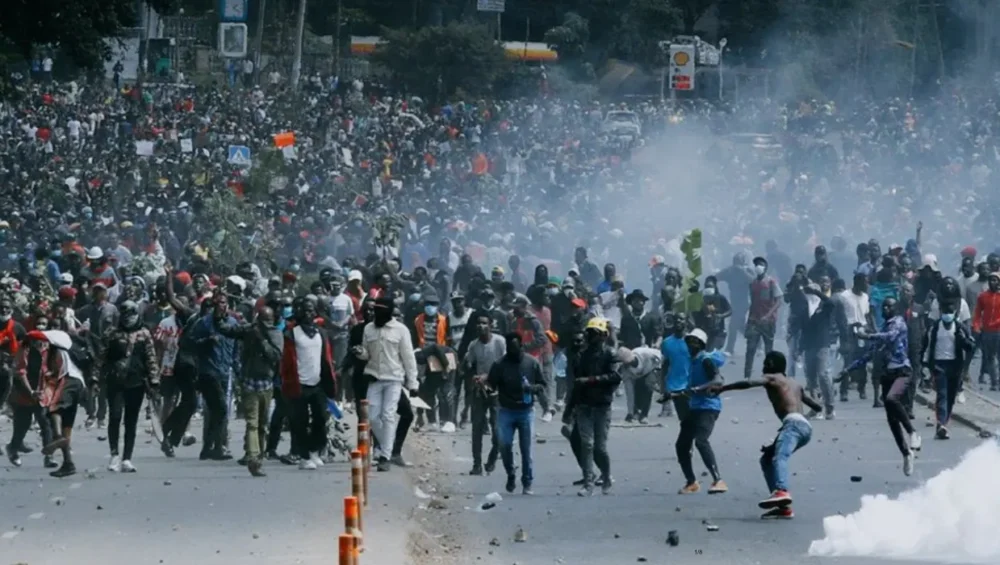
On June 25, 2025, thousands of Kenyans took to the streets across most of the country’s 47 counties to commemorate the anniversary of last year’s anti-tax protests, which had resulted in at least 60 deaths. The demonstrations were further fueled by outrage over the death of a blogger, Albert Ojwang, who suffered severe injuries while in police custody following a complaint by a senior police official.
The protests turned violent in several areas, with Amnesty Kenya reporting that 16 people died from gunshot wounds believed to have been inflicted by police officers during the demonstrations. Law enforcement used tear gas and water cannons to disperse crowds, and Julisha.co.ke documented numerous injuries among protesters due to clashes with police. Meanwhile, looting and arson caused significant property damage in central Nairobi, with smoldering buildings and charred debris marking the aftermath of the unrest.
The Media Ban and Broadcast Blackout
In the midst of the protests, the Communications Authority of Kenya issued a directive ordering, “all television and radio stations to stop any live coverage of the demonstrations forthwith”.
Warning of unspecified regulatory sanctions for non-compliance. The CA cited constitutional provisions—specifically Articles 33(2) and 34(1) of the Kenyan Constitution and Section 46I of the Kenya Information and Communications Act of 1998—alleging that live broadcasts could amount to “propaganda for war” and “incitement to violence”.
Following the directive, police and CA officials switched off the broadcast signals of several major privately owned media houses. However, some stations continued to share content online and on social media platforms. The sudden blackout also coincided with a digital clampdown that included throttling internet speeds and restricting access to social media apps, widely used for protest coordination and information sharing.
Alongside the broadcast ban, the government imposed restrictions on internet access and blocked Apps, which affected millions of Kenyans. Telecommunications companies such as Safaricom PLC, Jamii Telecommunication Ltd, and Liquid Intelligent Technologies complied with government orders to throttle internet speeds and restrict access, despite a previous High Court injunction prohibiting interference with internet access pending a constitutional petition.
Stakeholder Reactions and Legal Challenges
The ban and blackout drew swift and forceful condemnation from a broad coalition of civil society groups, media organizations, and legal experts.
This media and digital clampdown was widely condemned as a violation of constitutional rights, including freedom of expression (Article 33), freedom of the media (Article 34), access to information (Article 35), freedom of association (Article 36), and the right to peaceful assembly (Article 37). Civil society groups described these measures as a continuation of a troubling pattern of internet shutdowns and media restrictions witnessed in Kenya over the past year, including the first total internet shutdown in June 2024 and previous Telegram blockages.
Immediately, the Law Society of Kenya, Kenya Editors Guild, and Katiba Institute went straight to court. They argued the ban trampled on the three fundamental constitutional rights of freedom of expression, freedom of the media, and the right to information.
In a joint statement, the Law Society of Kenya, Police Reforms Working Group and Kenya Medical Association also expressed grave concern over the directive.
" This directive is a misinterpretation of constitutional provisions and a dangerous step towards suppressing fundamental freedoms in Kenya. We assert that the live broadcast of peaceful protests, and even those that may involve sporadic acts of violence by a few individuals, does not inherently constitute propaganda for war or incitement to violence." they said.
"On the contrary, live broadcasts serve a crucial role in a democratic society. Live coverage provides citizens with information about events as they unfold, enabling them to make informed decisions and understand the evolving situation. This transparency is vital in preventing the spread of misinformation and rumours."
"We remind the CA, that the media acts as a watchdog, documenting the actions of both protesters and law enforcement. Live broadcasts can deter excessive force and human rights violations by ensuring that actions are witnessed and recorded, thus fostering accountability. Shutting down live broadcasts of protests and the internet under the guise of preventing propaganda for war or incitement to violence is a dangerous precedent. It risks creating an information blackout that will only exacerbate an already fragile public order situation." they added.
Kenya Editors Guild called it a deliberate attack on media independence. The guild pointed out that the Communications Authority was actually misusing constitutional provisions meant to protect free speech, not restrict it.
Articles 33 and 34 of the Constitution only limit expression when it involves hate speech, incitement to violence, or war propaganda. Live factual reporting doesn’t fall into any of those categories.
The editors also noted that this wasn’t the first time the Communications Authority had tried this move. A 2023 High Court ruling had already restrained the regulator from interfering with live broadcasts. The new directive essentially ignored that earlier court order.
High Court Strikes Down Directive
In a major constitution win for the citizenry, a triumph to Press freedom and a blow to government's attempt to suppress right to information and gag media, a Nairobi Court has today, Thursday, November 27, delivered a decisive ruling, following a petition filed by Katiba Institute.
Justice John Chigiti, has struck down the entire directive and barred the Communications Authority and other government agencies from trying to enforce it again, ruling it's unconstitutional and illegal.
The ban on live coverage and internet restrictions undermine transparency, hinder accountability for security forces, and limit citizens’ ability to access reliable information during critical moments. The judiciary’s intervention, is a crucial check against executive overreach.
The events in Kenya reflect a broader global challenge where governments facing mass protests increasingly resort to restricting media freedom and digital communications to control narratives and suppress dissent. The Kenyan government’s actions have sparked a debate about the balance between maintaining public order and upholding constitutional rights.
This also comes on the backdrop of a controversial amendment to the cybercrime law enacted by President William Ruto recently that Kenyans, human rights organizations, International lobby groups and media organisations warn will be used to suppress dissent by targeting government critics and whistleblowers who expose companies or powerful individuals.