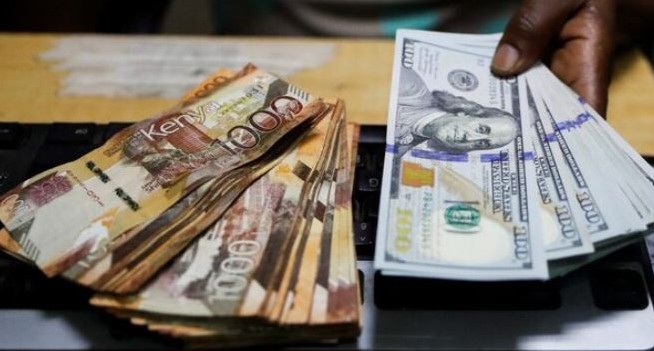
Kenya’s currency exchange landscape is closing the year on an unusually steady footing, with the shilling marking a full year plus of stability.
The Central Bank of Kenya (CBK) quoted the local currency at an average of 129 against the dollar, a record it has held since July 2024.
By August this year, the local currency had marked a full year of trading at the aforementioned rate to the dollar.
It began to retreat from the 130 mark in late July 2024, following a period of consecutive strengthening since early February, the same year, when it hit the historic low of 160.
The current stability stands in stark contrast to the volatility that drove the shilling to its historic low.
Notably, the downturn began in early 2020, slipping from highs of around 100 to the dollar.
The sustained stability since last year was attributed to the successful settlement of the inaugural $2 billion (Sh259.6 billion) Eurobond buyback plan, where the government paid back $1.5 billion (Sh194.7 billion) in February, boosting investor confidence.
According to the National Treasury, the stability is also underpinned by improved macroeconomic fundamentals, including improvements in foreign exchange inflows, driven by sustained diaspora remittances, strong export performance, and a rebound in tourism, which have in turn strengthened foreign exchange reserves.
Official data show that foreign exchange reserves have remained above $10 billion (Sh1.3 trillion) since May 2025, offering import cover of 4.7 to 5.3 months, well above the statutory minimum of four months.
With import costs directly tied to the strength of the shilling, the sustained rate signals some respite for the economy, particularly in stabilising the prices of imported goods.
The knock-on effect is to the benefit of the consumers, who would breathe a sigh of relief at the stabilising commodity prices, as the country is still a net importer.
Compared to the period last year when it traded at an all-time low of 160, the local currency has gained about 31 unit values, representing a 19 per cent gain.
Ideally, importers are now spending about Sh30 less per dollar on imports compared to when the shilling was at its lowest.
Kenya, being a net importer, this prospect prevents a steep rise in the cost of living by narrowing the cost of importing essential goods.
Items such as fuel, cooking oil, machinery, pharmaceuticals and food commodities arguably avoid further price surges that previously accompanied the weakening currency.
Transport costs, which ripple through nearly every sector, are also prone to steady currency stability. A stronger shilling reduces the landed cost of fuel, easing pressure on pump prices and softening the inflationary effects.
Analysts note that even modest stability in fuel pricing can slow inflation and support broader economic recovery.
For manufacturers who rely on imported raw materials and machinery, a stable shilling offers breathing room after a tough period of rising production expenses.
Evidently, business heads in an October CBK survey expressed optimism about improved businesses in the coming 12 months, partly on the back of the stable Shilling.
“This is supported by favourable weather conditions, stable macroeconomic environment, continued decline in banks’ lending rates, and expansion of the digital economy,” CBK said.
Additionally, a predictable exchange-rate environment often helps banks manage forex exposures better and encourages investors who had been adopting a wait-and-see posture during turbulence.
According to the World Bank’s latest economic update for Kenya, the country’s external debt profile has improved in the short term, supported by the appreciation of the shilling and government efforts to reduce refinancing risks.
“External debt declined in the last two years following the appreciation of the shilling, with the share of bilateral debt declining and the share of multilateral and commercial creditors increasing,” the World Bank said.
The lender, however, cautions that external debt remains susceptible to exchange rate risk as 59.8 per cent of external debt was denominated in dollars as of September 2025.
Conversely, in the remittance case, a strong shilling against the greenback is a disadvantage, despite the crucial role the diaspora inflows play in the country’s economy.
A weakening greenback against the local currency means receivers back home are not earning more in exchange compared to when the shilling is on a depreciating trend.
Western Union’s inaugural Global Money Transfer Index show that about 67 per cent of Africans abroad send more money when the currency value falls in their receiving country, with 65 per cent of receivers agreeing that when local currency values fall, they get more money.