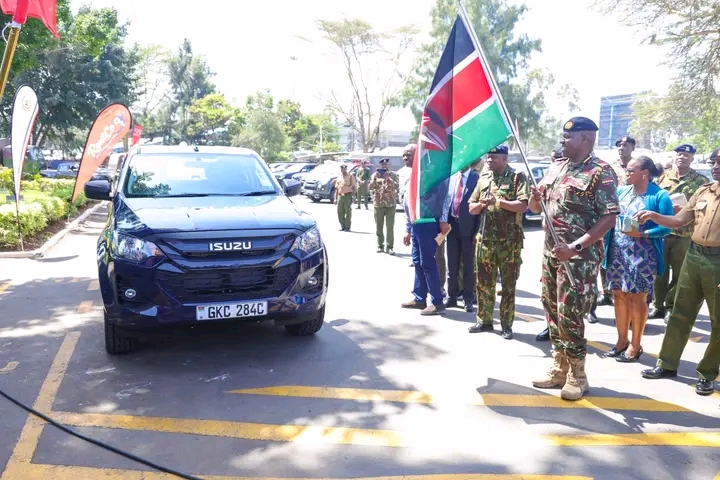
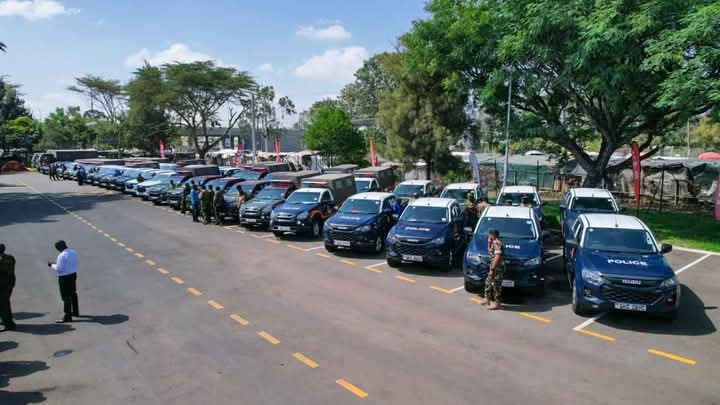
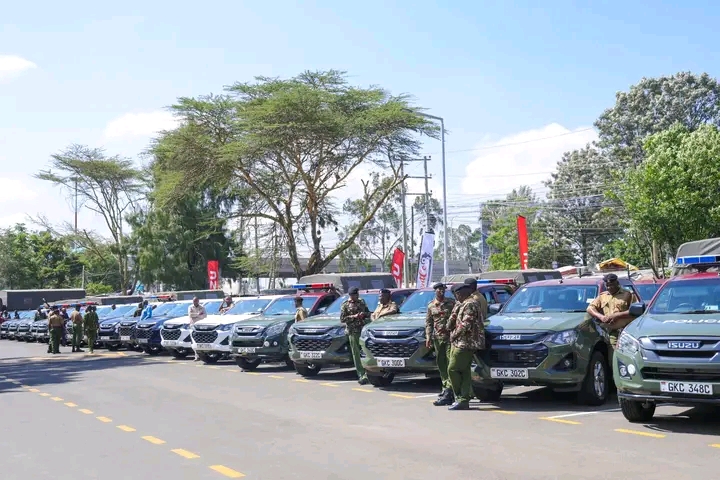
In a major boost to the country’s security agencies operations, the National Police Service (NPS) has received a fleet of 95 vehicles, part of 591 units scheduled for delivery under Phase VII of the Motor Vehicle Leasing Programme as part of the government's broader strategy to equip officers with the necessary tools to perform their duties more effectively.
The government has recently been making arrangements to purchase additional police vehicles to strengthen patrol efforts across the country. The initiative is designed to significantly reduce the number of stations that currently operate without patrol vehicles and improve mobility.
Deputy Inspector General of the Administration Police Service Gilbert Masengeli officiated the event on Friday, January 9, at the Isuzu East Africa offices on behalf of the Inspector General of Police, Mr.Douglas Kanja.
The vehicles received today form part of the lease programme anchored under the National Treasury that seeks to strengthen the operational capacity of the National Police Service.
The Motor Vehicle Leasing Programme, initiated in 2013, has contributed to significant improvements in mobility, leading to reduced response times to crime incidents and emergencies, DIG Masengeli noted.
The DIG added that officers are now able to arrive at scenes more promptly and contain situations more efficiently, enhancing overall public safety.
" These improvements also mean increased surveillance through mobile patrols, resulting in a reduction in crime rates. The programme has also enabled the Service to sustain a larger, more modern, and better-equipped vehicle fleet, while ensuring prudent financial management and long-term sustainability." he said.
According to the DIG, today’s flag-off serves as a clear demonstration of the Government’s commitment to equipping the National Police Service with the necessary tools to effectively fulfil its constitutional mandate of protecting life and property and maintaining law and order.
DIG Masengeli also expressed appreciation to the National Government for its unwavering support and the visionary adoption of the motor vehicle leasing framework. He also commended Isuzu East Africa for its partnership and efficiency in delivering the vehicles.
Speaking at the event, Isuzu East Africa Managing Director Ms.Rita Kavashe noted that the leasing programme has resulted in mutual growth for all stakeholders involved. She highlighted that the initiative has prompted Isuzu East Africa to decentralise maintenance services beyond Nairobi to 75 other locations, stimulating regional economic growth and creating opportunities for many.
The DIG-APS was accompanied by the Principal Deputy to DIG-KPS, Mr. Patrick Tito, SAIG; the Director of Logistics, APS, Mr. Wambua Kisyungu, SAIG; the Director of Administration, Planning and Finance, Mr. Richard Lesasuiyan, AIG; the Director of Logistics, DCI, Ms. Janet Shako, AIG; among other senior officers.
In attendance from Isuzu East Africa were the Executive Deputy MD and Board member, Mr.Isao Wada; Leasing and Fleet Operations Manager, Mr. Rodgers Ogechi; Director of Sales and Marketing, Mr.Wanjohi Kangangi; and the Communications Manager, Mr.Duncan Muhindi. Also gracing the event were the Group CEO and Founder of Rentco Africa, Mr.Robert Nyasimi, and Equity Bank General Manager, Ms.Lucy Ndururi.
The ceremony was also graced by the Principal Administrative Secretary of the National Treasury, Mr.Samson Wangusi, who underscored the programme’s significant contribution to enhancing security sector operations and value for money in public resource utilisation.
Security sector overhaul
The vehicles form part of broader reforms in the security sector and come weeks after President William Ruto issued a raft of directives in response to the findings of the countrywide Jukwaa la Usalala forums held between April and October last year.
The forums held across the 47 counties provided an opportunity for Kenyans, security officials, and other stakeholders to share firsthand insights into the security challenges affecting them with Interior CS Kipchuma Murkomen and his team from the Ministry of Interior.
The directives announced at the launch of the forum's report at State House last month include: the digitalisation of operations and human resources management of the police, National Police Reservists (NPRs), and National Government Administration Officials (NGAOs) in respect of promotions, training, and transfers.
At the same time, 900 police stations will be constructed in the next two years through the collaborative efforts of the Ministry of Interior, N-GCDF, and the Affordable Housing Programme.
Twenty-four sub-counties, 88 Divisions, 318 Locations, and 675 Sub-Locations will be operationalised in the next one year, as 17,500 housing units for the police and prison warders are constructed also within the next one year.
Also to be promoted are all police officers in the rank of Constable who are aged 50 years and above, as the IG issues promotion guidelines for other ranks.
At the same time, no officer will be transferred within one year of a previous transfer without considering their social situation.
Equally, no officer will serve in an operational area for more than three years, and those who are aged 50 years and above will be transferred closer to home.
To improve mobility, the government will procure 3,000 motor vehicles with more emphasis on electric vehicles to address inadequate fuel allocation and aid environmental protection.
Police Promotions
As part of the reforms, a wide-reaching overhaul of police career progression recently begun to take effect, with thousands of officers now moving up the ranks after years of stalled advancement, following the new policy direction introduced by President Ruto.
The changes, implemented after talks between Inspector-General Douglas Kanja and the National Police Service Commission, are intended to clear long-standing bottlenecks that left many officers stuck in the same positions despite meeting service and experience requirements.
National Police Service spokesperson Michael Muchiri confirmed that the promotions have already started, saying officers across the country are receiving their letters.
At the centre of the new framework is an automatic promotion system that prioritises officers who have served for long periods without disciplinary issues.
The first group to benefit includes police constables aged 50 years and above, who are now being elevated to the rank of corporal.
Previously, promotions were largely determined by interviews, supervisor reports and the availability of vacancies, a system that often left officers waiting for years without progress.
Muchiri said the revised approach acknowledges the contribution of officers who have given decades of service but remained in the same ranks.
“This also targets non-commissioned officers (NCOs) cadre — corporals, sergeants, and senior sergeants — who have remained in the same grade for up to 15 years or more. Under the new directive, senior sergeants will now be enrolled on the next promotional course for them to become inspectors,” Muchiri said.
He added: “This provides a structured path to supervisory leadership, solving the long-standing complaint of a ‘glass ceiling’ at mid-level ranks.”
Inspectors who have served for at least ten years in the same rank will now qualify for automatic promotion to Chief Inspector. However, Muchiri noted that further movement up the hierarchy will still depend on leadership training.
He explained that while Chief Inspectors are eligible for promotion, they will not move to the rank of Assistant Superintendent of Police unless they complete the required training courses.
According to Muchiri, training remains a mandatory requirement for senior leadership roles to maintain discipline and professionalism within the service.
A letter dated December 24, 2025, circulated to Traffic Police commanders in the Rift Valley region, highlights how the new system is being applied on the ground.
The letter outlines promotions from Police Constable to Corporal, Corporal to Sergeant, and Sergeant to Senior Sergeant across several traffic units.
The restructuring cuts across all arms of the National Police Service, including the Kenya Police Service, the Administration Police Service and the Directorate of Criminal Investigations.