Days after industry professionals warned that eighty-five per cent of buildings in Nairobi are unsafe for occupation, calling for stricter enforcement of construction standards and accountability for developers and engineers, another site has crumbled.
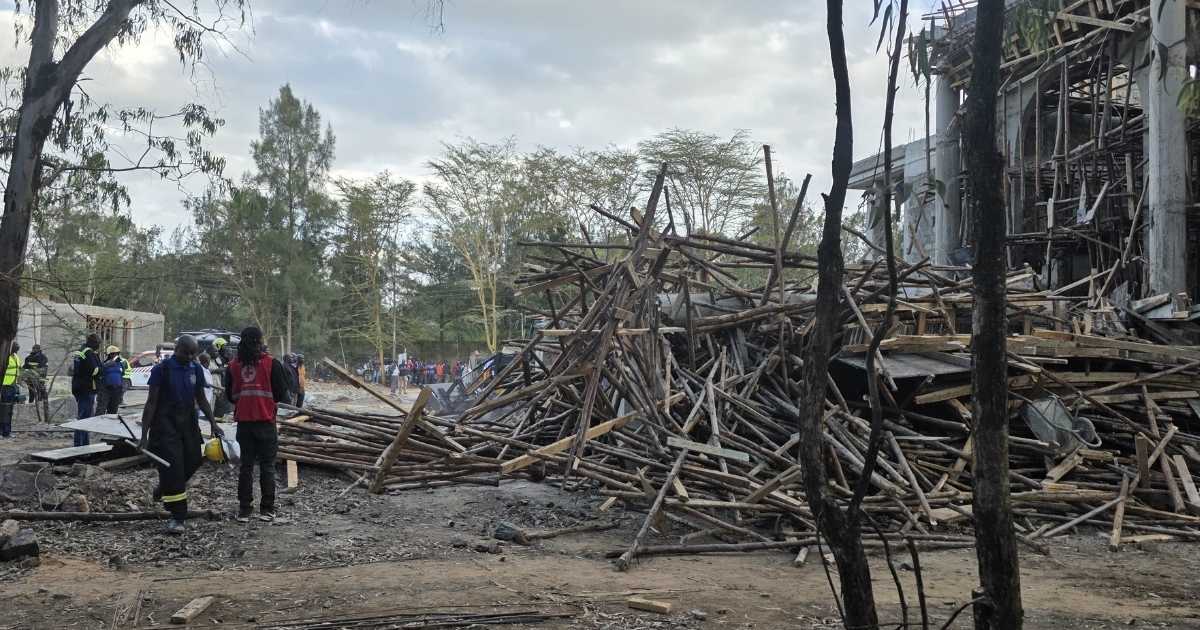
A construction site on Ngong Road collapsed unexpectedly on Saturday, leaving six people injured and rushed to a nearby hospital, officials said. Emergency crews responded immediately, launching search and rescue efforts while cordoning off the area to prevent further accidents.
The Kenya Red Cross reported that all individuals trapped in the debris have been rescued. Authorities continue to oversee cleanup efforts and have urged the public to stay clear of the site as safety assessments remain ongoing.
This latest collapse comes just days after a similar accident in South C, Nairobi. On January 2, a partially built structure at South C Shopping Centre collapsed, triggering panic among residents and business owners. Dust and debris spread through the area, forcing evacuations and highlighting the dangers of construction in crowded urban neighborhoods.
The response to the Ngong Road collapse involves multiple agencies, including the Kenya Red Cross, Nairobi City County officials, the National Disaster Management Unit, and the National Police Service. Teams are coordinating rescue, debris removal, and structural inspections, prioritizing the safety of nearby buildings and ensuring no one remains trapped.
Eyewitnesses of the South C incident described hearing a loud crash before realizing the building had fallen. Local residents and security personnel immediately assisted the injured, demonstrating how crucial rapid action can be during such emergencies. Nairobi police commander George Seda confirmed that authorities are inspecting nearby construction sites to prevent future accidents.
The collapses highlight the need for ongoing attention to safety in construction projects. Observers stress that consistent safety practices are essential to protect workers and nearby communities.
Experts, drawn from the Institution of Engineers of Kenya (IEK), The Architects Alliance (TAA), and the Kenya Institute of Planners (KIP), among others, said the recent South C building collapse exposed systemic failures in the construction sector and demanded urgent action.
They have called for a speedy investigation into the South C building collapse, saying those who approved the additional floors on the building should be held accountable for breaching the professional code of conduct.
The union painted a grim picture of the state of buildings in the country, revealing that over 85 per cent of buildings within Nairobi City are unsafe for occupation.
“The developer has that first duty of care of getting that consultant. The contractor has the duty of care in terms of quality, processes and approvals,” TAA President Sylvia Kasanga said.
IEK President Shammah Kiteme added, “Who was the responsible structural engineer? Is it the one in the NCA records? The one on site?”
Architectural Association of Kenya (AAK) president George Ndede noted, “It is not that you add another floor because you got more tenants. It is a calculation that starts from the foundation. If the foundation was not ready, you can’t add later.”
The professionals described the disaster as a clear example of systemic failures caused by corruption and greed.
“Can NCA blacklist all contractors who have issues? Make it public,” Kasanga said.
“These are systemic issues which are largely preventable,” Kiteme added.
The associations also highlighted the precarious state of Nairobi’s buildings, revealing that only 15 per cent of structures sampled were safe.
“NBI took a sample of 15,000 buildings and only 15 per cent of them were safe. You are talking about all the others as being unsafe,” Kiteme said.
Ndede warned of the potential dangers, saying, “If a tremor, even on a very low Richter scale, happened, many buildings would come down… If you have to switch on your lights during the day, that is a problem. If there is a sewer outside your house, that is a problem.”
The associations expressed sorrow for the families affected and stressed that such preventable tragedies are unacceptable in a country with professional expertise and regulatory frameworks.
The associations condemned systemic lapses across planning, design, approvals, construction, inspection, and enforcement, citing poor county development control, political interference, corruption, involvement of unqualified personnel, substandard construction practices and failure to learn from past collapses. They noted that over 100 buildings have collapsed in Kenya since 1996, yet impunity persists.
They called for immediate, independent, and transparent investigations into the South C collapse, with public reporting of findings, accountability for developers, reparations to affected families and audits of ongoing projects.
The experts proposed a multi-stakeholder technical task force, coordinated regulatory action, mandatory peer review at all project stages, strengthened county planning systems and a national planning information system to improve transparency, standardization and inter-county coordination.
The associations affirmed their commitment to working with governments, regulators and the public to restore integrity, safety and trust in Kenya’s built environment.