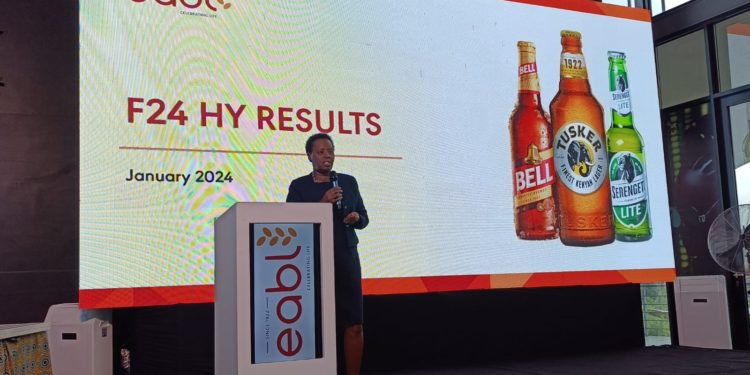
Minority shareholders of East African Breweries Limited (EABL) have lost about Sh12.45 billion in paper gains over the past four weeks.
Understanding unrealised profit and unrealised loss is critical for making informed decisions when investing or trading in the stock market. These concepts reflect the potential gains or losses in your investments before you sell, helping you decide whether to hold, sell, or adjust your portfolio.
Unrealised gains are a fascinating aspect of investing, often lurking quietly within your portfolio. Picture this: you buy shares of a promising company at Ksh10 each, and over time, the market value climbs to Ksh12. You haven’t sold those shares yet; thus, that extra Ksh2 per share is what we call an unrealized gain—a profit existing only on paper.
This concept can feel abstract at first glance. An unrealized gain occurs when the current market value of an asset exceeds its original purchase price but remains unsold. It’s sometimes referred to as a 'paper' gain because it doesn’t translate into actual cash until you decide to sell the asset. Until then, it’s just numbers on your financial statement—potential profits waiting for their moment.
Conversely, an unrealised loss, or "paper loss," occurs when the market value of an investment falls below its purchase price, and you haven’t sold the asset. This reflects a potential loss you would incur if you sold at the current price.
EABL Shareholders Losses
Minority shareholders of East African Breweries Limited (EABL) have lost about Sh12.45 billion in paper gains over the past four weeks after the brewer’s share price retreated from a sharp rally sparked by Diageo Plc’s planned exit.
The losses followed a decline in EABL’s stock after investors reassessed the implications of British multinational Diageo Plc selling its 65 percent stake to Japan’s Asahi Holdings at a premium that does not extend to minority shareholders.
Rally Fades After Initial Deal Optimism
EABL shares had surged in mid-December 2025 after Diageo disclosed plans to sell its majority stake. The stock jumped 18.94 percent on December 18, rising from Sh252 to Sh299.75 per share, as investors anticipated a broader value uplift.
At the peak of the rally, minority shareholders recorded an estimated Sh13.2 billion paper gain, contributing to an overall Sh37.8 billion increase in EABL’s market capitalization in a single day.
However, the optimism proved short-lived.
Share Price Retreat Wipes Out Gains
In recent trading, EABL shares closed at Sh254.75 on the Nairobi Securities Exchange (NSE), reversing much of the earlier gains. The pullback erased Sh12.45 billion in paper wealth held by minority investors.
EABL’s current valuation stands at about Sh201.45 billion, down from levels reached during the rally. Minority shareholders collectively hold roughly 35 percent of the company, translating to a stake valued at about Sh70.5 billion at the latest price.
Why Minority Investors Are Not Benefiting
Analysts attribute the decline to clarifications by Asahi Holdings, which cautioned investors against interpreting the transaction price as a direct valuation of EABL’s ordinary shares.
Diageo is selling its stake for $2.354 billion (Sh303.5 billion), equivalent to about 514 million shares, at a price that represents a significant premium to EABL’s NSE market value.
However, Asahi stated that the consideration should not be viewed as a per-share price benchmark for EABL stock or as an indication of a mandatory buyout for minority shareholders.
Analysts Reassess EABL’s Valuation
Market analysts note that the December 18 rally was driven by expectations that Asahi’s valuation implied a higher fair value for EABL shares. That optimism cooled after it became clear that minority investors would not receive a buyout offer or forced price equivalence.
The clarification punctured hopes of a sustained rally, triggering profit-taking and a reassessment of the stock’s fundamentals.
Dividend Outlook Remains in Focus
Despite the share price volatility, EABL remains attractive to income-focused investors. At the rally peak of Sh299.75, the brewer’s trailing dividend yield dropped to 2.66 percent, one of the lowest among blue-chip stocks.
With the share price easing, the dividend yield has improved, keeping EABL on the radar of long-term investors seeking stable payouts.
What the Diageo Exit Means for EABL
After the transaction closes, EABL will continue to manufacture and distribute Guinness beer under long-term licensing agreements. Local brands such as Tusker and Kenya Cane will remain under EABL ownership.
Diageo has also indicated it will renew production agreements for spirits such as Smirnoff and Captain Morgan, as well as ready-to-drink products like Smirnoff Ice and Origin, under licence terms.
For minority shareholders, the episode highlights the risks of short-term rallies driven by corporate actions that do not directly translate into broader shareholder benefits.
Transaction completion - regulatory scrutiny
Last week, Kenyan beer distributor, Bia Tosha, filed an urgent petition seeking to block the sale, arguing that if Diageo succeeds in disposing of its only asset in Kenya, the firm would be unable to execute any judgment against the company. “If they succeeded in disposing [of] their only asset in Kenya, we will not be able to execute a judgment against Diageo,” the lawyer said.
The application, filed under a certificate of urgency, asked the court to preserve the status quo over ownership and control of Diageo’s EABL stake until the underlying case is resolved. Bia Tosha’s legal team argues that the court’s jurisdiction and authority are at risk of being frustrated if the intended share sale proceeds, warning that Diageo would exit the country and make enforcement of any final orders “practically impossible.”
In a ruling delivered on Friday (9 January), Justice Bahati Mwamuye directed that regulatory approvals and other preliminary steps linked to the transaction may proceed uninterrupted, even as the court considers the Bia Tosha application seeking to block the deal.
However, the court issued a temporary preservation order restraining the final completion of the sale until Tuesday, 20 January, when the matter will be mentioned for further directions.
In a statement, EABL said the court had recognised the importance of allowing statutory and regulatory processes to continue, noting that global transactions of this scale typically require months of regulatory engagement. The brewer added that the interim order would not affect the overall transaction timeline.
“We welcome the court’s decision to allow the regulatory phases of this transaction to continue,” EABL said. The company reiterated that the underlying dispute is a legacy commercial matter relating to local distribution routes and “has no factual or legal connection to the shareholding of our parent company.”
Beyond the court challenge, the transaction requires approvals from multiple regulatory authorities. In Kenya, the Competition Authority must review the transaction to ensure it does not create anti-competitive effects in the beer and spirits markets. The Capital Markets Authority must approve the change of control given EABL’s status as a publicly listed company with minority shareholders whose interests must be protected.
Similar regulatory reviews will be required in Uganda and Tanzania, where EABL operates substantial brewing operations. Regional competition authorities will examine whether Asahi’s entry and Diageo’s exit create any concerns about market concentration, vertical integration, or potential foreclosure of competitors. Given EABL’s dominant market positions, regulators will scrutinize the transaction carefully.