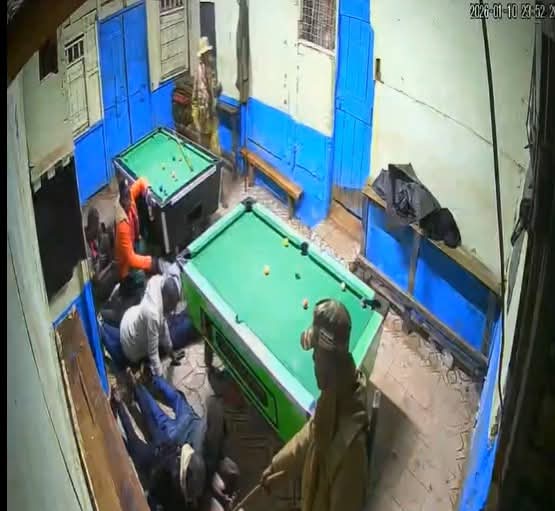
A disturbing video from Nandi County has reignited national debate over police brutality after uniformed officers were captured violently assaulting youths at a Nandi Hills pool hall despite no apparent provocation. The incident, which occurred on the night of January 10, 2026, has triggered widespread condemnation from political leaders, human rights advocates, and members of the public, once again placing the conduct of law enforcement under intense scrutiny.
According to eyewitness accounts and video evidence, the events unfolded at around 11 p.m. when police officers stormed a local Nandi Hills pool hall. The youths inside were reportedly playing pool when officers ordered them to lie face down on the floor. Despite complying fully with the instructions and offering no resistance, the young men were repeatedly beaten using batons and kicks. No arrests were made, and there was no indication of illegal activity.
The video, which began circulating widely on social media from January 15, shows officers methodically assaulting the youths as they cry out in pain and plead for mercy. At no point do the victims appear to resist or provoke the officers. The footage has since become a focal point of public anger, with many Kenyans questioning why such force was used in a non-confrontational civilian setting like the Nandi Hills pool hall.
Nandi Senator Kiprotich Arap Cherargei was among the first high-profile leaders to publicly condemn the incident. In a strongly worded statement, the senator described the actions of the officers as a blatant violation of the Constitution of Kenya, which guarantees every person the right to dignity, freedom from torture, and protection against cruel, inhuman, or degrading treatment. Cherargei called on Inspector General of Police Douglas Kanja and the Independent Policing Oversight Authority (IPOA) to immediately investigate the incident and ensure that the officers involved are held personally accountable.
“The Constitution is very clear. No Kenyan should be subjected to such brutality, especially when they have committed no crime and are fully compliant with law enforcement,” Cherargei said, adding that silence or inaction by authorities would only deepen public mistrust in the police service.
Adding to the condemnation, Embakasi East Mp Babu Owino said, “I am deeply disturbed by the incident where police officers from Nandi Hills Police Station violently assaulted young men whose only ‘crime’ was playing pool.”
He stressed that playing games is not a crime and warned against criminalising harmless activities undertaken by young people.
“Let it be stated clearly: playing a game is not a crime. Our youth are already going through a lot in this country. For many of them, engaging in games is not just leisure, but a positive way to keep themselves occupied, avoid crime and build talent,” he said.
Owino further noted that no law requires Kenyans to carry identification documents at all times, nor does any law prohibit people from playing games at night.
“Even where a law is alleged to have been broken, the police cannot act as both arresting officers and prosecutors, nor can they serve as judges. Kenya is a constitutional democracy founded on the principle of presumption of innocence,” he said, adding that brutality and violence have no place in law enforcement.
The two legislators have now demanded the intervention of the Inspector General of Police, Douglas Kanja, to interdict and suspend the officers involved, as well as administrative action against their superiors, including members of the county security team.
They also called on the Independent Policing Oversight Authority (IPOA) to begin investigations with a view to prosecution, with Cherargei accusing the watchdog of reluctance in past cases.
Human rights organizations have echoed these sentiments, noting that the incident at the Nandi Hills pool hall fits a worrying pattern of excessive use of force by police officers during routine operations. Several activists have pointed out that such incidents undermine ongoing police reforms aimed at professionalising the service and rebuilding public confidence.
Public outrage has been swift and vocal. Across social media platforms, Kenyans have demanded the immediate interdiction of the officers captured in the video, arguing that allowing them to remain on duty sends the wrong message about accountability. Hashtags calling for justice for the victims and an end to police brutality have trended, with many users sharing personal stories of similar encounters with law enforcement.
As of this writing, the National Police Service has yet to issue an official statement addressing the incident. The lack of a prompt response has further fueled criticism, particularly given past assurances by police leadership that cases of misconduct would be handled transparently and decisively.
The Nandi Hills pool hall incident is not isolated. In recent years, Kenya has witnessed multiple high-profile cases of police brutality, ranging from fatal shootings during protests to assaults in police custody. IPOA records and reports from civil society groups indicate that complaints against police officers for excessive force remain high, even as convictions and successful prosecutions lag behind. This gap between reported abuse and tangible consequences has contributed to a perception of impunity within the service.