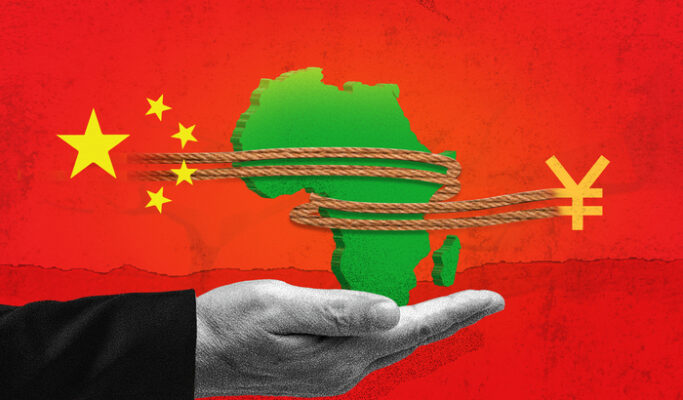
AFRICAN nations are now paying more money to China in debt repayments than they receive in new loans, marking a dramatic reversal in Beijing’s role as a leading financier to the developing world, a significant shift that reflects both a drying up of fresh Chinese financing and rising debt-servicing demands, according to new analysis released by the ONE Data initiative.
The findings show that China’s overseas lending has declined sharply over the past decade, while repayments on earlier loans — many issued during the peak of Beijing’s infrastructure financing boom — continue to rise across low- and middle-income economies.
Previously, China was a major source of development financing in Africa, funding large infrastructure projects under the Belt and Road Initiative and other bilateral programmes.
However, in the period from 2020 to 2024, African countries collectively shifted from a $30 billion net inflow (2015–2019) to a $22 billion net outflow, meaning more money was leaving Africa as debt service than coming in as new loans.
The core reason for the reversal is simple: new Chinese loans have dropped sharply, while repayments on past borrowing continue at pace. Multilateral lenders like the World Bank and African Development Bank have increased net financing, partly filling the gap left by Chinese lenders, but once debt service is factored in, many African governments are still net payers to Beijing.
The shift signals a fundamental change in global development finance. While China remains one of the world’s largest bilateral creditors, it is no longer expanding its lending footprint. Instead, debt servicing now outweighs new inflows, pushing African governments into net financial outflows just as multilateral lenders emerge as the primary source of development funding.
Several African states with large historical Chinese debts, such as Zambia, Ghana, Ethiopia, Angola, Kenya and Egypt, have been dealing with the complex reality of servicing Chinese loans accumulated over decades.
Zambia and Ghana have both experienced major debt restructurings in recent years after reaching limits on their ability to pay external creditors, including China, often under programmes with the IMF and other partners.
Ethiopia, another top Chinese borrower, has sought discussions with Chinese banks on converting a portion of its loans into renminbi-denominated debt as part of efforts to manage repayment burdens. Mozambique, while often receiving concessional support from multilateral lenders, recorded negative net transfers from China, meaning repayments exceed new financing, a stark illustration of the trend.
In many cases, these repayments are not cushioned by new Chinese financing, which means that African governments must allocate scarce budgetary resources toward servicing existing debt rather than new investment.
This dynamic can squeeze investments in public services, infrastructure and social programmes, areas critical for long-term growth. This shift carries several implications for African economies:
Fiscal strain and budgetary pressure: Higher outflows for debt service reduce fiscal space for public investment and social spending.
Currency and reserve risk: Large repayments in foreign currency can strain foreign exchange reserves, making countries more vulnerable to external shocks.
Incentive for debt sustainability frameworks: As traditional bilateral financing recedes, many governments may be pushed toward debt sustainability strategies, greater reliance on multilateral development partners, and domestic revenue mobilisation.
At the same time, some analysts argue that reduced reliance on external debt, especially if paired with stronger domestic accountability, could promote longer-term fiscal discipline and reduce vulnerability to external creditor pressures.
The shift from Chinese bilateral lending to multilateral financing mirrors broader changes in global development finance. As Chinese and other bilateral financing has fallen, multilateral institutions have taken on a far greater role.
According to the report, net financing from multilateral lenders increased by 124 percent over the past decade. These institutions now account for 56 percent of total net financial flows to developing economies.
Between 2020 and 2024 alone, multilateral banks provided roughly $379 bn in net financing once debt-service payments were deducted — making them the dominant source of external development funding worldwide.
Institutions such as the World Bank and regional development banks have increasingly focused on stabilisation lending, climate finance and budget support as debt vulnerabilities spread across emerging markets.
The ONE Data analysis does not yet capture funding cuts that took effect in 2025, which are expected to further reduce financial flows to developing countries.
The closure of the United States Agency for International Development last year, alongside lower aid allocations from several advanced economies, has already begun to affect African budgets.
Once 2025 data becomes available, Official Development Assistance flows are likely to show a substantial decline.
The report warned that while reduced dependence on external financing may strengthen domestic accountability, the immediate impact is negative for countries already struggling to fund essential public services.
The report also highlights a broader contraction in bilateral finance and private external debt — trends likely to intensify as global interest rates remain elevated and donor budgets tighten.
For Africa, the changing landscape presents a difficult balancing act: managing large repayment obligations while securing enough long-term financing to support growth, climate resilience and social stability.
As China’s lending era fades and multilateral banks assume centre stage, the continent’s development trajectory will increasingly depend on debt restructuring, fiscal reform and the ability of governments to mobilise domestic resources in an increasingly constrained global system.