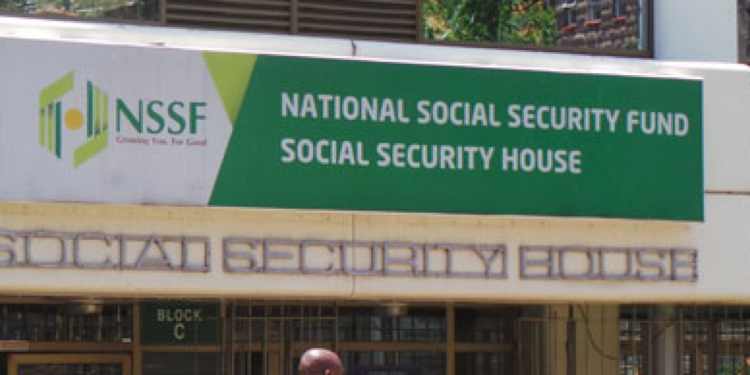
The National Social Security Fund (NSSF) Act of 2013 marked a major shift in Kenya’s pension landscape by moving away from the old flat-rate contribution of KES 200 per month, matched by the employer. Instead, the Act introduced a more robust system where employees contribute 6.0% of their pensionable earnings, with employers matching the same amount. This reform aimed to improve retirement savings adequacy and align Kenya’s pension system with global best practices.
Recognizing the impact such an increase would have on employees and employers, the Act provided for a gradual implementation over five phases, spread across five years. Each phase incrementally increases the pensionable earnings bands used to calculate NSSF contributions. The changes effective 1st February 2026 represent the fourth phase of this rollout.
Under the new rates, the Tier I (Lower Earnings Limit) increases from KES 8,000 to KES 9,000. As a result, the employee contribution rises from KES 480 to KES 540, with the employer matching the same amount. This is an increase from the previous total Tier I contribution of KES 960 to KES 1,080 per month.
For employees earning between KES 9,000 and KES 72,000, the overall NSSF contribution remains unchanged. While Tier I contributions increase by KES 60, Tier II contributions reduce by an equivalent amount, effectively neutralizing the impact on total monthly deductions for this income bracket. This ensures that mid-income earners are not disproportionately affected by the fourth phase of the implementation.
However, employees earning above KES 72,000 will experience a noticeable increase. The Tier II (Upper Earnings Limit) rises significantly from KES 72,000 to KES 108,000. Previously, the maximum Tier II contribution stood at KES 3,840 by the employee and KES 3,840 by the employer. Under the new rates, this increases to KES 5,940 each, bringing the total Tier II contribution to KES 11,880. Consequently, the maximum total NSSF contribution per employee increases from KES 8,640 to KES 12,960 per month.
Financial Performance
NSSF reported its strongest financial performance on record in the fiscal year ended 30th June 2025 mainly driven by the phased implementation of the NSSF Act 2013. In the period under review, NSSF witnessed dramatic growth in its asset base and investment returns.
There was a substantial surge in member contributions which grew by 35% from KES 62.29 billion in June 2024 to KES 83.97 billion by June 2025. This growth reversed nearly a decade of stagnation where collections typically hovered between KES 13 billion and KES 16 billion. This expansion was supported by an 8% growth in active membership, which rose from 3.3 million to 3.6 million members over the same period.
Income grew by 152%, reaching KES 105.3 billion in 2025, compared to KES 41.7 billion in 2024. The Fund recorded a 22% nominal return in the 2025 financial year, a significant jump from 12.02% in 2024. Growth was largely concentrated in sovereign fixed income and listed equities. Treasury bond holdings alone expanded by KES 101.6 billion to reach KES 355.4 billion, accounting for nearly 64% of total investment assets. Eurobond holdings also grew sharply from KES 7.2 billion to KES 34.3 billion.
NSSF’s total investment assets grew by 43% (KES 168 billion) to reach KES 558 billion in 2025. Total Member Funds expanded by KES 172.6 billion, reaching KES 572.8 billion as of June 30, 2025. This growth is attributable to both the impressive increased volume of member contributions.
Although the contribution rate remains 6% for both employers and employees, the expanded earnings bands will raise the maximum individual monthly contribution to KES 6,480, up from KES 4,320 in 2025. This brings the maximum combined monthly contribution to KES 12,960. Employees earning at or above the new upper threshold could see their take-home pay decline by up to KES 2,160 per month, in exchange for higher long-term retirement savings.
The trade-off is stronger retirement security through increased individual pension savings. Notably, member benefits paid declined by 10% (KES 977 million) to KES 8.74 billion in 2025, driven by an 11% drop in claim applications (11,893 fewer claims). This decline has further strengthened the Fund’s financial position.