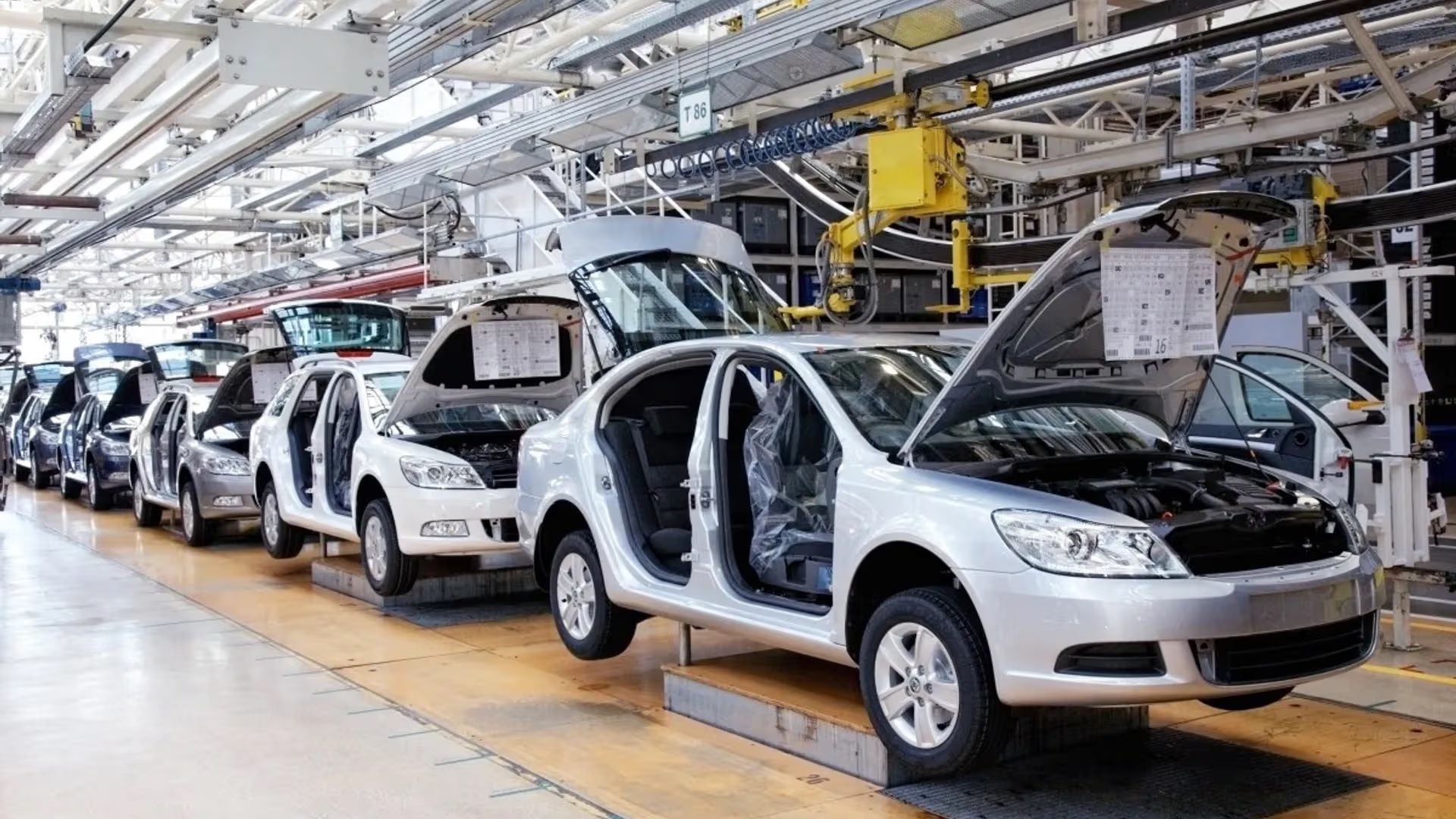
Rideence Africa Limited has announced a Sh320 million investment to begin local assembly of electric vehicles at the Associated Vehicle Assemblers plant in Mombasa, in a significant development for Kenya’s emerging electric mobility sector.
This strategic move marks a pivotal transition for the Chinese-backed company from being solely an importer and operator to becoming a local manufacturer, while positioning Kenya as a potential regional hub for electric vehicle production.
The investment, announced on February 2, 2026, will result in the assembly of 152 electric vehicles by the end of February 2026 using completely knocked-down kits.
The initial production will include 132 Henrey electric taxis and 20 Joylong electric high-roof matatus, representing what industry analysts describe as Kenya’s first dedicated electric vehicle assembly line.
Rideence’s decision to establish local assembly operations follows three years of successful deployment of imported electric vehicles in Kenya. Since 2023, the company has invested over Sh1.4 billion in the Kenyan market, importing more than 180 fully built electric vehicles from China. This fleet includes 54 electric matatus and 128 taxis, forming what Rideence describes as East Africa’s largest electric ride-hailing fleet.
The company’s operational model centers on a lease-to-drive arrangement that has proven attractive to drivers seeking relief from volatile fuel costs. Under this scheme, drivers lease Henrey electric taxis at Sh2,400 per day, spending approximately Sh400 to charge the vehicles for a range of up to 200 kilometres. This represents a substantial cost saving compared to the more than Sh2,000 required for petrol to cover the same distance in internal combustion engine vehicles.
“Having already invested over Sh1.4 billion in Kenya since 2023, Rideence is strategically transitioning from an operator to a local manufacturer,” said Minnan Yu, Managing Director of Rideence Africa Limited. “Our partnership with AVA will push local parts procurement to over 25 per cent by 2026. We are moving beyond importing solutions to co-creating them locally, building an ecosystem that addresses Kenya’s specific challenges, from fuel price volatility to the need for skilled jobs.”
The partnership with Associated Vehicle Assemblers, owned by Simba Corporation, brings together Rideence’s electric mobility expertise with AVA’s established automotive manufacturing capabilities. AVA, located at Miritini in Mombasa County, is Kenya’s market leader in multi-brand vehicle assembly, currently commanding approximately 43 percent of all assembled vehicles in Kenya despite operating at just 22 percent of its 30,000-unit annual capacity.
The Mombasa facility has assembled more than 150,000 vehicles to date and maintains relationships with over 40 globally leading quality systems. AVA is the only vehicle assembler in the region to have achieved IATF16949 certification, an international standard that demonstrates commitment to producing safe products and following effective systems for addressing consumer safety issues.
“This partnership delivers Kenya’s first dedicated electric vehicle assembly line, clearly demonstrating that the country has the capacity to assemble EVs locally at scale,” said Matt Lloyd, Managing Director of AVA. “Through local assembly, we are accelerating the transition to affordable, low-emission transport while creating jobs, enabling technology transfer and strengthening Kenya’s industrial base for long-term economic growth.”
The investment covers multiple components including the cost of importing assembly kits, plant fees payable to AVA, taxes, freight charges, and expanding labour capacity to increase production output. According to company representatives, production will range between five and ten vehicles daily at the Mombasa facility.
Rideence projects that the assembly phase will generate at least 3,000 additional direct and indirect jobs across supply chains, charging infrastructure, and related services. This employment creation builds upon the company’s existing workforce contribution, with Rideence reporting the creation of between 550 and 680 direct jobs since commencing operations in 2023.
The localisation strategy aims to source between 15 and 25 percent of components locally in the short term, with a longer-term objective of achieving 40 to 60 percent local content. This approach aligns with Kenya’s broader National Automotive Policy, which seeks to revitalise the automotive industry by promoting local assembly and manufacturing while gradually reducing over-reliance on imported used vehicles.
Industry observers note that Rideence benefits from Kenya’s existing supply chain for van components, as electric models share numerous parts with their internal combustion engine counterparts. The company plans to source components such as tyres, upholstery, and leaf springs from local manufacturers, strengthening domestic industrial linkages.
One of the primary drivers behind Rideence’s shift to local assembly is the substantial tax savings available under Kenya’s automotive policy framework. The government exempts local assemblers from the 35 percent import duty levied on fully built vehicles, while also charging a lower import declaration fee of 2.5 percent for completely knocked-down parts headed to assembly plants, compared to the standard 3.5 percent applied to finished vehicles.
For the Joylong vans, which currently retail at approximately Sh7 million excluding VAT, Rideence expects prices to drop by as much as 25 percent through local assembly, though final pricing will be announced after costs are fully factored in. This price reduction could significantly expand the addressable market for electric commercial vehicles in Kenya.
Complementing its assembly operations, Rideence is pursuing an aggressive expansion of its charging network infrastructure. The company currently operates 16 charging stations spread across multiple counties including Kisii, Narok, Nakuru, Machakos, Nairobi, Kiambu, and Kajiado. Plans call for increasing this network to 100 stations nationwide by the end of 2026, with most additional stations expected to cater to the electric vans being assembled at the Mombasa facility.
This infrastructure expansion addresses one of the critical barriers to widespread electric vehicle adoption in Kenya: charging accessibility. The stations will utilize Kenya Power’s special e-mobility tariff, which offers lower rates during off-peak hours, making electric vehicle operation even more economically attractive for fleet operators and individual drivers.
Beyond manufacturing and infrastructure, Rideence is investing in the development of human capital necessary to support a robust electric vehicle ecosystem. The company is offering technical training programs at its service centres, focusing on electric vehicle maintenance, battery management systems, and charging infrastructure operation.
Additionally, Rideence is in advanced discussions with the University of Nairobi regarding the introduction of electric vehicle technology programs. These educational initiatives aim to build local expertise in electric mobility, creating a skilled workforce capable of supporting the industry’s long-term growth and reducing dependence on expatriate technical personnel.
Technical Specifications and Vehicle Models
The Henrey electric taxis being assembled by Rideence are marketed versions of the Beijing Henrey Xiaohu FEV model, known in China as the Xiahou or “Mini Dragon.” These compact electric hatchbacks feature a battery system that provides a range of up to 200 kilometres on a single charge, with charging costs of approximately Sh400 to Sh500 for a full charge using standard charging equipment.
The Joylong electric high-roof matatus represent a 16-seater commercial vehicle designed for the public transport market. These vans, manufactured by Jiangsu Joylong, a Chinese commercial vehicle company, are specifically configured for Kenya’s matatu industry with features suited to local operating conditions and passenger requirements.
Both vehicle models utilize completely knocked-down kits, which allow for assembly at the local facility while maintaining quality standards established by the original equipment manufacturers. This approach facilitates technology transfer while enabling cost reductions through local value addition.
Economic Rationale and Market Opportunity
Kenya’s transport sector accounts for more than 40 percent of the country’s total energy consumption and represents the fastest-growing source of emissions, according to the Energy and Petroleum Regulatory Authority. The country spends over $5 billion annually on fuel imports, equivalent to approximately 15 percent of GDP, making the transport sector highly vulnerable to fluctuations in global oil prices.
The electric vehicle market in Kenya has shown significant growth potential. According to the National Transport and Safety Authority, Kenya currently has an estimated 9,000 registered electric vehicles, compared to approximately 600 in Rwanda and more than 10,000 in South Africa, the continent’s largest EV market. This indicates substantial room for market expansion as infrastructure develops and awareness increases.
For taxi and matatu operators, the economic case for electric vehicles is compelling. Beyond the fuel cost savings, electric vehicles feature fewer moving parts than internal combustion engine vehicles, eliminating the need for oil changes, reducing engine maintenance requirements, and lowering overall operational costs. These factors contribute to improved profitability for drivers and fleet operators.
Challenges and Market Dynamics
Despite the promising outlook, Kenya’s electric vehicle sector faces several challenges. The upfront cost of electric vehicles remains higher than conventional alternatives, creating barriers to adoption particularly among individual buyers and small operators. Rideence’s lease-to-drive model addresses this challenge by reducing the initial capital requirement, but broader access to financing remains a constraint.
Charging infrastructure availability, while expanding, still lags behind the requirements for mass market adoption. Range anxiety—concerns about battery depletion before reaching charging facilities—remains a psychological barrier for potential users, particularly for long-distance travel.
The dominance of used imported vehicles in Kenya’s automotive market presents competitive pressure. Imported second-hand vehicles offer lower purchase prices, and consumer preference for these units based on perceived value remains strong. Kenya imports an average of 7,600 second-hand vehicles per month, compared to approximately 430 assembled units, illustrating the scale differential between market segments.
Grid capacity and reliability pose additional considerations as electric vehicle adoption scales. Increased electricity demand from vehicle charging, particularly during peak hours, will require investments in generation and distribution infrastructure to maintain service quality and prevent congestion.
Future Outlook and Strategic Implications
Rideence’s Sh320 million investment in local electric vehicle assembly represents a tangible commitment to Kenya’s emerging clean mobility sector at a critical juncture. As the country seeks to reduce transport emissions, lower dependence on imported fossil fuels, and advance industrial development objectives, partnerships between international technology providers and local manufacturing capabilities offer a viable pathway.
The success of this initiative will likely influence other potential investors evaluating Kenya as a location for electric vehicle manufacturing. Demonstration of viable commercial operations, supportive policy frameworks, and adequate infrastructure could catalyze additional investments, creating clustering effects that strengthen the overall ecosystem.
For Kenya’s broader industrialization agenda, the electric vehicle sector offers opportunities to leapfrog traditional automotive development paths by positioning directly in future technologies. Rather than competing with established internal combustion engine manufacturing hubs, Kenya can develop specialized capabilities in electric mobility where global markets are still evolving and competitive positions remain fluid.
The commitment to skills development, infrastructure expansion, and local content integration suggests Rideence is pursuing a long-term strategy rather than short-term opportunistic market entry. Whether this model proves scalable and financially sustainable will determine its ultimate impact on Kenya’s transportation landscape and industrial development trajectory.