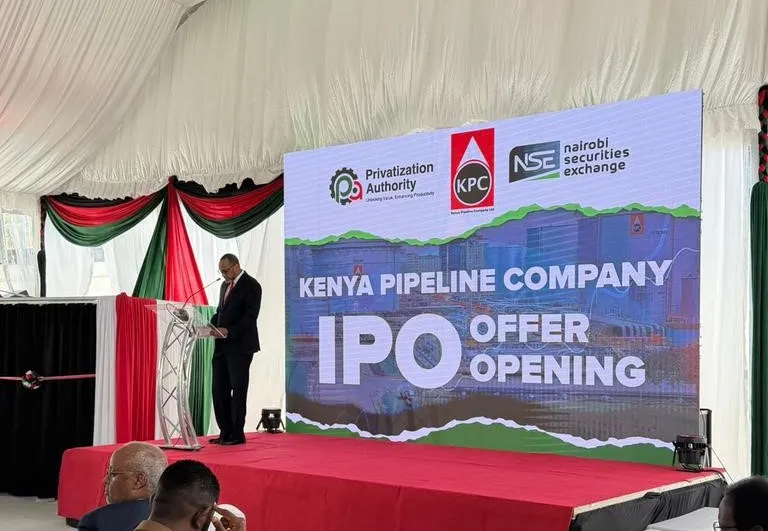
The Kenya Pipeline Company (KPC) has thrown a last-minute lifeline to investors, extending the deadline for bank guarantees in its initial public offering to March 6, 2026 and lengthening bank settlement timelines.
This strategic pivot, sanctioned by the Capital Markets Authority (CMA), underscores the high stakes of this transaction, as the state-owned energy giant seeks to secure maximum participation in its ambitious bid to raise capital. By widening the window, KPC is effectively acknowledging the logistical friction in the banking system and ensuring that institutional investors are not locked out by procedural delays.
The update appears in a Supplementary Information Memorandum dated February 18, 2026, issued one day before the offer is scheduled to close on February 19.
Under the revised terms, the final date for payment under Irrevocable Bank Guarantees for both domestic and international investors moves from March 5 to March 6. In addition, the standard guarantee form now allows guarantor banks up to 48 hours to settle valid payment demands, replacing the earlier 24-hour requirement, with a firm cut-off set at 3:00 p.m. on March 6.
The revised timeline comes at a critical juncture for Kenya’s energy sector. The original deadline of March 5 threatened to bottleneck inflows from major institutional players relying on Irrevocable Bank Guarantees. The new 48-hour settlement extension is designed to smooth out these wrinkles without altering the fundamental mechanics of the offer.
Market analysts interpret this move as a sign of KPC’s determination to hit its subscription targets despite a challenging macroeconomic environment. Irrevocable Bank Guarantees are typically used by large domestic institutions, oil marketing companies, pension funds, and cross-border investors that settle after allocation rather than funding applications upfront.
Kenya Pipeline also amended the assignment clause within the bank guarantee. The previous wording allowed the company to assign or transfer rights under the guarantee without consent. The revised clause now requires prior written consent from the guarantor bank before any transfer of rights, tightening contractual certainty for institutions issuing the guarantees.
Extending the settlement window reduces operational and liquidity pressure on guarantor banks as allocation and funding processes begin.
The IPO involves the sale of 11.81 billion ordinary shares, equal to a 65% stake in the state-owned fuel transporter, at an offer price of KSh 9.00 per share.
The company said the revisions relate solely to payment mechanics under the guarantee framework and do not alter the offer price, transaction size, share structure, or allocation categories. Kenya Pipeline added that all other terms and conditions of the IPO remain unchanged.
The extension plays out against a backdrop of spirited debate regarding the IPO’s valuation. The Ksh9 share price sits squarely at the center of a growing controversy that threatens to undermine the offering’s success. Independent analysts who have scrutinized KPC’s financials argue that the government’s pricing embeds a substantial premium that may constrain near-term upside for investors entering at the offer price.
Ugandan analysts, led by Old Mutual Investment Group Uganda, have emerged as among the most vocal critics of the pricing strategy. In a detailed initiation note released in late January 2026, Old Mutual valued KPC shares at just Ksh4.61 — nearly half the offer price — warning of limited upside due to what they characterize as an “embedded premium” in the current pricing.
“The current IPO pricing embeds a valuation premium that may constrain near-term upside for public market investors,” the Old Mutual report stated. “We anticipate a post-listing repricing as investor expectations normalize and improved trading liquidity enables clearer price discovery more closely aligned with intrinsic value.”
Old Mutual’s assessment is based on a blended valuation framework combining discounted cash flow analysis and relative market comparables. Their DCF model, using a 16.04% weighted average cost of capital and a 3.0% terminal growth rate, yields a value of Ksh4.26 per share. A second analysis benchmarking KPC against regional utilities including KenGen and Kenya Power, alongside oil and gas operators such as Seplat and Aradel, produces Ksh5.27 per share. Weighting these two methodologies results in the Ksh4.61 fair value estimate, implying a 49% downside to the IPO price.
This skepticism is not limited to Ugandan analysts. Local research houses have reached similar conclusions through independent analysis. NCBA Investment Bank placed fair value at approximately Ksh6.35 per share, arguing that the IPO implies a premium earnings multiple for what is fundamentally a mature, regulated utility. Standard Investment Bank’s pre-offer valuation work estimated KPC’s equity value at around Ksh102 billion, implying roughly Ksh5.61 per share on the post-IPO share base. Other independent analyses have produced fair-value ranges between Ksh3.28 and Ksh5.41.
The government, for its part, set the share price at Ksh9.00 using an earnings-based valuation, specifically an EV/EBITDA multiple of 8.1 times applied to FY2025 EBITDA of Ksh18.6 billion. This methodology implies an equity valuation of approximately Ksh163.6 billion for the entire company based on 18.17 billion shares outstanding — a figure that independent analysts argue significantly overstates intrinsic value.
The valuation debate is particularly striking given that KPC’s underlying business fundamentals appear robust on most operational and financial metrics. The company operates Kenya’s main fuel pipelines and storage facilities, transporting petroleum products across 1,342 kilometers of pipeline infrastructure connecting the Port of Mombasa to inland markets including Nairobi, Eldoret, and Kisumu, with extensions serving landlocked neighbors across East Africa.
This strategic infrastructure position gives KPC steady demand and a central role in the region’s energy supply chain. The company holds a dominant 91% market share in Kenya’s petroleum transportation sector, operating what amounts to a natural monopoly with high barriers to entry that protect its competitive position.
On paper, KPC presents impressive financial figures. The company holds assets worth Ksh163 billion and posted a profit of Ksh7.49 billion for the year ended June 30, 2025. Revenue for the same period reached Ksh38.6 billion, up from Ksh30.86 billion in 2023, reflecting rising petroleum demand across the region. Over the past 12 months, KPC paid Ksh10.5 billion in dividends to the Treasury, demonstrating consistent cash generation capabilities.
The company’s EBITDA margins average approximately 45%, typical of infrastructure-like businesses with regulated revenue streams and limited direct competition. Net cash flow from operating activities reached Ksh14.3 billion for FY2025, underscoring solid cash-generating capabilities. Importantly, KPC carries no debt on its balance sheet, having recently cleared a $350 million 10-year borrowing within seven to eight years, significantly strengthening its financial profile.
Perhaps most attractive to income-focused investors, KPC has pledged to distribute 50% of net profits as dividends to shareholders post-listing, subject to financial performance and investment needs. Based on historical profitability, this policy could deliver meaningful dividend yields, though analysts note that even with this payout ratio, the implied dividend yield struggles to compete with double-digit, tax-free government infrastructure bonds currently available in the market.
The IPO carries significant regional implications beyond Kenya’s borders. Uganda accounts for more than 30% of KPC’s throughput and revenue, with approximately 2.7 billion liters of fuel transported to Uganda in 2025, expected to rise to 2.9 billion liters in 2026. More than 90% of Uganda’s fuel imports transit through Kenya’s pipeline system, creating a deep interdependence that has taken on policy dimensions.
However, Uganda’s own infrastructure ambitions could complicate KPC’s regional growth narrative. The $5 billion East African Crude Oil Pipeline linking Uganda’s oil fields to a Tanzanian port is nearing completion, with production expected to begin in the second half of 2026. More significantly, Uganda expects to build its own refinery by 2029/30. KPC itself acknowledged in its prospectus that “if this materializes, it will pose a significant risk to KPC in terms of its regional expansion strategy.”
This creates an interesting dynamic where Ugandan analysts are among the most skeptical of KPC’s valuation precisely because they understand both the company’s current importance to Uganda’s fuel supply and the structural threats on the horizon as Uganda develops its own petroleum infrastructure.
The government has attempted to address concerns about monopoly behavior and potential price manipulation through a framework of regulatory oversight. Treasury CS Mbadi has repeatedly emphasized that the Energy and Petroleum Regulatory Authority (EPRA) controls tariffs and will continue to protect consumers, even with majority private ownership.
The IPO framework embeds strict governance controls requiring oversight by multiple institutions including the Competition Authority of Kenya, EPRA, and the National Assembly. These safeguards are designed to preserve KPC’s role as a neutral, regulated infrastructure operator while transitioning from a state corporation to a public liability company adopting enhanced corporate governance standards in line with Capital Markets Authority regulations.
Critics, including former Chief Justice Willy Mutunga-era judicial figures, have warned that privatization of strategic public assets could lead to higher fuel prices and rising inequality. However, government officials maintain that the regulated nature of KPC’s operations, combined with the state’s retention of a 35% stake subject to a 24-month lock-in period, will ensure continued alignment with national interests.
The IPO requires at least 250 applicants and a minimum subscription of 50% of the shares on offer to proceed to listing. If certain allocation categories fall short, regulations allow the company to reallocate shares, starting with local retail investors — providing some flexibility in meeting minimum thresholds even if overall subscription remains below target.
Officials continue to express confidence in a late surge, banking on cultural patterns where Kenyans tend to act at the last moment on major decisions. The government kept the subscription window open for a full month, significantly longer than most past IPOs, specifically to accommodate this anticipated behavior. Investors can still apply through banks, traditional brokers, or the new Ziidi Trader platform until 5pm on February 19.
However, market observers warn that if subscriptions remain weak, the government may face difficult choices: extend the deadline (as happened with previous struggling state offers), adjust the terms to make the offering more attractive, or accept a partial subscription that would reduce the capital raised. Each option carries political and market credibility risks at a time when the Ruto administration is already navigating significant economic headwinds.