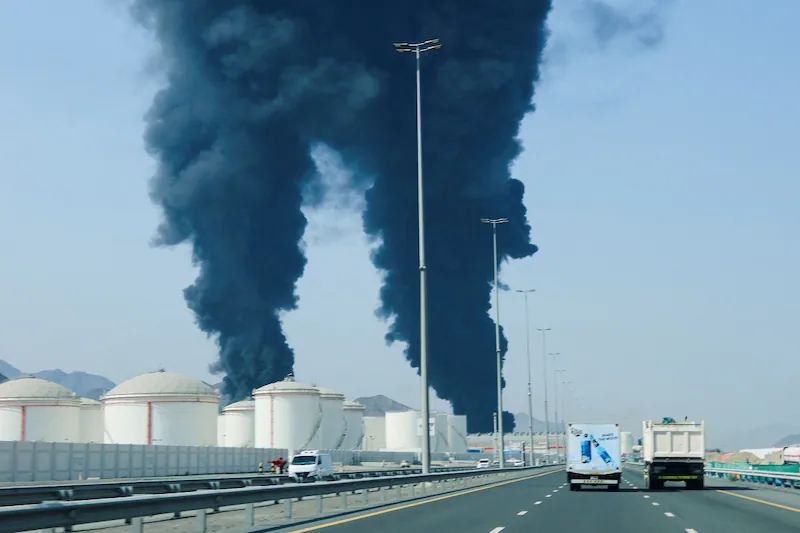
Smoke billowed over the Persian Gulf on Thursday morning, marking not just a localized tactical escalation, but a seismic shift in global energy security. The targeted strike on a critical Qatari energy hub has sent shockwaves through international financial markets, triggering an immediate 6 percent surge in crude oil prices.
The strike, executed during the early hours of March 19, targeted key infrastructure within a Qatari energy hub responsible for a significant percentage of liquefied natural gas and condensate exports. While initial reports from the ground remain fluid, the market reaction was instantaneous. Brent crude, the international benchmark, spiked by 6 percent within hours of the first reports, reflecting investor anxiety over supply chain integrity in one of the world's most critical energy arteries.
Oil prices rose on Thursday, with benchmark Brent rising as much as $5 a barrel, after Iran attacked energy facilities across the Middle East following a strike on the South Pars gas field, a major escalation in the war with the US and Israel.
Brent futures were up $4.66, or 4.3%, at $112.04 a barrel by 4am GMT, after an earlier rise of more than $5 to $112.86 a barrel. US West Texas Intermediate (WTI) crude rose 96c, or 1%, to $97.28 a barrel, after having risen more than $3.
Brent closed up 3.8% on Wednesday, while WTI settled nearly flat. WTI has been trading at its widest discount to Brent in 11 years due to releases from US strategic reserves and higher freight costs, while renewed attacks on Middle Eastern energy facilities boosted support for Brent.
“Escalation in the Middle East, precise attacks on oil infrastructure, and the death of Iranian leadership all point to a prolonged disruption in oil supplies. Adding fuel to the fire, the Federal Reserve served ‘steady rates’ with a hawkish narrative, pointing to the economic concerns that follow a war.” an analyst told Julisha Media.
The US central bank held interest rates steady on Wednesday, projecting higher inflation as policymakers take stock of the impact of the US-Israel war with Iran.
On Wednesday, QatarEnergy said Iranian missile attacks on Ras Laffan, the site of Qatar’s core LNG processing operations, caused “extensive damage” to its energy hub.
Saudi Arabia said it intercepted and destroyed four ballistic missiles launched on Wednesday toward Riyadh and an attempted drone attack on a gas facility.
Iran issued evacuation warnings before its attacks for several oil facilities across Saudi Arabia, the United Arab Emirates and Qatar, as it prepared to retaliate for strikes on its own energy infrastructure in South Pars and Asaluyeh.
South Pars is the Iranian sector of the world’s largest natural gas deposit, which Iran shares with US ally Qatar on the other side of the Gulf.
Israel carried out the South Pars gas field attack, but the US and Qatar were not involved, President Donald Trump said late on Wednesday.
He added that Israel would not further attack Iranian facilities in South Pars unless Iran attacked Qatar, and warned that the US would respond if Iran acted against Doha.
"Oil prices are set to stay supported as Iran’s fresh strikes on Middle Eastern energy infrastructure worsen regional tension, with no sign of de-escalation in the conflict or a near-term reopening of the Strait of Hormuz." said a market strategist who spoke to https://julisha.co.ke/subscriptions