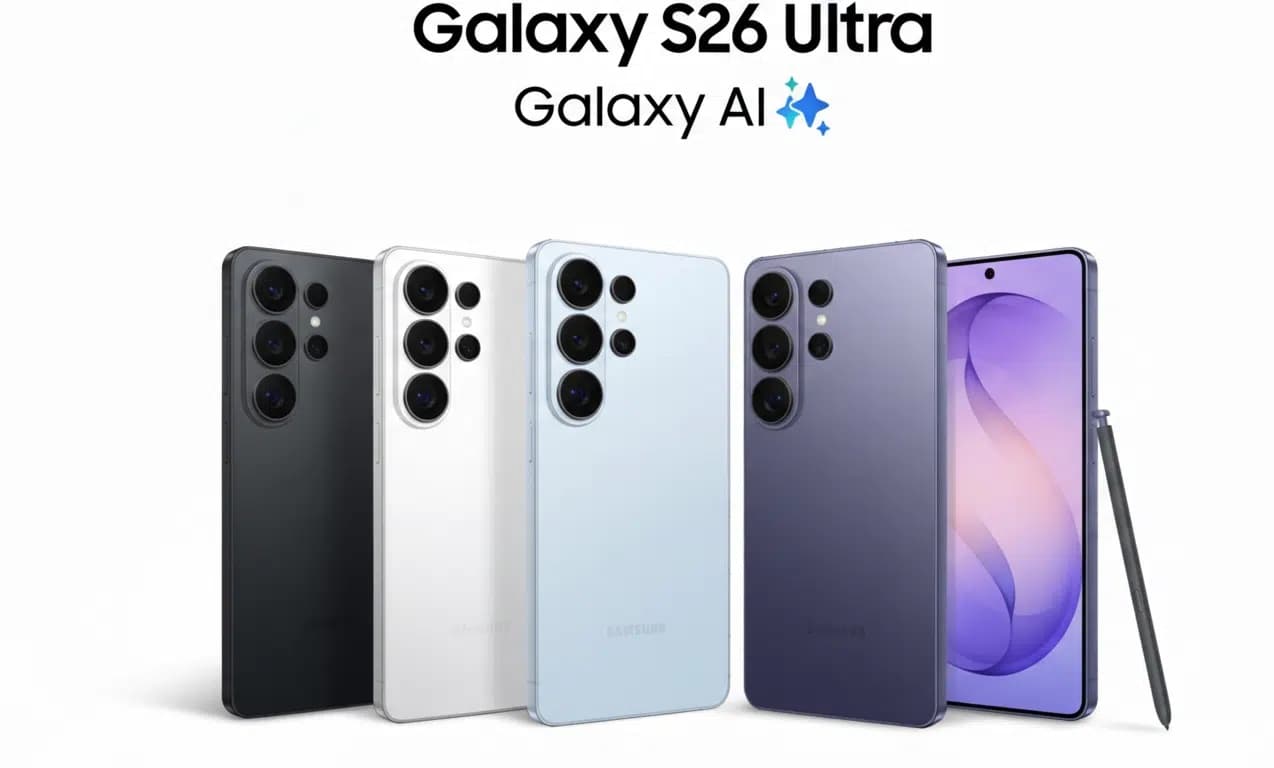
Samsung used its latest Galaxy Unpacked to push two themes in tandem: premium hardware refinements across the Galaxy S26 lineup and a bolder bet on on-device privacy and agentic AI. The company introduced the Galaxy S26, S26 Plus, and S26 Ultra, rolled out a new Privacy Screen for the Ultra, deepened its AI stack with Google Gemini and Perplexity, and topped it off with new Galaxy Buds4 and Buds4 Pro.
Galaxy S26 Lineup And Key Specs Across All Three Models
The three phones lean into focused upgrades. All models ship with Qualcomm’s latest Snapdragon 8 Elite Gen 5 in many markets, while some regions get Samsung’s Exynos 2600 on the S26 and S26 Plus. The base S26 sees a meaningful battery bump over last year, and the S26 Plus adds 20W wireless charging—modest on paper but useful for desk charging without cables.
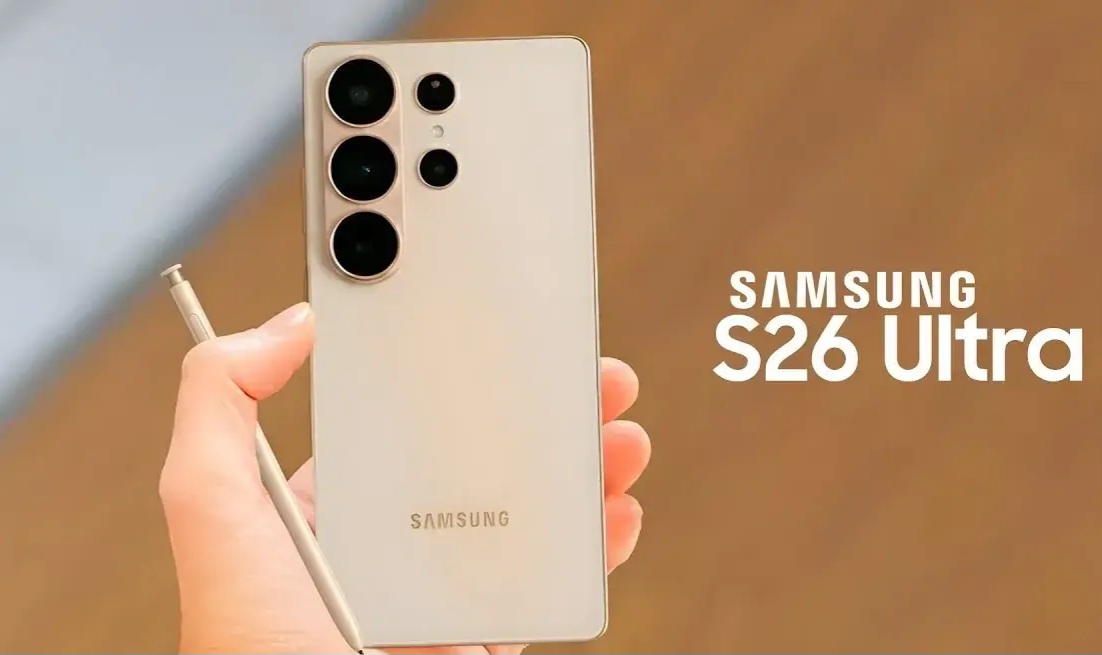
The S26 Ultra headlines with a 6.9-inch QHD+ display, a 5,000 mAh battery, S Pen support, and 60W wired charging that Samsung says takes the phone from 0% to 75% in 30 minutes. That’s not the fastest in the industry—Chinese rivals regularly tout 80W to 120W—but Samsung has historically favored conservative thermal profiles and cycle longevity, a trade-off many U.S. carriers and enterprise buyers prefer.
Camera hardware stays familiar in resolution yet improves in light capture. The Ultra retains a 200-megapixel wide and 50-megapixel telephoto, now with wider apertures (f/1.4 on the main, f/2.9 on the telephoto). Wider apertures allow more light, improving low-light performance and reducing shutter times, which should help with indoor portraits and nighttime street shots without over-reliance on heavy processing.
Pricing nudges upward: Galaxy S26 starts at $899, S26 Plus at $1,099, and S26 Ultra at $1,200—each $100 more than their predecessors. That tracks with a broader premium shift in the market: research firms like IDC and Counterpoint Research have noted that high-end devices drive the bulk of smartphone profit, even as total unit sales remain uneven globally.

Privacy Screen Is Ultra’s Standout Feature
Beyond raw specs, Samsung’s most novel change is the Privacy Screen option on the S26 Ultra. Instead of relying on third-party films that dim viewing angles, users can selectively obscure on-screen zones—like notification trays or password fields—or the entire display. Settings can be customized app by app, which is practical for work chats and banking apps while leaving media and maps untouched.
There’s also a “maximum privacy” mode that lifts dark areas and tones down bright regions, making shoulder surfing harder in bright environments like planes and cafes. It’s a small shift with big implications: as more personal and work data surfaces on phones—spurred by proactive AI—on-screen privacy becomes as critical as encryption. Expect CIOs and BYOD programs to pay attention here.
AI Assistants Multiply Across Galaxy Phones And Apps
Samsung’s AI strategy now embraces a trio: Bixby, Google Gemini, and Perplexity. The company is preloading the Perplexity app and tapping its APIs for actions like setting alarms, taking notes, and powering browser search. Galaxy AI, Samsung’s on-device suite, adds call screening with summaries, a timely feature as spam and unknown numbers continue to climb globally, according to telecom watchdog reports.
Google used the stage to preview a more agentic Gemini that can complete tasks end to end. A live demo showed Gemini parsing a group chat to place a meal order through Grubhub and, separately, hailing a ride via Uber. Circle to Search also gains multi-object recognition, letting users highlight multiple items on-screen for contextual results. The ambition is clear: less app hopping, more intent-driven automation.
Choice is welcome, but there’s potential for overlap. Power users may like having three assistants, while casual users could default to whichever answers first. The bigger test will be how smoothly these services respect user permissions, share context securely, and surface the right assistant at the right time without creating notification clutter.
New Galaxy Buds4 And Buds4 Pro Add Durability And Power
Samsung rounded out the ecosystem with the Galaxy Buds4 and Buds4 Pro. Both adopt a flatter stem design and carry IP54 (Buds4) and IP57 (Buds4 Pro) ratings, meaning resistance to dust and water that should comfort runners and commuters caught in the rain. The Buds4 Pro adds an 11mm woofer that Samsung says increases the speaker area by 20%, aiming for stronger low-end without muddy mids.
The Buds4 Pro also promises slightly longer standalone battery life than the standard model. Prices land at $179 for Buds4 and $250 for Buds4 Pro, positioning them squarely against mainstream competitors while undercutting some audiophile-focused sets with similar durability claims.
What It Means For Buyers Considering The Galaxy S26 Series
For most people, the S26 and S26 Plus are incremental refinements with a smarter ecosystem. The Ultra, however, blends top silicon with a practical Privacy Screen that solves a daily annoyance in shared spaces. The multi-assistant approach is ambitious; its success will hinge on thoughtful defaults and transparent controls. Given recent moves to extend software support on flagship phones, Samsung’s long game is clear: make the Galaxy the most useful screen you can trust to look at anywhere.