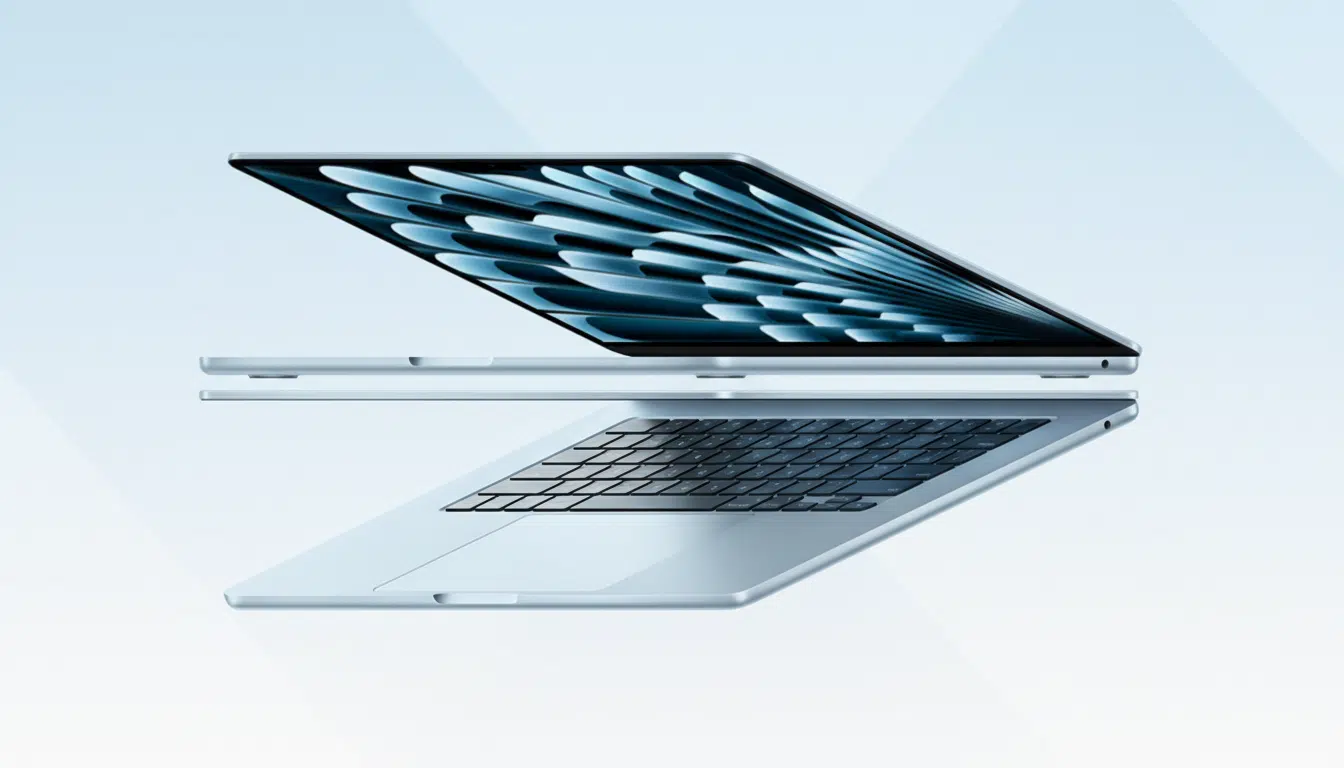
Apple’s new MacBook Air M5 arrives with a modest price increase and a handful of meaningful upgrades aimed at everyday speed, storage, and connectivity. The 13-inch model now starts at $1,099 and the 15-inch at $1,299—each $100 more than their immediate predecessors—raising a fair question: what exactly does that extra money buy?
The most tangible change is storage. The base MacBook Air now ships with 512GB of local storage—double last year’s entry configuration—alongside Apple-quoted read and write speeds that are up to 2x faster than the prior generation. That matters in daily use: app launches, large photo libraries, and project files all feel snappier when the SSD isn’t the bottleneck.
This also addresses a long-standing gripe reviewers flagged in recent years, when some base models with smaller SSDs used fewer NAND packages and showed slower throughput. Outlets like AnandTech and Notebookcheck previously documented those deltas in synthetic tests and file transfers. By moving the floor to 512GB, Apple restores the parallelism that enables higher sustained speeds.
There’s new headroom on the high end, too. For the first time, MacBook Air supports up to 4TB of internal storage, expanding its appeal for creators who travel with large RAW catalogs, 4K footage, or local AI models without relying on external drives.
Under the hood, the M5 features a 10-core CPU and 10-core GPU, with Apple claiming up to 9.5x faster performance versus the MacBook Air with M1. Expect that to translate to shorter code compile times, quicker Lightroom exports, and smoother timeline scrubbing for social-ready video. While independent benchmarks will pin down the spread, the generational uplift should be noticeable if you’re jumping from an M1-era machine.
Connectivity sees a genuine leap. A new N1 wireless chip enables Wi‑Fi 7 and the latest Bluetooth standard, paving the way for multi-gigabit networking, lower latency via multi-link operation, and more resilient performance in crowded environments. For video calls, cloud development, or large collaborative files, this upgrade could be as impactful as raw CPU cycles—especially on modern Wi‑Fi 7 routers.
I/O remains practical for a thin-and-light: two Thunderbolt 4 ports, support for two external displays with the lid open, and a 12MP Center Stage camera that tracks you during calls. Those touches bring the Air closer to MacBook Pro versatility without adding complexity.
Memory, Battery Life, and Design Updates Remain Familiar
Apple continues the more generous baseline of 16GB unified memory, which became standard with the previous generation. In a market where many Windows ultrabooks still ship with 8GB at entry, that headroom pays off in Safari tab jungles, Figma sessions, and multi-app workflows. Unified memory also benefits GPU tasks and on-device AI features that share the same pool.
Battery life is rated at up to 18 hours, matching the prior model—still a standout figure among ultraportables. The design and finishes carry over as well: Silver, Starlight, Sky Blue, and Midnight. The Air remains slim, light, and easy to toss in a backpack, which is precisely why it tops many buyer shortlists.
Pricing and Configurations for the New MacBook Air M5
The 13-inch MacBook Air M5 starts at $1,099, while the 15-inch begins at $1,299. As always, the real price will depend on your build—bumping storage to 1TB or more and memory beyond 16GB can add up quickly. With the base now at 512GB, fewer buyers will feel pressured into an immediate storage upgrade, which softens the impact of the $100 increase.
It’s also worth noting where the Air sits against the Pro. The new pricing inches the Air closer to Pro territory, but for many students, commuters, and mobile creators, the Air’s balance of performance, battery life, and weight is still the sweet spot.