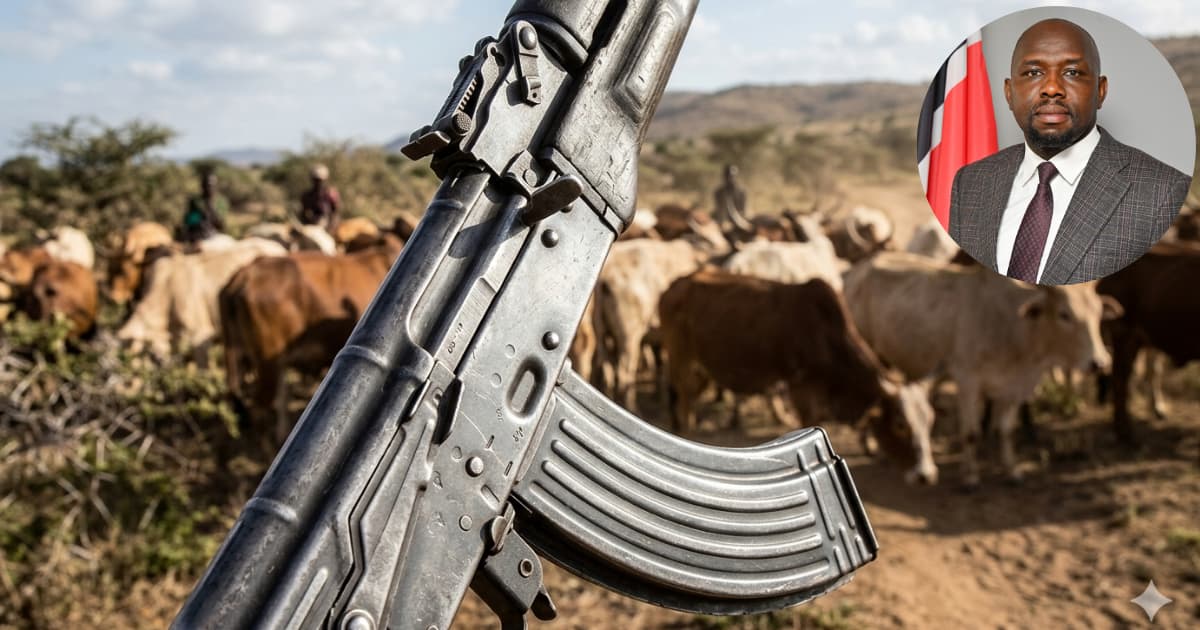
Meru’s northern belt is gripped by fear. In Tigania, Igembe and parts of Buuri, the sound of gunfire and the sight of fleeing livestock have become disturbingly familiar, as armed bandits tighten their grip on a region long plagued by cycles of violence.
What was once sporadic cattle rustling has evolved into a sophisticated and deadly enterprise which is marked by coordinated attacks, modern firearms and increasing fatalities.
Residents say the insecurity has deepened in recent months, with bandits striking villages, killing locals and driving away large herds, often without resistance.
“This is no longer theft. It is organized violence,” said a resident in Nyambene, where recent attacks have left families counting losses and living in constant fear.
The roots of Meru’s insecurity stretch back years.
Communities recall that during past disarmament operations, particularly in the early 2000s, the region experienced relative calm after security forces cracked down on illegal arms in neighbouring counties.
But those gains began to erode around 2018, when armed groups gradually re-emerged, taking advantage of porous borders, weak enforcement and recurring drought.
Today, banditry has morphed into a cross-county network involving attackers moving between Meru, Isiolo, Samburu and Laikipia, making it harder for security agencies to contain them.
The current spike in attacks has been exacerbated by the dry season.
With pasture and water scarce, competition over resources in the northern grazing zones has intensified, creating fertile ground for conflict.
Areas such as Tigania East and Igembe North have become hotspots, where herders are frequently targeted and livestock – a key economic lifeline – is stolen in large numbers.
The loss is devastating for families who depend on animals for survival, pushing many deeper into poverty.
In response, the government has declared parts of Meru, alongside sections of Laikipia and Isiolo, as security-disturbed and dangerous zones, paving the way for a major security operation.
Interior Cabinet Secretary Kipchumba Murkomen said the crackdown includes deployment of additional officers, aerial surveillance and a mop-up of illegal firearms.
“We shall intensify our efforts until banditry is completely eradicated and criminal networks dismantled,” he said.
Security teams are now conducting operations on the ground, targeting bandit hideouts and attempting to recover stolen livestock.
But for many residents, similar operations in the past have brought only temporary relief.
Even as the crackdown unfolds, political tensions are rising.
Deputy President Kithure Kindiki has clashed with former Deputy President Rigathi Gachagua over how to address the crisis, exposing divisions that risk complicating security efforts.
Kindiki has rejected calls for timelines and ultimatums, insisting that security operations require patience and coordination.
“We are not acting because of pressure, but because it is our duty to protect lives,” he said.
Gachagua, however, has demanded urgent action, warning that residents could resort to self-defence if the government fails to act decisively.
The exchange has amplified political pressure around the crisis, even as residents continue to bear the brunt of the violence.
Local leaders are now pushing for tougher intervention.
Meru Woman Representative Karambu Kailemia has called for the deployment of the Kenya Defence Forces (KDF), arguing that police operations alone are not enough.
“We are tired of deaths and livestock theft. The government must take decisive action,” she said.
Ms Kailemia also criticized the slow recovery of stolen animals, questioning how large herds can disappear without being traced.
On the ground, frustration is growing.
Residents say bandits often strike with impunity, taking advantage of vast, rugged terrain and limited security presence.
Many families have lost both livelihoods and loved ones, while others live in constant fear of the next attack.
For them, the crisis is not just about policy or politics, it is about survival.