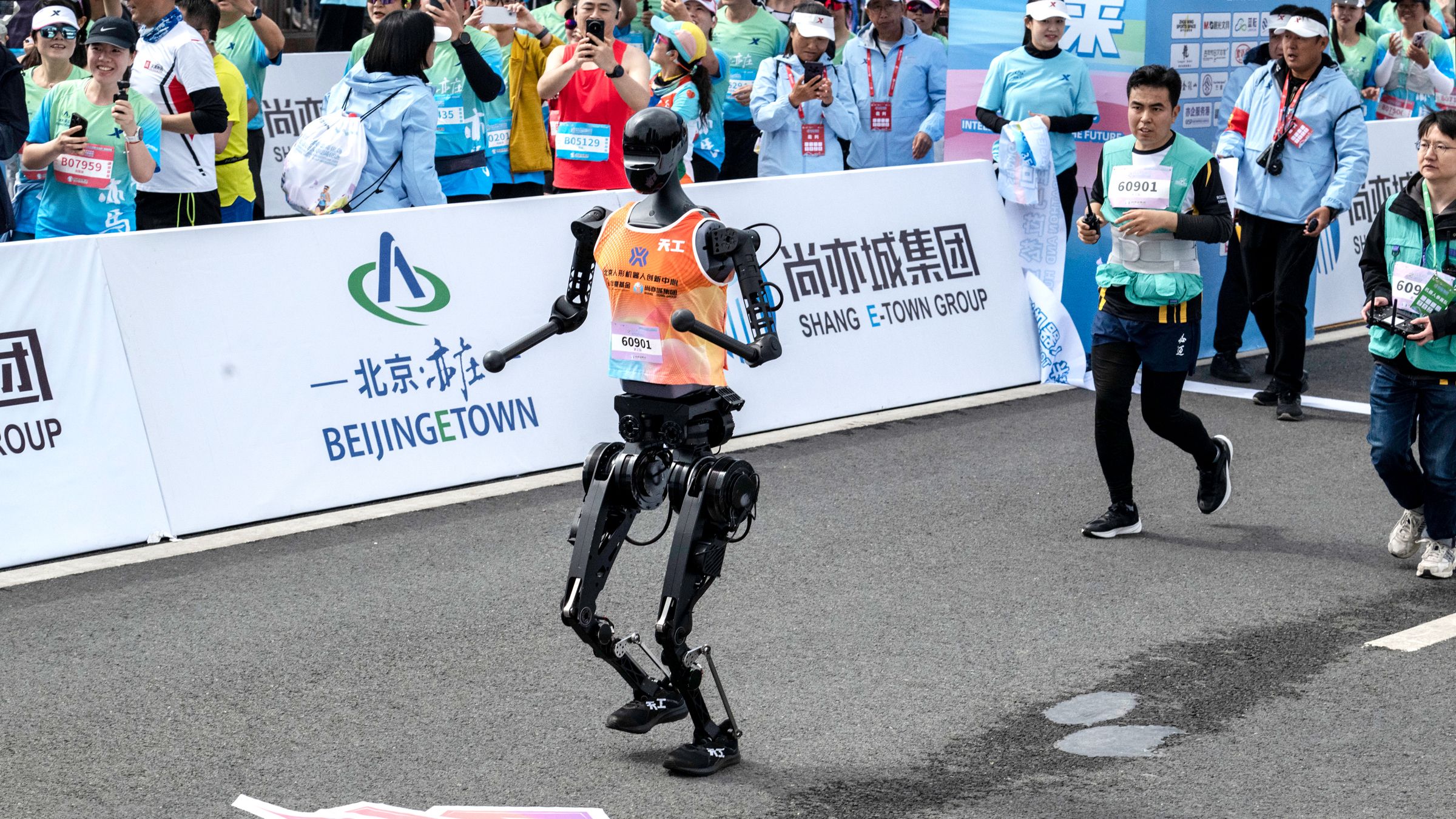
The China humanoid robot half marathon 2026 is returning this April, and it’s not just a quirky experiment anymore—it’s becoming a serious test of how far robotics has come. Step by mechanical step, dozens of humanoid robots will take to the streets of Beijing, joining thousands of their flesh-and-blood counterparts in a half marathon showcasing China’s drive to lead the global race in cutting-edge technology.
Set to take place on April 19, the event in it's second edition, will once again see humanoid robots sharing the course with human runners. It’s part spectacle, part stress test, and entirely fascinating to watch.
On the robots’ side, more than 300 humanoid machines will compete in the Humanoid Robot Half Marathon, representing at least 100 company and university teams. The total is a five-time increase from last year’s figure.
Competing robots must be stand-alone units with a torso, upper limbs and two feet, standing over 70 centimetres tall and using bipedal running as their core mode of movement.
The race features two categories – autonomous navigation and remote control – with mixed timing and a single ranking.
Autonomous robots must complete the course on their own, with human intervention allowed only during battery or robot swaps or when a robot falls and cannot recover, and only after approval from the officials.
Remote-controlled robots are operated by team members from a car following the race or a designated control centre. The human-runner segment, offering 12,000 places, has attracted more than 32,000 sign-ups from 27 countries and regions. For the first time, robots will also serve as pacers for human runners during the race.
Organisers have launched a new “robot service officer” programme, which allows robots to play multiple roles: not only as competitors, but also as performance robots, course-clearing bots and even food-service assistants at the event site. Last year, the race was widely described as the world’s first humanoid robot marathon. The robot Tiangong Ultra, from the Beijing Innovation Centre of Human Robotics, claimed top honours in two hours, 40 minutes and 42 seconds, while the men’s winner of the race had a time of 1:02.
Before the Race, a Tough Challenge Awaits
The main race isn’t the only thing on the schedule. A day earlier, on April 18, teams will take part in a special event called the Robot Baturu Challenge.
This isn’t about speed—it’s about survival and adaptability.
Robots will go through 17 different obstacle-based tasks
Some challenges will simulate disaster-like environments
Performance will be judged on stability, agility, and control
This pre-event adds another layer to the competition, giving teams a chance to test how their machines handle unpredictable situations.
Last Year Showed Just How Hard This Is
If you think running a half marathon is tough, try building a robot that can do it. Last year’s race made it clear that this is no easy task.
Only 6 out of 21 robots managed to finish the course
Many dropped out due to overheating or mechanical issues
Still, there was a standout moment.
Tiangong Ultra completed the race in 2 hours and 40 minutes
That time was within the human qualifying limit of 3 hours and 10 minutes.
Why This Race Actually Matters
At first glance, it might seem like a novelty. But there’s a bigger picture here.
Events like the China humanoid robot half marathon 2026 are helping push the entire robotics industry forward. They force teams to move beyond lab conditions and deal with real-world challenges.
Here’s what that leads to:
Better coordination between hardware and software
More durable and efficient robot designs
Faster progress toward fully autonomous systems
Challenge Human Records
Several teams have said they will challenge the human champion record this year. The human world record for a half-marathon is 57 minutes 20 seconds, while BHRIC's Tiangong Ultra won last year's half-marathon with a time of two hours, 40 minutes, and 42 seconds, meaning that androids need to double the pace of last year's winner to break the human record.
Robots' leap in speed comes after comprehensive upgrades to their hardware and algorithms. The joint torque output and explosive power of this year's participants are much stronger than last year, while new cooling systems technology is being used to ensure stable performance during prolonged high-intensity running.
Optimization of the motion control system has made the robots' gait more human-like, improving energy and running efficiency, Tang noted. In addition, thanks to improved battery performance, some robots may finish without needing to recharge mid-race.
This year's robots will also use electronic maps to independently complete environmental perception, path planning, and real-time decision-making, unlike last year's entries, which required human pacemakers or remote control. This year's track will also be more complex, posing greater terrain adaptability challenges, organisers said.
The humanoid robots China event isn’t just about winning—it’s about learning what works and what doesn’t. Competing in the event is an extreme test of software and hardware, especially the stability and consistency of motion control algorithms. The race provides a valuable validation scenario for the long-term stable operation of androids in complex environments.