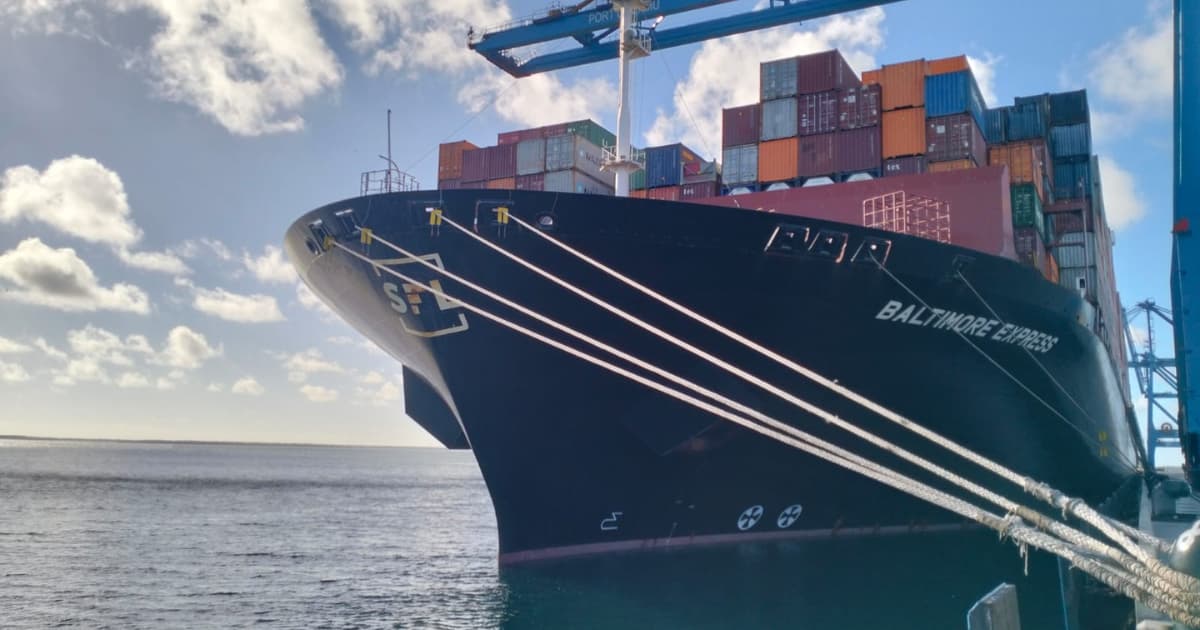
Kenya’s ambitious bet on the Lamu Port is beginning to pay off in ways that are hard to ignore. The arrival of the MV Baltimore Express, the largest cargo vessel ever to dock in East and Central Africa, marks more than just a maritime milestone. It is a signal that Kenya is positioning itself as a serious player in global shipping and regional trade.
The vessel, a massive 369-metre-long container ship operated by Hapag-Lloyd, arrived at Lamu from Oman’s Salalah Port on May 10, instantly setting a new regional record.
To put that into perspective, the ship stretches nearly the length of three football pitches, a size that many ports across Africa simply cannot accommodate.
The successful berthing of such a vessel is not accidental, it is the result of deliberate infrastructure planning.
Unlike many ports that require constant dredging, Lamu benefits from a naturally deep harbour of about 17.5 metres, combined with 400-metre-long berths, allowing ultra-large vessels to dock with minimal difficulty.
According to Kenya Ports Authority (KPA), this achievement demonstrates that Lamu can now handle the kind of shipping traffic typically reserved for global giants like Singapore and Rotterdam. As noted by port officials, “this call lifts Lamu’s profile on the global maritime map.”
It is a significant shift for a port that, until recently, was still finding its footing.
Lamu Port is not just another coastal facility, it is the anchor of the LAPSSET Corridor, one of East Africa’s most ambitious infrastructure projects. Conceived to link Kenya with Ethiopia and South Sudan through roads, pipelines and rail, the corridor is designed to transform regional trade flows.
For years, critics questioned whether LAPSSET would deliver on its promise, citing delays, insecurity concerns and funding challenges. But milestones like the docking of the Baltimore Express suggest that the port is steadily moving from vision to operational relevance.
The numbers reinforce this trajectory. Since the beginning of 2026 alone, Lamu Port has handled over 120 vessels, a sharp increase that points to growing confidence among global shipping lines.
The rise of Lamu inevitably raises questions about its relationship with Port of Mombasa, Kenya’s traditional maritime hub.
While Mombasa remains the busiest port in the region, it faces structural limitations, including congestion and draft restrictions. Lamu, by contrast, offers a deeper, less congested alternative, making it attractive for larger, next-generation vessels.
Rather than direct competition, the two ports may increasingly operate as complementary hubs, Mombasa handling high-volume regional cargo, while Lamu positions itself for transshipment, bulk cargo and transit trade to landlocked neighbours.
The arrival of mega-ships like the Baltimore Express has implications far beyond Kenya.For landlocked countries such as Ethiopia and South Sudan, Lamu offers a shorter, potentially more efficient route to global markets. In 2024, the port already handled cargo destined for Ethiopia, signalling early adoption by regional partners.
If fully realised, Lamu could reduce transport costs, shorten delivery times and reshape trade routes across East and Central Africa.
Handling a ship of this scale is not just about physical infrastructure, it is also about operational capability.
During its stay, the Baltimore Express conducted complex cargo operations, including the handling of hazardous materials in compliance with international safety standards, demonstrating that Lamu is not only big enough, but also technically capable.
This matters because global shipping lines are not just looking for space, they are looking for reliability, safety and efficiency.
The docking of the Baltimore Express is symbolic of a broader shift. Kenya is moving to position itself as a regional logistics hub, leveraging geography, infrastructure and policy to attract global trade flows.
But challenges remain. The full success of Lamu will depend on completing the supporting infrastructure, roads, rail and pipelines, that connect the port to inland markets. Without these, even the largest ships risk docking at a port that cannot efficiently move cargo inland.
The arrival of the MV Baltimore Express is a defining moment for Lamu Port, and for Kenya’s maritime ambitions. It proves that the infrastructure can handle the world’s largest vessels and that global shipping players are willing to test its potential.