The much-awaited Talanta Sports City Stadium now Raila Odinga International Stadium, will be ready for use this January, setting the stage for Kenya to host major matches ahead of the 2027 Africa Cup of Nations (AFCON), which Kenya will co-host alongside Uganda and Tanzania.
Speaking during the finals of the Kakamega Governor’s Cup 2025 at Bukhungu Stadium, President William Ruto said the 60,000-seater facility, located in Nairobi’s Jamhuri, has been earmarked for major continental games and will be completed in the coming weeks.
It is set to feature a shopping mall and hotel, seven modern changing rooms, VIP lounges, fully equipped media centres, and VAR booths integrated with goal-line technology.
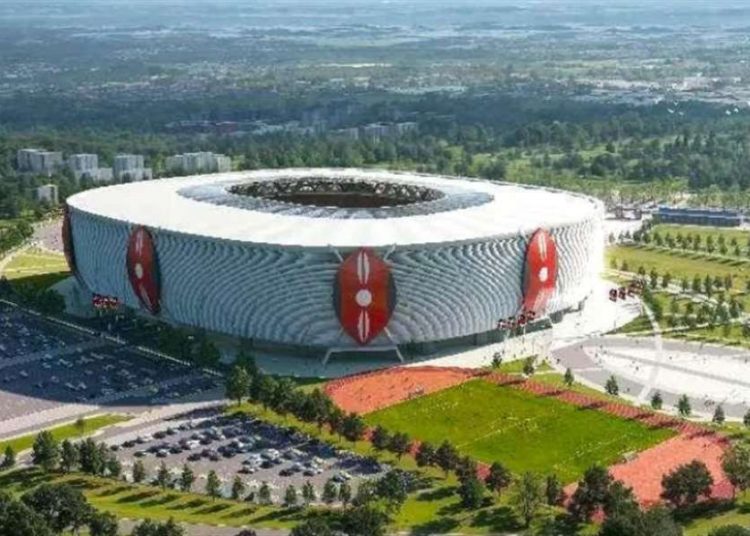
Work on the exterior is complete, including the stadium emblem, while interior canopy installation is nearing completion, and the playing surface is being levelled to meet international standards.
The facility will be renamed Raila Odinga International Stadium in honour of the late Prime Minister.
“Talanta Stadium, which I proposed be renamed Raila Odinga International Stadium, will be completed this January. We will begin using it immediately, ahead of its role in the 2027 AFCON games,” Ruto said.
Ruto emphasised that expanding sports infrastructure will support athletes in football, athletics and other emerging disciplines while positioning Kenya as a competitive host for international tournaments.
“Talanta is not the only one, we are building 21 stadiums to ensure Kenya’s youth can harness their talent across different sports. By providing the right infrastructure, we can unlock and nurture that potential,” Ruto said.
The stadium’s completion had initially been projected for December 2025, then revised to March 2026, but Ruto said it will be ready earlier. Construction began in 2024, and the stadium is being designed exclusively for football, with no athletics track, to meet international football standards.
In anticipation of the increased traffic, the government has embarked on the construction of the Ngong Road/Naivasha Road flyover at the Junction Mall.
The Ksh 45.3 billion ( $350 million) project is a collaborative effort between the Government of Kenya and the private sector via a public-private partnership (PPP) model, with China Road and Bridge Corporation (CRBC) as the main contractor.
A PPP model is where private partners, in this case CRBC, meet the project’s cost and once completed, charge and collect fees to recoup investments over a given period, often more than 20 years. This saves the government from meeting the development budget or borrowing, which can be costlier.
In the Talanta Sports Stadium project, local and international designers collaborated on the architectural plans, which included the University of Nairobi's Enterprises and Services Limited and Professor Erastus Abonyo, the lead consultant. This collaboration delivered a blend of global standards and local cultural aesthetics.
The design draws inspiration from Kenyan cultural symbols, aiming to reflect the nation's rich heritage. It incorporates elements reminiscent of traditional Maasai shields and spears, symbolizing strength and unity. The stadium will feature state-of-the-art facilities, including VIP lounges, modern locker rooms, and advanced media centers, ensuring it meets international standards for hosting major sporting events especially as stipulated by the Confederation of African Football (CAF).
One of the key highlights of the design is the absence of an athletics track, focusing solely on football and rugby to provide an intimate and engaging experience for spectators.
CRBC, renowned for expertise in large-scale infrastructures, is constructing the Stadium, having delivered similar capital-intensive projects in the country, including the Nairobi Expressway and Standard Gauge Railway (SGR). For the stadium project, advanced construction technologies have been employed to ensure efficiency and adherence to international standards.
As a state-of-the-art facility, it will elevate Kenya’s position in international sports by providing a venue that meets FIFA and World Rugby standards. This will enable the country to host regional and global tournaments, boosting its profile on the world sports stage.
From an economic perspective, the stadium has created numerous jobs across various sectors, including construction and after-construction jobs, events management, and stadium operations. Its modern training facilities will nurture local talent, providing a platform for young athletes to hone their skills and compete at higher levels.
Beyond sports, the stadium will serve as a multipurpose venue, hosting cultural events, concerts, and exhibitions that foster community engagement and cohesion. Moreover, the architectural marvel of the stadium celebrates the Kenyan spirit with symbolisms of the Kenyan flag embedded in the façade design.
However, the promising project has also raised several public concerns. The biggest of these is the issue of financial transparency and economic viability given that previous projects such as SGR and Nairobi Expressway, both constructed by CRBC, have struggled to generate revenue as initially projected. Kenyans especially the popular Gen Z critics and stakeholders have called for greater accountability and detailed reporting on expenditures to ensure funds are used responsibly.
Environmental sustainability is another critical concern. The large-scale development has sparked discussions about its impact on local ecosystems and green spaces around the Jamhuri Grounds, known for the green spaces that surround it. One of the merits is that the project will incorporate eco-friendly practices, such as renewable energy systems and rainwater harvesting. To minimize its ecological footprint, as shown in the design proposals, the incorporation of cross ventilation systems along the façade walls goes a long way in eliminating the need for Air Conditioning.