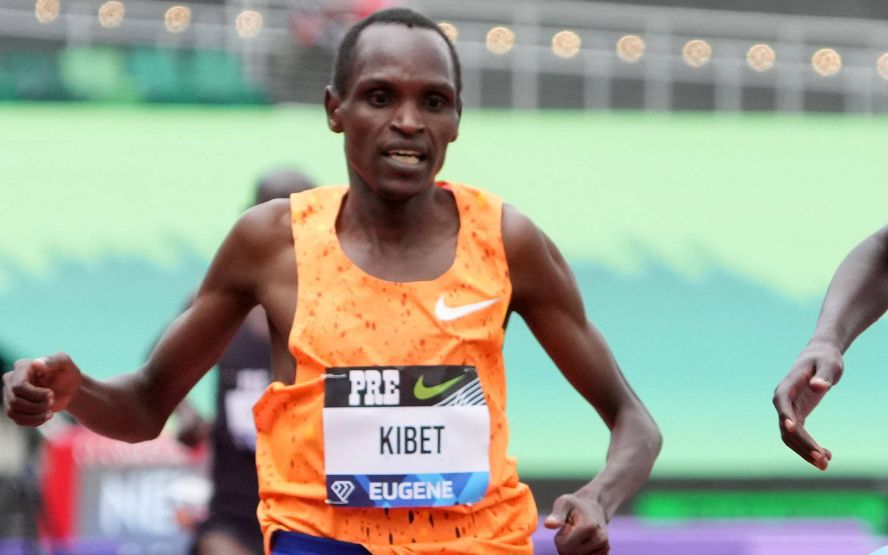
Kenya’s long-distance runner Benard Kibet Koech has been banned for four years by the Athletics Integrity Unit (AIU) for using a prohibited substance or method, with the suspension running from June 10, 2025, to June 9, 2029.
In addition, all of Koech’s competitive results from June 26, 2024, to June 10, 2025, have been disqualified.
Koech, 26, who finished fifth in the men’s 10,000m final at the 2024 Paris Olympics, was charged after abnormalities were detected in his Athlete Biological Passport (ABP).
The AIU said it found that blood samples collected between February 15, 2020 and August 15, 2024 “highly likely” to indicate the use of a prohibited substance or method, including patterns consistent with blood manipulation.
“The consistent pattern of high HGB with suppressed reticulocytes and elevated OFF scores in July 2024 strongly supports the likelihood of blood doping. No alternative physiological or environmental explanations adequately account for these anomalies,” the AIU said in its report.
“We, therefore, conclude, considering the information within the passport at this stage and in the absence of an appropriate explanation, that a prohibited substance or prohibited method has highly likely been used and that it is unlikely that the passport is the result of any other cause, such as environmental factors or a medical condition.”
Koech, born on November 25, 1999, is an International-Level Athlete with notable achievements, including the world's best performance in the 10-mile road race in Japan on December 4, 2022.
AIU said he denied any wrongdoing and argued that a combination of acute COVID-19 infection in June 2024, a 30-day oral iron supplementation course and high-altitude training in Eldoret explained the abnormalities in his ABP.
His explanation was supported by Professor Dr Stephen J. Brandt, a haematologist from Vanderbilt University Medical Centre.
However, the AIU said it reviewed Koech’s submissions and evidence, including testimonies from his wife, roommate and coach, but reaffirmed its findings.
In the second expert opinion issued on May 28, 2025, the AIU said, “The abnormalities began before the onset of the illness on June 30; on July 4, we observed the peak of HGB with initial reticulocyte suppression; on July 9, after the illness, the erythropoietic suppression worsened with the lowest reticulocytes. Thus, the haematological anomalies began at least 5 weeks before the Olympic 10,000m event, where the Athlete ran a personal best (26:43.98) and placed fifth, a highly competitive result globally.”
The panel also dismissed the athlete’s claim that iron supplementation or altitude exposure could account for the blood abnormalities.
“Oral iron supplementation is not known to suppress reticulocyte production and is unlikely to cause rapid haemoglobin elevation in a subject without depleted iron stores and efficient erythropoiesis. Even athletes with ferritin levels in the low normal range will not experience an increase in the HGB after several weeks of oral iron administration,” it noted.
The disciplinary panel ruled that Koech had committed an Anti-Doping Rule Violation (ADRV) and imposed four years of ineligibility, commencing on June 10, 2025.
The panel further ordered the disqualification of all results from June 26, 2024, to June 10, 2025, including forfeiture of medals, titles, points and prize money.
Each party was directed to bear its own legal costs.
“The Disciplinary Tribunal has jurisdiction to decide on the subject matter of this dispute. The Athlete has committed an ADRV pursuant to Rule 2.2 ADR. All competitive results obtained by the Athlete from 26 June 2024 to 10 June 2025 shall be disqualified with all resulting Consequences, including forfeiture of any titles, prizes, medals, points and prize and appearance money, pursuant to Rule 10.10 ADR,” the panel said.
AIU said Koech has the right to appeal the decision to the Court of Arbitration for Sport (CAS) in Lausanne, Switzerland, within 30 days from receipt of the ruling.