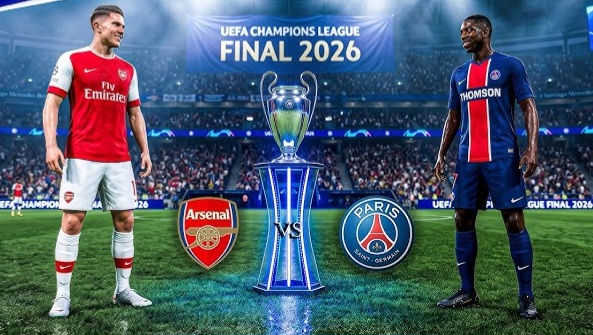
On Saturday, the attention of the footballing world will be captured by the Puskás Aréna in Hungary, where Paris Saint-Germain and Arsenal lock horns for the Champions League final. Budapest becomes the center of European football for one night, a city that has hosted drama before and now prepares for a final that pairs the tournament’s most prolific attack against a team built on control and defensive order.
The stadium will hold more than 60,000 spectators, but the audience will extend to millions watching around the globe, because finals at this level carry weight beyond the clubs involved. They define seasons, careers, and sometimes the direction of a club for years afterward.
The final will also make history for another reason. UEFA has officially moved the Champions League final kickoff to 18:00 CET (earlier than the traditional 21:00 start) in a move designed to improve the experience for fans and host cities.
Luis Enrique's crop are bidding to become the first-ever French team to win back-to-back European Cups, while the Gunners seek to etch their name onto the prestigious trophy 20 years after their first failed shot at European supremacy.
Saturday's showpiece marks the first Champions League final between two domestic champions since the 2019-20 season, when PSG were bested 1-0 by Bayern Munich behind closed doors - an optimistic omen for the more superstitious Arsenal supporters.
It is only appropriate that the Gunners will be going for European glory against Paris Saint-Germain two decades after their heartbreak in the French capital, where Jens Lehmann's red card, Samuel Eto'o's offside escape and Juliano Belletti's clincher saw Barcelona conquer the continent at the expense of a crestfallen Arsene Wenger.
The illustrious Frenchman left the Emirates without ever triumphing in the Champions League, but his disciple Mikel Arteta is now just 90 minutes away from a momentous European Cup and English top-flight double - a feat previously achieved by Liverpool (twice), Manchester United (twice) and Manchester City.
The naysayers will point to Arsenal's perceived 'easy' run to Budapest, but the Premier League champions earned their position on the kinder side of the draw thanks to their flawless league-phase performance, before out-witting all of Bayer Leverkusen, Sporting Lisbon and Atletico Madrid en route to Hungary.
Still unbeaten in Europe this season, Arsenal are already the first side to go 14 games without losing in a single Champions League campaign, during which they have also kept an unrivalled nine clean sheets - one fewer than their 2005-06 joint-record alongside 2015-16 Real Madrid.
Arsenal's 2-1 Premier League triumph at Crystal Palace last weekend - which preceded the long-awaited trophy lift - also marked their fifth win in a row across all competitions, although six of their last seven victories have been by just the one goal, the exception a 3-0 success over an illness-hit Fulham.
Arteta did mastermind a two-goal triumph over PSG in last year's UCL league phase, albeit before Enrique's men eliminated Arsenal from the semi-finals; one year later, a kiss on the Champions League trophy would represent the sweetest taste of revenge.
Meanwhile, prioritising a cohesive unit over superstar names, serial silverware collector Enrique - who could now join Carlo Ancelotti, Pep Guardiola, Bob Paisley and Zinedine Zidane as the fifth manager to win three European cups - oversaw an unremarkable league phase with 14 points from a possible 24, but PSG quintessentially came alive in the knockout rounds.
Monaco, Chelsea, Liverpool and most recently Bayern Munich have been slain by the reigning European champions, who unsurprisingly lead the way in this year's UCL goal charts with 44 - one shy of the all-time record set by the 1999-00 Barcelona team.
Only once have PSG failed to find the back of the net in the 2025-26 Champions League - December's forgettable goalless draw with Athletic Bilbao - and they have struck multiple goals in seven of their eight knockout matches, that streak ending in their 1-1 semi-final second-leg draw with Bayern Munich.
The nominated 'hosts' did end the 2025-26 Ligue 1 season on a sour note with a 2-1 loss to Paris FC, but the obligatory title had already been secured, and Bradley Barcola's opener in that clash means that PSG head to Budapest on a sensational 27-match scoring sequence.
Tactically, the tension is clear. PSG want to accelerate the game, stretch the pitch, and create situations where their attackers can isolate defenders. Arsenal want to slow the tempo, keep distances short, and make PSG earn every yard. Whichever side imposes its preferred rhythm early will gain an edge. If PSG can find rhythm between the lines and turn the match into a series of quick attacks, they will test Arsenal’s organization repeatedly. If Arsenal can establish control, move the ball through midfield without forced turnovers, and limit PSG to low-quality shots, they will increase their chances of deciding the game on their terms.
Beyond tactics, the final represents a shift in European football’s power balance. PSG’s rise reflects the investment, infrastructure, and global reach that have allowed them to compete at the top every season. Arsenal’s return to the summit reflects patience, academy development, and a coaching project that rebuilt the club’s identity after years of transition. Both models have merit, and both have earned the right to be tested on the biggest stage. That makes the result meaningful beyond the trophy, because it will validate how each club chose to build.