Google has expanded the availability of Gemini in Chrome for users across Africa, the Middle East and Latin America, extending its AI browsing assistant to millions of people who rely on the browser daily.
The update means Kenyans and other users in the newly covered regions can now summon Gemini directly from Chrome without opening a separate website or app.
The expansion marks another major step in Google's efforts to integrate artificial intelligence into its products and services.
What Gemini in Chrome Actually Does
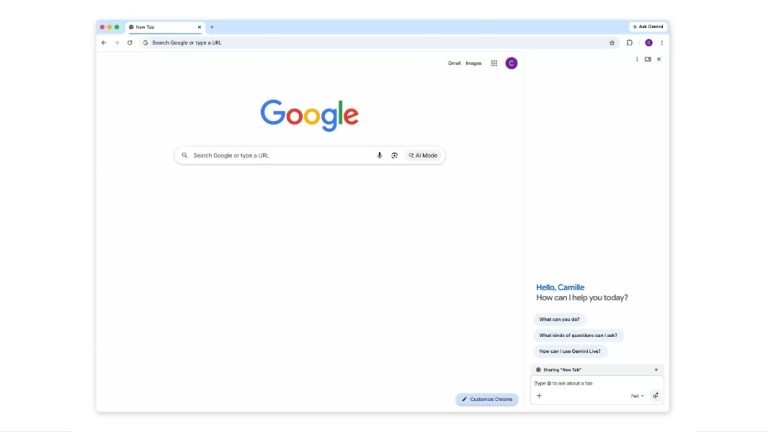
Gemini in Chrome is Google’s built-in AI helper that sits inside the browser as a sidebar. Instead of forcing users to jump between tabs, search engines and standalone chatbots, the assistant works with whatever page you’re already viewing.
It can condense lengthy articles into key points, answer questions about the content on your screen, compare details across multiple tabs, and explain technical or academic topics in plain language. Because Gemini reads the context of the page you’re on, it delivers answers that feel more relevant and saves the effort of copying and pasting text.
The design is meant to make browsing smoother and more productive. Whether you’re researching, shopping, studying or just trying to understand a complicated story, the assistant stays available as you move from one tab to another.
How Users in Kenya Can Turn It On
Activation is straightforward. Once Chrome is updated to the latest version, a small “Ask Gemini” icon appears in the top-right corner. Clicking it opens the Gemini sidebar, which then remains accessible across all open tabs.
From there, the assistant can summarize news reports, break down complex subjects, compare product specs while you shop online, and even generate written content based on your browsing activity. The integration goes beyond reading and writing. Gemini is linked to Google’s broader suite of tools.
You can ask it to draft an email in Gmail, add an event to Google Calendar, pull up directions or business details on Google Maps, or help plan a trip using information gathered from several websites. Google has also built image generation into the sidebar, so users can create AI images without leaving Chrome or downloading extra software.
The Bigger Push Into AI-Powered Browsing
This expansion is part of Google’s wider strategy to weave artificial intelligence into products people already use every day. Chrome is the world’s most popular browser, so embedding Gemini directly inside it puts AI assistance in front of a massive audience.
For students, professionals and casual users in Africa, the Middle East and Latin America, the change reduces friction. Instead of switching between multiple apps to summarize, research and act on information, Gemini handles those steps from one place. Over time, Google is expected to improve how the assistant works with local languages and region-specific services, making it more useful for everyday tasks across diverse markets.
The rollout also positions Chrome to compete more directly with other browsers adding AI features. By making Gemini native rather than an add-on, Google is betting that convenience and deep integration will keep users inside its ecosystem.
Europe Still Waiting on Privacy Approval
While access is now open across most regions, Europe is still an outlier. The delay comes down to the European Union’s strict data privacy framework under the General Data Protection Regulation.
Because Gemini in Chrome can view and interpret content displayed in browser tabs, Google must meet tougher requirements around data processing, storage and explicit user consent. The company says it is working with regulators to ensure the service complies before a wider launch.
Some early testers have already spotted Gemini in Chrome Canary, Google’s experimental version of the browser. That signals progress on compliance and suggests a European release could follow once legal and technical checks are complete. Until then, users in Africa, the Middle East and Latin America will be among the first outside North America to use the full version.
What It Means for Everyday Browsing
The arrival of Gemini in Chrome changes how millions of users interact with the web. Research that once required multiple tabs and tools can now happen in a single sidebar.
The real test will be whether Gemini feels like a genuine productivity boost rather than just another chatbot. Google’s advantage is integration. The assistant already knows how to work with Gmail, Calendar, Maps and search, giving it context that standalone AI tools lack.
Gemini in Chrome could become a default part of how people in Africa and other new markets read, learn and get things done online.