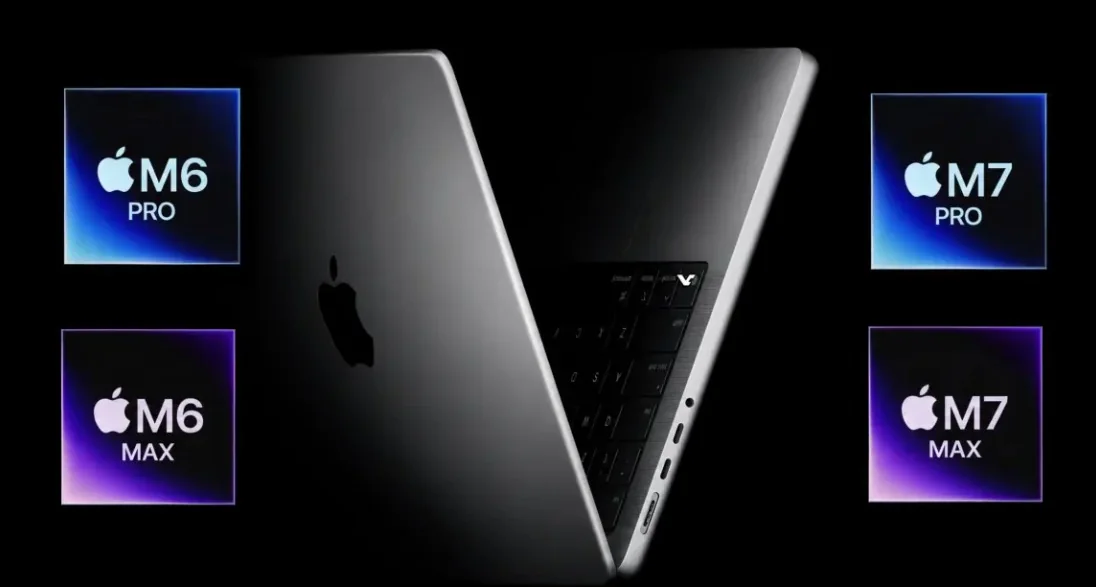
Apple is reshaping its Apple Silicon roadmap by skipping the high-end M6 Pro and M6 Max processors and moving engineering resources directly to the next-generation M7 family, according to reports, marking the first time Apple will launch an M-series generation without Pro and Max variants.
The change points to a bigger shift in priorities by accelerating on-device AI performance instead of following the usual M-series cadence of Standard → Pro → Max → Ultra.
Apple is still testing and planning to release the base M6 chip. It’s expected to power the entry-level MacBook Pro and deliver incremental upgrades over the current M5. The rumored M6 improvements include:
Redesigned CPU microarchitecture for better efficiency and single-core performance.
Faster Neural Processing Unit (NPU) to handle AI tasks locally.
Memory bandwidth jump from ∼123 GB/s to around 200 GB/s, which helps with AI models, video editing, and large codebases.
Larger GPU with 12 cores, up from 10 cores on the M5.
So the standard M6 isn’t standing still. It’s a meaningful update, but Apple is reportedly holding back its biggest architectural leaps for M7.
Why Apple would skip M6 Pro/Max
Reports say the main reason is AI. Apple is pushing to run more generative AI features directly on Macs rather than in the cloud. That includes Intelligent Writing tools, image generation, voice recognition, advanced photo/video editing, coding assistants, and other productivity features.
On-device processing improves privacy, cuts latency, and avoids cloud costs. To deliver that, Apple needs more AI compute, bandwidth, and efficiency. Shifting resources from M6 Pro/Max to M7 is framed as a way to get those chips out faster.
It’s a break from Apple’s typical release pattern, which has used Pro and Max chips to serve professional users each generation. Skipping them for M6 would be unprecedented.
The M7 plan: bandwidth, a new fab, and more AI headroom
The base M7 is expected in the first half of 2027, with memory bandwidth rising further to around 240 GB/s. The bigger news is manufacturing. Reports suggest M7 could be Apple’s first chip made on Intel’s advanced 18A-P process. That would mark a major change in Apple’s foundry strategy, which has been TSMC-focused so far.
M7 Pro and M7 Max are tipped to follow later in 2027, with much higher CPU/GPU performance and stronger AI capabilities. An M7 Ultra for systems like the Mac Studio is projected for 2028.
In short, Apple appears to be compressing the timeline: modest M6 base chip now, then jump straight to a more ambitious M7 stack designed around local AI workloads.
What this means for buyers
If you’re eyeing a pro Mac this year, the lineup could look different. There may be no M6 Pro/Max MacBook Pros, so professionals who need more GPU, memory bandwidth, and AI throughput might wait for M7 Pro/Max in late 2027. The base M6 will still bring better efficiency, GPU, and NPU, but it won’t target the same high-end segment.
Apple has not confirmed any of this, and roadmaps can change. But the reported move lines up with Apple’s repeated emphasis that on-device AI will be central to its long-term Mac strategy.