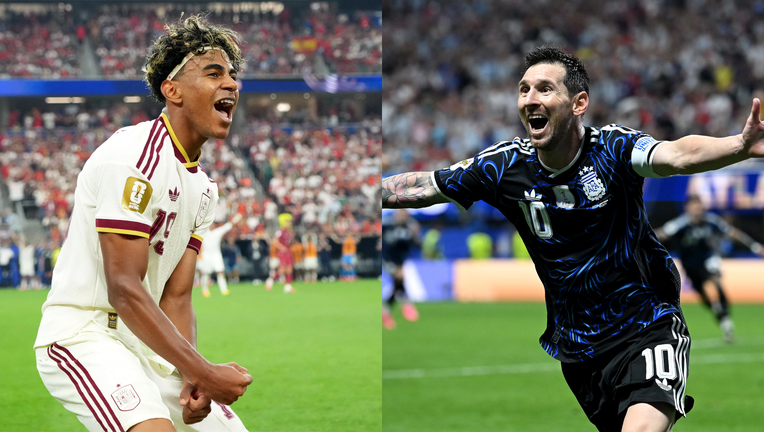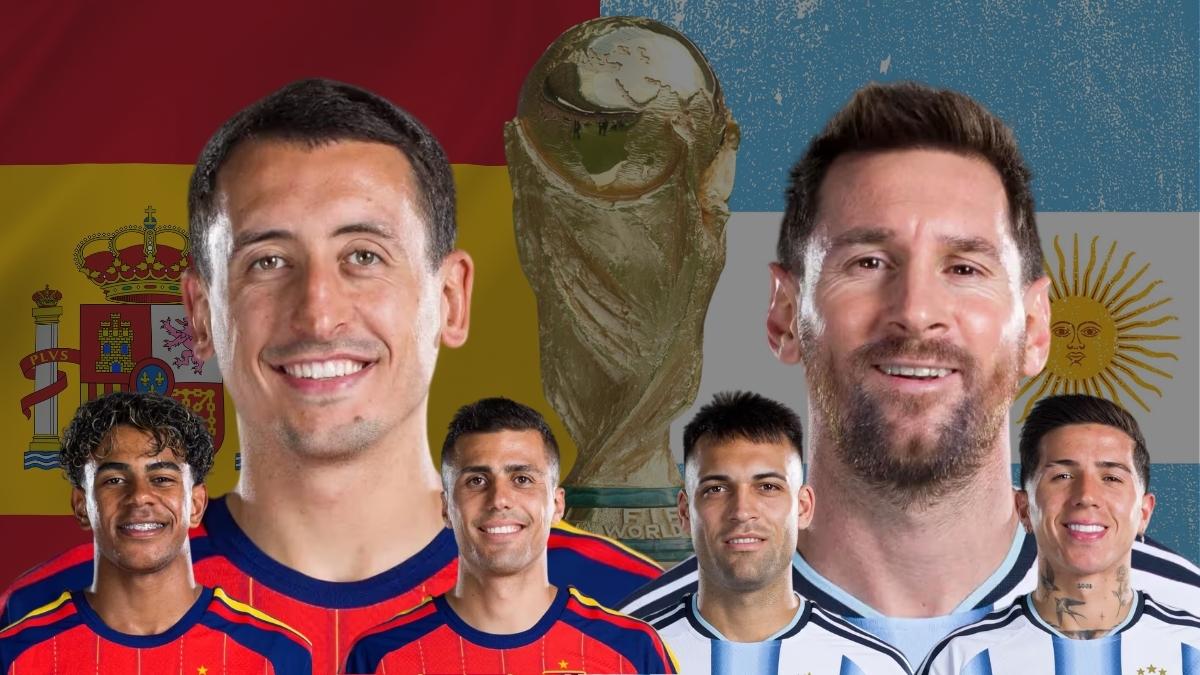
After six weeks of football across three countries and 16 host cities, the 2026 FIFA World Cup will conclude this Sunday when Spain face Argentina in the final at MetLife Stadium, bringing to an end the first 48-team edition of the tournament.
It is a final that pits the team ranked first in the world against the team ranked second, and the reigning European champions against the reigning Copa America and World Cup holders.
The road to New Jersey could not have been more different for the two finalists, yet both have come to embody the identity that has carried them through the tournament.
Argentina’s path has been defined by late drama and a refusal to accept defeat. In the Round of 32 against Cape Verde, they trailed and were pushed to extra time before Lisandro Martinez scored in the 92nd minute and an own goal in the 111th sealed progression after the underdogs had equalised twice.
In the Round of 16, Argentina found themselves 2-0 down to Egypt with 11 minutes remaining, seemingly on the verge of one of the biggest upsets of the tournament. What followed was 14 minutes that summed up this team. Cristian Romero pulled one back in the 79th minute, Lionel Messi equalised in the 84th, and Enzo Fernandez struck in the second minute of stoppage time to complete the comeback.
Against Switzerland in the quarter-final, it went to extra time again, and again Argentina found the goals late, with Julian Alvarez in the 112th minute and Lautaro Martinez in the 120th.
The semi-final against England followed the same script. Anthony Gordon put England ahead in the 55th minute, but Enzo Fernandez equalised from distance in the 85th, and then Lautaro Martinez headed home a cross from Messi deep into stoppage time to send Argentina through.
That means the defending champions have now scored 11 goals in the 79th minute or later during this World Cup, a figure that speaks as much to fitness and belief as it does to tactics. This is a side that plays as if it knows the game is not finished while Messi is still on the pitch.
Spain, by contrast, have built their campaign on control, patience and a defence that has barely been breached. La Roja have conceded only once in seven matches, that goal coming against Belgium in the quarter-final and bringing to an end Unai Simon’s run of 649 minutes without conceding at a World Cup.
Only two teams in history have reached a World Cup semi-final having conceded just once before, France in 1998 and Italy in 2006, and both went on to win the trophy. Spain have played an additional match because of the expanded Round of 32, and their defensive record is even more remarkable in that context.
Their approach has been unchanged from the philosophy that has defined Spanish football for nearly two decades.
Possession is not a means to an end, it is the end itself. No player illustrates that better than Rodri, who has completed 655 passes in the tournament, more than any other player in a World Cup since records began in 1966. He has been the tempo-setter, the player who recycles, protects and starts attacks.
Spain’s credentials were questioned early, after they were held to a 0-0 draw by Cape Verde in their opening game despite 27 shots and 74 percent possession, with 40-year-old goalkeeper Vozinha producing a performance that kept the debutants in the game. Since then Spain have beaten Austria, Portugal, Belgium and France in the knockouts without ever looking rattled.
The final therefore brings together two extremes. Argentina have scored late, conceded at times, and relied on individual moments to survive. Spain have suffocated opponents, limited chances, and worn teams down with the ball. It is the tournament’s most prolific attack in the closing stages against its most miserly defence over 90 minutes.
The context adds another layer. This is the first World Cup final between the current European champions and the current Copa America champions. It is also the first final to feature the world’s No.1 and No.2 ranked teams according to FIFA’s current rankings.
The expanded format, which ran from June 11 to July 19 and increased the field from 32 to 48 teams, was designed to bring more nations into the competition and more matches to more cities.
It has delivered both, with games played from Vancouver to Mexico City to Miami, and with several first-time qualifiers making an impression. But after all the expansion and all the extra fixtures, the tournament has narrowed to the two teams most expected to be here.
For Argentina, the stakes are clear. A second consecutive World Cup would place this generation alongside the greats of 1978 and 1986, and would give Messi another opportunity to add to a legacy that already includes a World Cup, a Copa America and multiple Ballon d’Or awards.
For Spain, it is about completing a cycle that began with tiki-taka dominance and has evolved into something more pragmatic without losing its core principles. A win would be their first major trophy since Euro 2024 and would confirm that this young squad belongs at the very top.
Kickoff is set for Sunday evening at MetLife Stadium, where more than 82,000 fans are expected and millions more will watch around the world. After a tournament that began with 48 teams and countless storylines, it ends with one match, between Spain’s composure and Argentina’s conviction, to decide who will lift the World Cup in 2026.