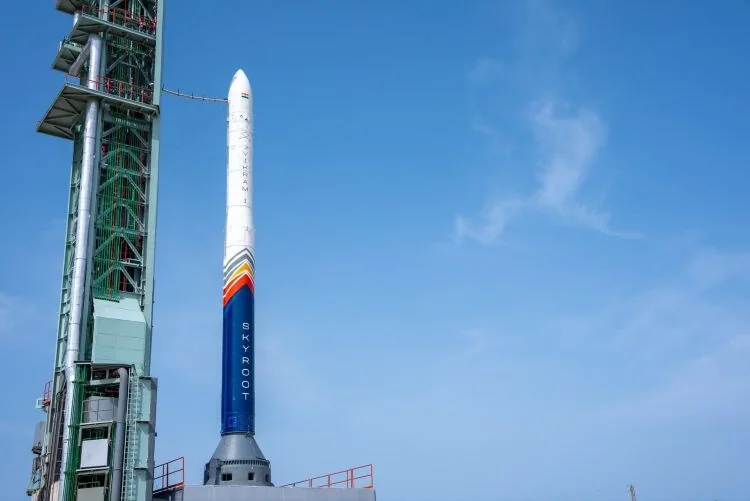
Private space start-up Skyroot Aerospace has successfully launched its first orbital rocket, Vikram-1, into space, marking a historic milestone for India’s private space industry.
The seven-storey rocket lifted off on Saturday at 11:30 am from the Indian Space Research Organisation’s Satish Dhawan Space Centre at Sriharikota. Within minutes, Vikram-1 reached orbit in a mission named “Mission Aagaman”, meaning “arrival”.
With this launch, India becomes the third country in the world to achieve private orbital launch capability, after the United States and New Zealand.
The rocket is named in honour of Dr Vikram Sarabhai, widely regarded as the Father of the Indian space programme.
Vikram-1 has been designed to carry up to 350 kg of satellite payloads to low Earth orbit. According to Skyroot’s founders, the rocket is meant to function like a “cab to space”, allowing satellite companies, universities and institutions to access specific and unique orbits on demand.
The design emphasizes speed and cost efficiency. It features 3-D printed engines and a carbon-fibre composite outer structure, allowing for faster manufacturing and rapid production cycles compared to traditional rockets.
This four-stage vehicle is positioned as a solution for small satellite operators who need flexible, responsive launch services without waiting in long government queues.
On its maiden flight, Vikram-1 carried more than just technology. The rocket transported handwritten messages from Skyroot’s team, investors, policymakers, and well-wishers from around the world.
Among them was a postcard from Prime Minister Narendra Modi bearing the words “Vande Mataram”, meaning “Salutations to the Motherland”. The gesture underscored the national significance of the launch for India’s ambitions in space.
Modi congratulated Skyroot and described the launch as a defining moment in India’s space journey.
“This mission highlights the talent, determination and entrepreneurial spirit of our youth. It also shows how our space-sector reforms are unlocking new opportunities for innovation and enterprise. The growing participation of the private sector will open new frontiers and accelerate innovation.” PM Modi said.
He added that the success of Vikram-1 will encourage countless youngsters to dream bigger and innovate fearlessly in science and technology.
With Vikram-1, Skyroot becomes the first private Indian company to launch a rocket to orbit, following in the footsteps of ISRO, which has led India’s space programme for decades.
Today’s launch was the second orbital attempt from Sriharikota this year. The first, the PSLV C62 mission in January, ended in failure due to a stage-III anomaly. The success of Mission Aagaman therefore comes as a boost for India’s overall launch cadence in 2026.
Skyroot officials said the flight was planned both as a technology demonstration and as a learning mission to validate systems for future commercial launches.
Skyroot Aerospace said it is already working on next-generation versions of Vikram that will be capable of carrying heavier payloads.
“With Vikram-1, we take our biggest step yet toward a reliable, high-cadence launch programme built in India, for India and the world,” said Naga Bharath Daka, COO and co-founder of Skyroot Aerospace, in a press release ahead of the launch.
The company aims to offer rapid-turnaround launches to meet growing global demand for small satellites, including those used for earth observation, communications, and scientific research.
Industry analysts say the success of Vikram-1 could accelerate investment in India’s private space ecosystem, which was opened to commercial players following government reforms in recent years.
The launch represents more than a technical achievement for India. It signals that the country’s space ambitions are no longer limited to government agencies, and that private innovation is now part of the journey to the stars.