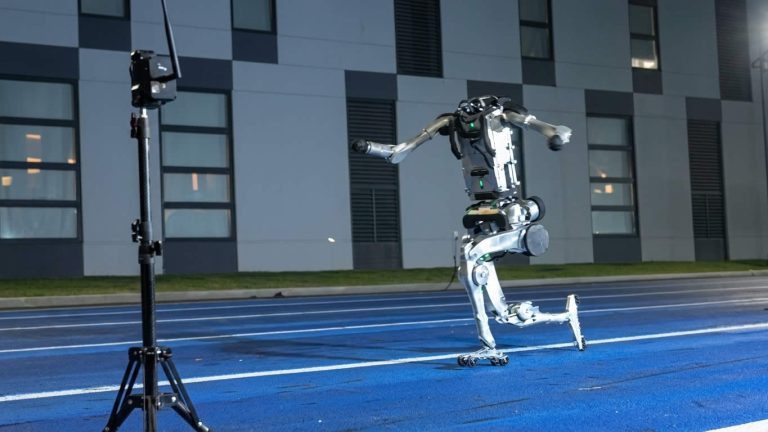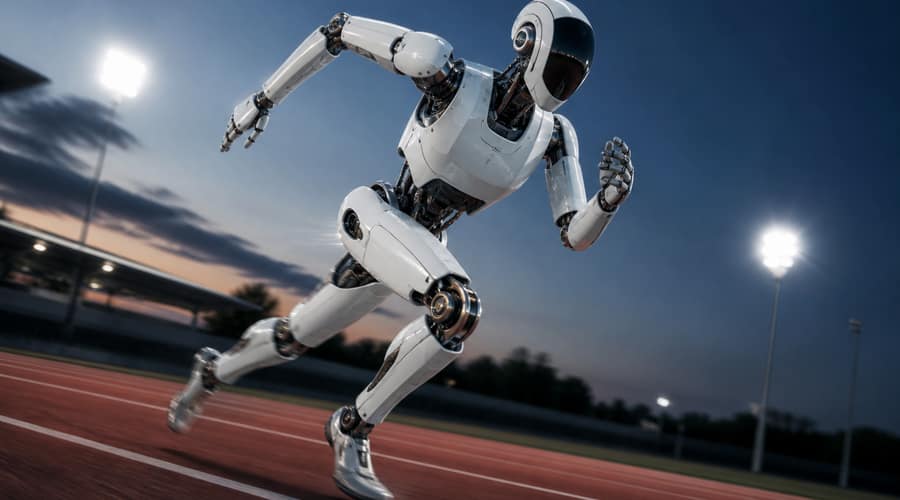
Chinese robotics company Unitree has unveiled a new humanoid robot called “Superman” that it says can run at 12.66 meters per second and clear a two-meter standing jump, performance figures that beat the best ever recorded by humans.
In a statement on August 17, 2026, during the official reveal, Unitree said Superman hit a top speed of 12.66 m/s, which converts to 45.6 km/h, and completed a standing high jump of 2.0 meters on legs that measure just 0.85 meters.
For comparison, the best recorded standing jump by a human is about 1.8 meters, and the fastest sprint ever recorded was 12.42 m/s by Usain Bolt during his 100m world record run in 2009.
If Unitree’s figures are accurate, the “Superman” robot is now faster than the world’s fastest man ever managed.
While the figures are yet to be verified by independent industry benchmarks, Unitree's official video channel simultaneously released a 30-second demonstration video.
In the footage, "Superman" performs a vertical leap with no run-up, reaching an airborne height nearly 2.4 times its own leg length, then immediately transitions into a high-speed sprint upon landing.
The company said engineers built the humanoid in a little over three months. Unitree also noted that the current hardware still has plenty of room for improvement, suggesting future versions could go even faster and jump higher.
The reveal is not entirely a surprise. Unitree founder Wang Xingxing hinted at the possibility back in March during the Yabuli China Entrepreneurs Forum.
He predicted that humanoid machines would break human sprint limits by mid-2026, citing cheaper components and advances in control algorithms as the key drivers. With Superman, that prediction has come to pass just within the timeline he set.
The timing of the announcement is also significant. Unitree is set to begin public trading in Shanghai in two days, in what is already one of the most oversubscribed tech listings the market has seen this year.
The company priced its IPO at 150.8 yuan per share and raised about 6.1 billion yuan, roughly $905 million. That deal values Unitree at about $9 billion.
Demand was so strong that the IPO was oversubscribed by more than 5,000 times. In the end, Unitree raised 45% more than the 4.2 billion yuan it had initially targeted.
Investors appear to be betting on both the technology and the business. Unitree reported real revenue of 1.7 billion yuan last year, more than four times the figure from 2024. Net profit came in at 591 million yuan.
The company also sold over 5,500 humanoid units across its G1, H1 and R1 models in 2025. Most of those units went to research laboratories and entertainment companies rather than factories, but the sales volume shows there is already a market for humanoid robots beyond industrial use.
Superman is not Unitree’s only recent product. A few weeks earlier the company introduced the As2W, a wheeled quadruped robot built for cargo. The As2W weighs 25 kilograms, can carry a maximum recorded load of 180 kilograms, and can move a continuous cargo of up to 16 kilograms.
That platform is aimed squarely at logistics and delivery applications, while Superman appears designed to push the boundaries of mobility and athletic performance in humanoid form.
The leap in capability raises questions about what humanoid robots will be used for next. In research labs, machines that can run and jump like this could be tested for disaster response, search and rescue, or navigating rough terrain where wheels fail. In entertainment, Unitree has already found buyers for dance, exhibition and media performances.
The company has not yet announced factory deployments for Superman, but the speed and agility demonstrated would make it a candidate for tasks that require quick movement in human-designed spaces.
Still, experts caution that lab benchmarks do not always translate directly to real-world use. Endurance, balance under load, energy consumption and safety around people will determine whether Superman moves from demo videos to practical work.
Unitree itself said the hardware is not yet at its limit, implying that software and battery improvements could push performance further in the coming months.
The company’s rapid progress also reflects a broader race in humanoid robotics. Firms in the US, China and Europe are all competing to build machines that can walk, run and manipulate objects with human-like dexterity.
What sets Unitree apart right now is the combination of speed, jumping ability and commercial scale. Selling more than 5,500 humanoids in a year and pulling in 1.7 billion yuan in revenue gives it a base that few competitors can match.
The debut of "Superman" further expands Unitree's humanoid robot product portfolio. To date, Unitree has released six related products spanning the H series (H1, H2), G series (G1), R series (R1 and the entry-level R1-Air), and the GD01, the world's first mass-produced manned transforming mech.