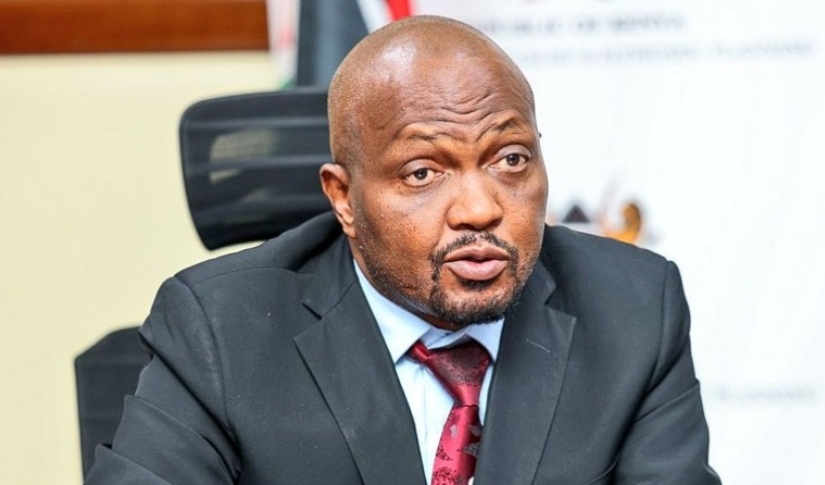
President William Ruto’s Economic Advisor, Moses Kuria, has drawn parallels between the upcoming 2027 General Election and the landmark 2002 vote, claiming it will be shaped by a national consensus on the presidency rather than a fiercely contested race.
Speaking during an interview, Kuria said leaders eyeing the presidency will reach an agreement on a single candidate before the election, similar to how the late former President Mwai Kibaki’s 2002 candidacy was endorsed by a broad coalition.
“Let me shock you. Some people are training for a football match that will not happen,” Kuria said.
He argued that the 2027 election will not be business as usual and that the country will witness a new political path grounded in dialogue.
“2027 will be like 2002. There will be no presidential election. There will be a consensus,” he said.
Overwhelming nationwide support.
Kuria noted that by the time Kenyans headed to the polls in 2002, the outcome was already evident, as Mwai Kibaki enjoyed overwhelming nationwide support.
“Have you ever seen that margin again?” he posed rhetorically.
He dismissed expectations of a tight race, saying the era of fiercely fought presidential contests like those in 2013 and 2017 is over.
“There’s not going to be that kind of presidential contest. Some people are training for football, but it will be a tennis match,” he said.
Kuria emphasised the need for national dialogue, warning of dire consequences if the country fails to unite.
“We have two options: go out one day and destroy the nation, or let’s agree,” he said.
“Let there be honour among men and women.”
The 2002 General Election.
On 25th October 2002, President Daniel arap Moi officially announced the end of his 24-year rule of the country, dissolving Parliament and launching the electoral campaign for the presidential and legislative elections scheduled for 27 December 2002.
President Moi was constitutionally barred from running for a new term. The nomination of his successor, Mr. Uhuru Kenyatta, son of Kenya's founding president Jomo Kenyatta, split the ruling party, the Kenyan African National Union (KANU), leading key party and government officials to resign and defect to the main broad-based opposition alliance, the National Rainbow Coalition (NARC).
The elections marked the first time since the establishment of a multiparty system in 1991 that the opposition was able to offer a coherent challenge to the KANU party. Unlike in the two previous elections, when the opposition was fragmented, in 2002 the NARC was a strong alliance of opposition parties that had promised sweeping constitutional reforms and an end to corruption.
Two weeks before the polls, ten political parties signed an electoral code of conduct amid rising incidents of violence, foul language and claims of vote-buying.
Among the five candidates vying for the Presidency, the two main contenders were Mr. Kenyatta and Mr. Mwai Kibaki, the leader of the NARC. Mr Kibaki, a former Vice-President, ran a campaign based on corruption-related issues and Mr. Kenyatta's lack of political experience, as well as direct attacks on KANU and the country's rulers for the last 39 years characterised by corruption and mismanagement. He further stressed the fact that the country's economy was in the doldrums and that the IMF had suspended aid because of concerns about corruption.
Mr Kenyatta had to campaign hard to distance himself from his mentor, outgoing President Moi. Mr. Kenyatta had only entered Parliament in October 2001 as a member nominated by the President, after a failed electoral bid in 1997. During the campaign, he promised to clean up KANU and presented himself as a "fresh face" untainted by power, pointing out that the NARC was full of recent defectors from KANU and led by the "old generation".
A total of 40,000 local and foreign observers were accredited by the Electoral Commission, making these the most closely scrutinised polls in the country's history. Both the European Union and the Commonwealth election monitoring groups congratulated Kenyans on conducting free, fair and peaceful elections.
The opposition won an overwhelming majority in both the presidential and parliamentary elections. In Parliament, the NARC took 126 seats out of the 210 at stake, as against 64 for KANU.
On 29 December 2002, opposition leader, Mr. Kibaki was declared Kenya's third President. He was sworn in on the following day.