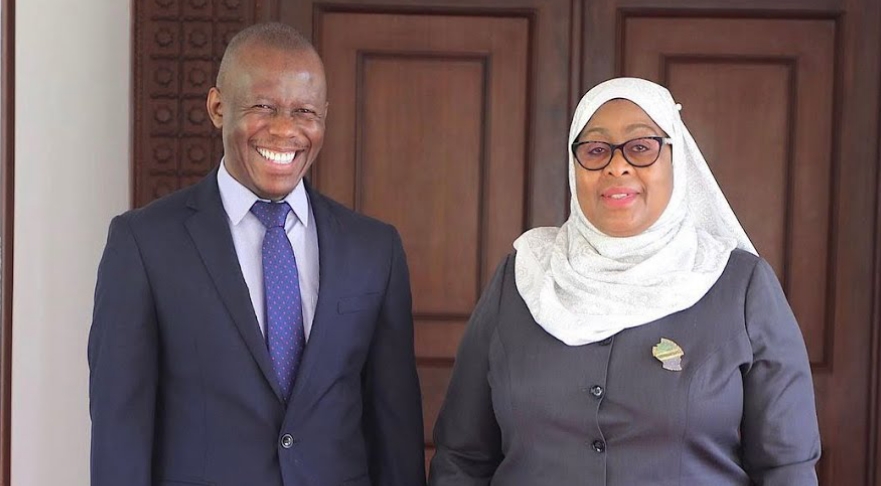
Tanzania's Ambassador to Cuba, Humphrey Polepole, has resigned from his diplomatic post and all public leadership positions, citing a fundamental loss of faith in the country's governance and ruling party.
In a detailed letter addressed to President Samia Suluhu Hassan on Sunday, Polepole described his decision as one born not of haste but of deep reflection on the direction of national leadership.
The letter, dated 13 July 2025, is unusually candid for a Tanzanian diplomat and amounts to a damning critique of the Chama Cha Mapinduzi (CCM) party - the same party he has long loyally served.
"Kwa heshima na unyenyekevu, naomba kukutaarifu kuwa nimefikia uamuzi wa kujiondoa kwenye nafasi ya Uongozi wa Umma..." ("With respect and humility, I wish to inform you that I have decided to withdraw from public leadership...")
Polepole, who previously served as an MP and ambassador to Malawi, had been posted to Cuba, where he represented Tanzania in the wider Caribbean region, including Venezuela and Colombia.
He was appointed to the Havana post in April 2023 in a diplomatic redeployment by President Samia Suluhu Hassan.
But in his two-page resignation, Polepole lamented that the ruling party had veered away from its founding principles, especially in the way it selects leaders.
He pointed to a worrying culture of opportunism and suppression of reform voices.
"Nilipoona kauli hii inafanyika vinginevyo, nimejiuliza mara kadhaa ni maslahi ya nani yanapinganiwa: mtu, kikundi au Chama Taasisi?" ("When I saw that this statement was being acted upon contrary to its meaning, I kept asking myself—whose interests are being fought for: an individual, a clique, or the institution of the party?")
He questioned the legitimacy of the phrase "Chama kwanza, mtu baadaye" — loosely, the party before the person — which he said has now been distorted to serve political gatekeeping rather than collective interest.
He warned that such rhetoric had become a cover for loyalty tests and exclusion, undermining the party's stated mission of justice and dignity.
Polepole added that he could no longer serve in a leadership system that "violates the constitution, principles of justice, integrity, and public accountability."
Though he reaffirmed his loyalty to the party as a member, he made it clear he would no longer participate in what he called "a leadership space divorced from ethics and values."
"Kwa kuwa siwezi kuendelea kuwa sehemu ya uongozi usiohamasika na utiifu wa misingi ya katiba..."
("Since I can no longer be part of leadership that disregards constitutional principles...")
The letter is as much a moral protest as it is a political statement.
A recent crackdown on opposition party activities and institutions critical of Tanzania's President Samia Suluhu Hassan administration has left many political observers and analysts concerned about the East African country's democratic space.
The latest moves, point to a return to the dark days in Tanzania when opposition parties and their supporters faced significant crackdowns, arbitrary arrests and other forms of political persecution — particularly during Magufuli's rule, which lasted from 2015 until his death in 2021.
Suluhu, 65, ascended to the presidential seat after the death of Magufuli in March 2021. Until then, she was Magufuli's deputy. The President, has in recent weeks made headlines for all the wrong reasons, after Kenyan and Ugandan activists and lawyers, who had travelled to the country ahead of opposition figure Tundu Lissu’s trial, were deported from the country, others held incommunicado and allegedly tortured.
Under Suluhu's leadership, calls have mounted for electoral reforms, mainly an overhaul of how election commissioners are appointed.
Currently, the election commissioners, including the chairperson, are presidential appointees, and their appointments are not subject to a parliamentary vetting process.
Lissu, a fierce critic of the government and a high-ranking member of the opposition Chadema party, has been advocating for a change of how the commissioners are appointed to guarantee a "level playing field." His mantra has been "no reforms, no election."
Lissu, 57, has been arrested on several occasions, and in 2017 he survived an assassination attempt after his vehicle was shot 16 times.
He, thereafter, went into exile in Belgium, and briefly returned to Tanzania in 2020 to run against the then-incumbent President John Magufuli. Lissu lost the election and returned to Belgium.
In January 2023, he announced his return to Tanzania after President Suluhu announced changes that allowed the opposition more freedom.
Lissu's party, Chadema, has been barred from fielding candidates in Tanzania's October 28, 2025 general election, which would see Tanzanians vote for president and members of parliament.
Ramadhani Kailima, the director of elections at Tanzania's Independent National Elections Commission, said that Chadema had failed to sign a code of conduct document that was due on April 12, 2025.
President Suluhu's Chama Cha Mapinduzi party (CCM), which has governed Tanzania since 1977, is widely expected to retain power following the ban on Chadema's participation.