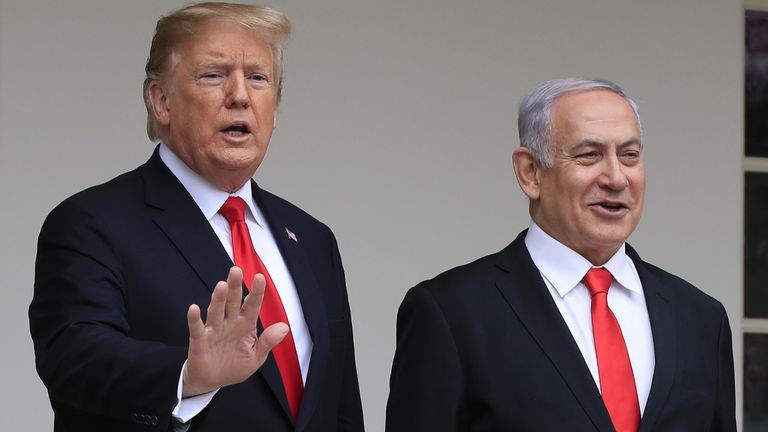
President Donald Trump has brokered a ceasefire between Israel and Hamas, marking a pivotal moment in the two-year war that has devastated Gaza and drawn global condemnation. The agreement includes the release of hostages and prisoners, a phased Israeli withdrawal, and expanded humanitarian aid.
Prime Minister of Israel Benjamin Netanyahu, on Thursday, endorsed the US President for the Nobel Peace Prize, following his announcement of the ceasefire agreement and hostage release arrangement between Israel and Hamas.
"Give @realDonaldTrump the Nobel Peace Prize -- he deserves it!" was posted as a message on the official X platform from the Israeli Prime Minister's Office, just a day before the winner is set to be announced by the Nobel committee.
The Israeli PM's office also shared an AI image of Trump celebrating while wearing the Nobel Peace Prize medal, standing alongside a cheering Netanyahu and other supporters.
Neanyahu formally sent the letter for Trump's nomination in July, citing his role in “forging peace in one region after another.”
Presenting a letter to Trump during talks at the White House, Netanyahu had said (at the time), “I want to present to you, Mr President, the letter I sent to the Nobel Prize Committee. It’s nominating you for the Peace Prize, which is well deserved, and you should get it."
Meanwhile, while actively campaigning for the honour in the past, Trump seemed to downplay the hopes in the most recent statement. When asked about his chances of winning the prize, Trump told reporters, “I have no idea… Marco would tell you we settled seven wars. We're close to settling an eighth. I think we'll end up settling the Russia situation… I don't think anybody in history has settled that many. But perhaps they'll find a reason not to give it to me.”
About the Ceasefire Deal.
Israel and Hamas have agreed to a ceasefire and reciprocal release of detainees, with the deal expected to be signed in Egypt today.
Hamas will release 20 surviving hostages; Israel will publish a list of Palestinian prisoners for release.
Five border crossings, including Rafah, will reopen to allow hundreds of aid trucks into Gaza.
Israel will begin a phased withdrawal from most of Gaza, with maps and troop repositioning plans included.
Trump’s plan includes an international security force inside Gaza and a U.S.-led reconstruction effort.
Hostage and prisoner exchanges are expected to begin Sunday or Monday, pending final approval by Israel’s cabinet and parliament.
Despite Thursday’s ceasefire announcement, negotiators remain at odds over the final list of Palestinian detainees, with Hamas warning that Israeli backtracking could derail the agreement.
Why Trump Thinks He Deserves the Prize.
As the Norwegian Nobel Committee prepares to announce this year’s winner of the Nobel Peace Prize, one name, one persona hovers over its decision – the United States president, Donald Trump.
Speaking at the United Nations General Assembly (UNGA) in New York in September, Trump said, “Everyone says I should get the Nobel Peace Prize.”
“I ended seven wars. No president or prime minister has ever done anything close to that,” he added.
Trump noted that the wars he ended include Cambodia and Thailand; Kosovo and Serbia; the Democratic Republic of the Congo (DRC) and Rwanda; Pakistan and India; Israel and Iran; Egypt and Ethiopia; and Armenia and Azerbaijan.
Some of the wars Trump claims to have ended are ones he participated in himself. His role in some other ceasefires is disputed. Still, there are other conflicts where the involved parties do credit him with playing a key role as mediator.
The war between Iran and Israel in June ended with a ceasefire brokered by Trump. But the bout of fighting, which started with Israel striking Iranian nuclear facilities, killing scientists and bombing residential neighbourhoods, also included the US as an active participant. Trump took part in it by ordering his military to strike three Iranian nuclear sites. Iran struck back by hitting the largest US military base in the Middle East, in Qatar, before the ceasefire was announced.
In May, India and Pakistan waged an aerial war, bombing each other’s military bases. India said it also hit “terrorist” bases in Pakistan and Pakistan-administered Kashmir, while Pakistan claimed India killed dozens of civilians. Ultimately, Trump announced a ceasefire after four days of fighting. But while Pakistan credits the US president for helping halt the fighting, India insists he had no role.
Cambodia and Thailand saw five days of hostilities in August, and a truce began after phone calls from not only Trump, but also mediation from Malaysian Prime Minister Anwar Ibrahim and a delegation of Chinese negotiators. So far, only Cambodia has thanked Trump for his role.
Relations between Serbia and Kosovo have been tense since the early 2000s. The European Union and NATO have always been key mediators in this region. Kosovo and Serbia signed a deal in 2020 under Trump during his first term. While relations remain tense, the two have not been involved in a full-blown war since Trump’s return to power.
Trump says he ended a war between Egypt and Ethiopia. But while the two nations have had tense relations, especially over a hydroelectric dam which opened on a tributary of the Nile River, they have not been in any war.
Rwanda and the DRC signed a peace deal in June, brokered by Trump. The ceasefire is fragile and tensions between the two countries remain high, but the deal is holding for now.
In August, Trump oversaw a peace agreement between Armenia and Azerbaijan at the White House, which promises to end a simmering conflict that often exploded into open war since the dissolution of the Soviet Union in 1991. But in a subsequent interview with Fox & Friends, Trump appeared confused about the countries he had mediated between. He told his hosts that he had ended a war between Azerbaijan and Albania.
Why does Trump want the Nobel Prize?
Trump says he deserves it — and many of his supporters agree. But the US president has also often compared his foreign policy initiatives with the global recognition that former US President Barack Obama received during his stint in power.
Obama won the Nobel Peace Prize in 2009 “for his extraordinary efforts to strengthen international diplomacy and cooperation between peoples” — even though he had been in power for only a few months at that point. Obama’s win has long been criticised, given his role in expanding the use of drone attacks overseas, including against US citizens, and his continuation of multiple wars around the world.
“If I were named Obama, I would have had the Nobel Prize given to me in 10 seconds,” Trump said last year.
According to Norwegian newspaper Dagens Naeringsliv, in July, Trump also called Norway’s Finance Minister Jens Stoltenberg — the former NATO chief — to discuss tariffs and lobby for the Nobel Peace Prize.
The Nobel Peace Prize, established under the will of Sweden’s Alfred Nobel, is given to “the person who shall have done the most or the best work for fraternity between nations, the abolition or reduction of standing armies and for the holding and promotion of peace congresses”. But in reality, the prize is shrouded in controversy.
Nominations for the 2025 Nobel Peace Prize closed on January 31, just days after Trump returned to the White House.
In July, Netanyahu said he nominated Trump for the prize, followed by Cambodia’s Prime Minister Hun Manet in August. Armenian Prime Minister Nikol Pashinyan and Azerbaijani President Ilham Aliyev also jointly endorsed Trump for the prize in August.
There are 338 nominees for the prize, and the Nobel Committee — a group of five people selected by the Storting, the Norwegian parliament— picks the winner.