

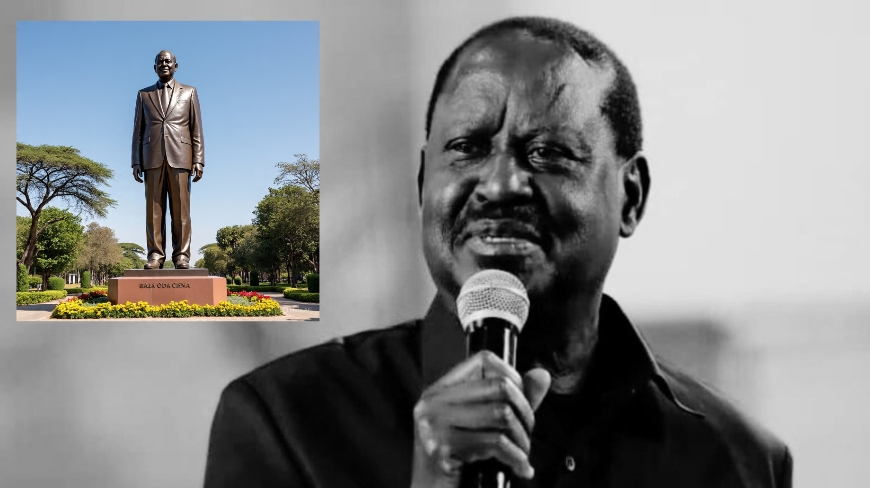
The Indian community in Nairobi is seeking permission from Nairobi Governor Johnson Sakaja's administration, to erect a statue in honour of the late former Prime Minister Raila Odinga.
The community announced plans on Sunday to fund and construct a grand statue of Odinga in Nairobi’s central business district (CBD), describing him as a statesman who stood for unity and justice.
Former Parklands Highridge Member of County Assembly (MCA) Jayendra Malde said the community is ready to fully finance the project as a gesture of appreciation for Odinga’s immense contribution to Kenya’s democracy and freedom.
“We as the Indian community are ready to build Baba a big statue in CBD in his memory, provided the governor approves,” said Malde, who served as Parklands Highridge MCA between 2017 and 2022.
He added that the community would formally write to President William Ruto and Governor Sakaja to request a site for the monument, which they hope will serve as a lasting tribute to the late ODM leader’s legacy and the values he stood for.
“Tomorrow, we as the Indian community will send a formal letter to H.E. William Ruto and H.E. Sakaja to give us a site in CBD for BABA’s statue,” he stated.
Unifying figure
Malde noted that Odinga’s leadership, sacrifice, and commitment to democracy deeply resonated with many communities, including the Indian diaspora in Kenya, who viewed him as a unifying figure and a defender of social justice.
He added that the proposed statue would not only celebrate Odinga’s memory but also symbolise Kenya’s diversity and the strong bonds among communities that have coexisted peacefully for generations.
The proposal has sparked interest among Nairobi residents, with many saying the gesture reflects the broad respect and admiration Odinga commanded across social and ethnic lines.
If approved, the statue would be among the most prominent monuments in Nairobi’s CBD, joining others such as that of Tom Mboya, which celebrate Kenya’s historical and political icons.
The announcement follows news that Germany’s Otto von Guericke University Magdeburg, Odinga’s alma mater, plans to launch an academic exchange programme in his honour and Durham University has initiated a study on the same.
International Academic Scrutiny
Durham University, a globally recognized centre for research, has initiated a major academic study into the life and political legacy of the late Kenyan statesman. The project, led by the university's Department of History, aims to provide a comprehensive analysis of Mr. Odinga's profound and often paradoxical influence on Kenya's political landscape over several decades.
The study is spearheaded by Professor Justin Willis, a renowned historian specializing in East African politics at Durham University. Professor Willis and an international team of scholars intend to examine how Mr. Odinga's career, marked by relentless opposition activism, periods of state power, and complex political alliances, fundamentally reshaped Kenyan democracy. The researchers noted that his death has created a "political vacuum that other leaders will struggle to fill," signaling the study's focus on the future of Kenyan politics in his absence.
The Durham study will delve into the multifaceted nature of Odinga's political identity. He is remembered as both a fierce nationalist who mobilized support across ethnic divides and the dominant leader of the Luo community. A self-identified revolutionary who was detained for years for his role in agitating against one-party rule, he later became a key architect of institutional reform. His most significant achievement is widely considered to be the 2010 Constitution, which introduced devolution and aimed to curtail the powers of the 'imperial presidency'—a cause he championed for years.
The Durham University initiative is part of a broader international recognition of Odinga's stature. In a related development, Otto von Guericke University Magdeburg in Germany, where Mr. Odinga studied mechanical engineering from 1965 to 1970, announced plans to launch an academic exchange program in his honor. The university's president, Professor Dr.-Ing. Jens Strackeljan, described Odinga as a "great engineer and bridge-builder," whose technical training influenced his public career. This gesture underscores the international academic interest in understanding the forces that shaped a pivotal figure in African politics.

For Kenya, this international scholarly focus provides a critical lens through which to assess a significant chapter of its history. The study's findings will likely influence contemporary political discourse, particularly concerning constitutionalism, electoral reform, and national unity. As Kenya navigates the political landscape following the death of a man who was a constant feature for over forty years, the objective analysis from a respected institution like Durham University, which boasts a top-ranked history department, will be invaluable. The research will explore his final political acts, including his controversial backing of President Ruto's government in March 2025, and what his absence means for the 2027 elections and beyond.
Born on January 7, 1945, the son of Kenya's first Vice President, Jaramogi Oginga Odinga, Raila was born into political influence yet became a vocal critic of the country's enduring inequalities. His political journey included five unsuccessful presidential bids, notably the 2007 election which was marred by widespread violence and allegations of rigging, leading to the formation of a Grand Coalition Government in which he served as Prime Minister from 2008 to 2013.
Odinga died on Wednesday, October 15, 2025, while undergoing specialised treatment in India. He was later laid to rest at his ancestral home in Kang’o Ka Jaramogi, Bondo, Siaya County.