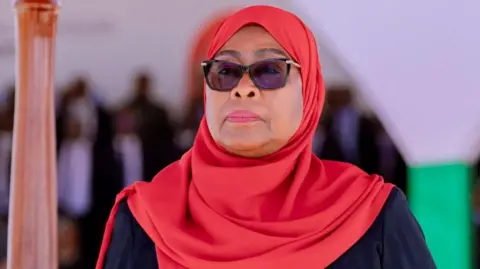
Tanzania's President Samia Suluhu has been sued at the International Criminal Court (ICC) over post-election violence that happened on October 29, 2025.
The World Jurists Association and the Madrid Bar Association, in a statement released Tuesday, November 25, argued that the East African country's security forces have murdered thousands of civilians, enforced disappearances, tortured detainees, committed sexual violence, and displaced Maasai communities.
“This Communication is respectfully submitted before the Office of the Prosecutor (OTP) of the International Criminal Court (ICC) pursuant to Article 15(2) of the Rome Statute of the International Criminal Court. This Communication provides to the OTP substantiated information concerning crimes against humanity perpetrated against the civilian population of the United Republic of Tanzania, with particular focus on the systematic attack that occurred during and following the general elections of 29 October 2025 and ongoing facts.” the petition reads in part.
The two organizations led by lawyer Juan Carlos Gutierrez filed a petition to the ICC, presenting detailed accounts of crimes against humanity they claim are linked to the country’s 2025 elections.
“The crimes documented in this Communication constitute violations of Article 7 of the Statute and have been committed as part of a widespread or systematic attack directed against civilian populations across multiple regions of Tanzania. The attack was conducted pursuant to state policy, with the knowledge and direct participation of the highest levels of the Tanzanian government, including President Samia Suluhu Hassan and her security apparatus.” Read the petition.
They have highlighted their arguments dated from 2022 to date as a systematic pattern of events against humanity that happened during the October 2025 electoral period and supported it with background information from Tanzania’s post-independence history.
“The temporal scope of this Communication extends from 2022 to the present (November 2025), documenting a systematic pattern of crimes against humanity that intensified dramatically during the October 2025 electoral period. However, the contextual background necessarily reaches further into Tanzania’s post-independence history to demonstrate the legal and institutional framework that has enabled these atrocities.” Read part of the petition.
Through their petition, the World Jurists Association and the Madrid Bar Association have demanded action following the delayed justice for the crimes committed.
“The time for action is NOW. Tanzania’s victims-protesters murdered for demanding electoral integrity, activists disappeared for advocating human rights, journalists tortured for documenting truth, indigenous Maasai dispossessed of ancestral lands, Muslim communities decimated by “counterterrorism”-have waited long enough for justice.”
The petitioners, have requested the Office of the Prosecutor to open a preliminary examination into the situation in Tanzania, investigate and prosecute.
At the time of this publication, the ICC was yet to confirm the admissibility of the petition or whether an investigation will be conducted.
Disputed Polls.
Tanzania's 2025 general elections have triggered outrage and mourning after violent clashes between protesters and security forces left hundreds dead and thousands injured in what observers describe as the country’s worst post-election unrest in decades.
Authorities have not released an official death toll, but unconfirmed reports suggest the number of fatalities could exceed 1 000.
Families across major cities have reported missing relatives — mostly young men.
The Independent National Electoral Commission (INEC) declared Suluhu, 65, the winner with 97.66% of the vote, extending the ruling Chama Cha Mapinduzi (CCM) party’s unbroken rule since independence in 1961.
The landslide win, coupled with widespread allegations of fraud, has fuelled scepticism about the vote’s credibility and the independence of electoral institutions.
In her victory speech, Samia defended the process, calling it “free and democratic,” while condemning protesters as “unpatriotic”.
“The incidents that occurred in Dar es Salaam, Arusha, Mwanza, Mbeya, and Songwe were neither civil nor patriotic. Patriotism is about building the nation, not destroying it,” she said in Dodoma, vowing that security agencies would “investigate and examine in detail what happened”.
But rights groups and regional observer missions painted a starkly different picture ; concluding that the elections “fell short of regional standards,” citing widespread intimidation and obstruction of monitors.
Similar criticisms came from the European Union (EU) and the European Parliament, which described the elections as “neither free nor fair.” In a joint statement, the EU said, “The fraud did not begin at the ballot box — it has been unfolding for months,” referring to intimidation of opposition figures, abductions, disappearances, and media restrictions.
The government also restricted access to social media platforms, which were later flooded with graphic videos of the violence once services were restored. Police have since warned citizens against sharing such footage.
Samia was sworn in on 3 November in a low-key ceremony at the Chamwino Military Parade Grounds in Dodoma. She dismissed international criticism as “distortions” aimed at undermining Tanzania’s sovereignty, urging citizens to remain calm and respect the outcome.