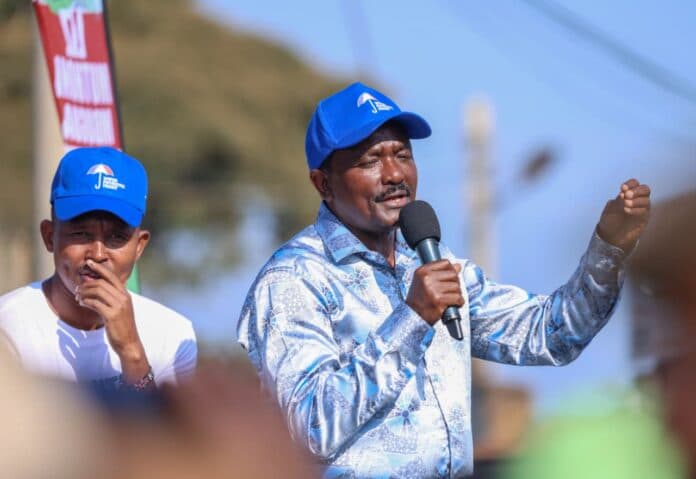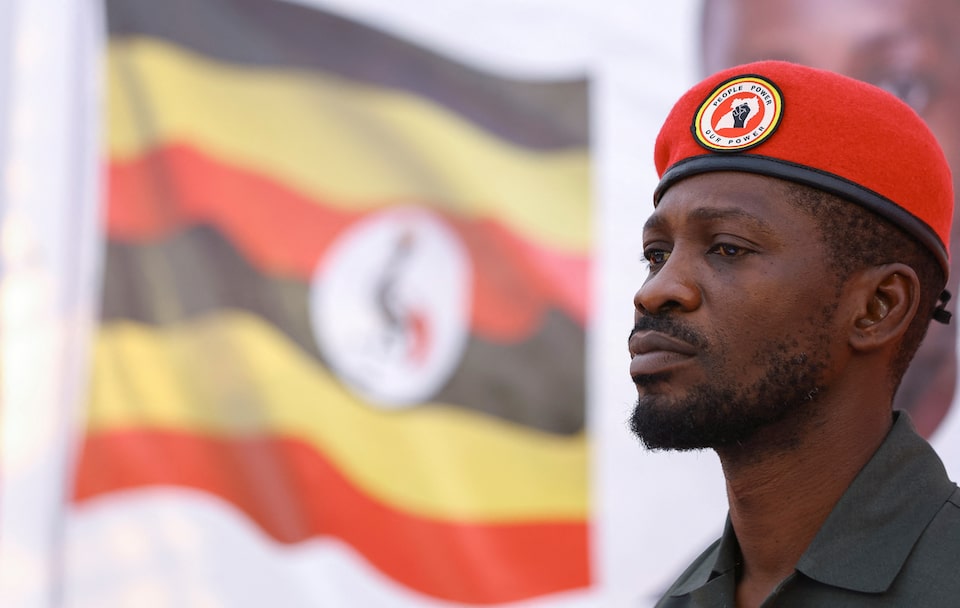
Suit torn, tie askew, eyes half-shut, Bobi Wine stood on his veranda and addressed a crowd. That morning, on November 3rd, 2020, the Ugandan pop star had handed in his nomination papers to run for president in elections in January 2021. Moments later, police smashed the window of his car, arrested him and pepper-sprayed his face before driving him home. Bedraggled but defiant, he greeted his fans. “This is a revolutionary election,” he said. “If it’s a boxing fight, it has begun.”
That is the setting in which Robert Kyagulanyi Ssentamu, aka Bobi Wine, took on Museveni. The popstar-cum-politician, ran a campaign against Museveni in particularly difficult circumstances. He had 64 days to campaign in 146 districts in what was his first ever countrywide tour as a politician. He had attempted to tour the country before the campaigns – and the law allows a presidential aspirant to conduct such a tour one year to the election – but the authorities blocked him. His music concerts had been banned over three years earlier when he made it clear that he harboured presidential ambitions.
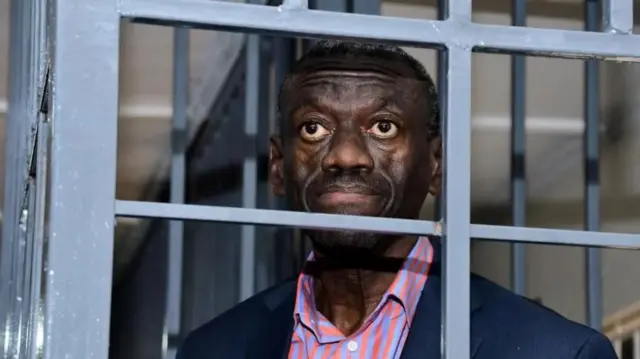
Like Kizza Besigye, who before him had challenged Museveni at the polls four times, Kyagulanyi ran his campaign through a tightly disrupted trail dominated by tear gassed rallies, arrests and intense crack down from law enforcement.
When the campaigns kicked off on 9 November 2020, Kyagulanyi started with a bang in an area far away from his native land. The crowds kept growing bigger and the narrative that he was only popular in his native Buganda region collapsed as quickly as it had been been constructed by regime propagandists. As the days wore on Kyagulanyi continued to pick up steam as he went through the districts and his tour of Buganda region drew closer. The regime ran out of patience.
Kyagulanyi had scheduled rallies in the east on 17 November 2020, to be followed by his first rally in Buganda the following day. He visited Masaka – the epicenter of anti-Museveni activities – on his first day in Buganda. The authorities couldn’t allow that so on the morning of 17 November, Kyagulanyi was arrested as he arrived at the venue of his scheduled rally. It took something like a garrison of the army and the police to arrest him, and after a mini scuffle the presidential candidate was whisked away like a hardcore criminal. The abduction was relayed live on social media and some of it was on television. Kyagulanyi’s supporters violently protested in Kampala, Masaka and other towns and after two days of rioting the security agencies had shot and killed at least 52 Ugandans. According to official records, two others were run over by vehicles that were caught up in the melee.
When Yoweri Museveni was declared winner of the January 2021 election, the situation in Kampala and other townships across the country remained calm - not the peaceful kind - one of unease and uncertainty. There were no spontaneous celebrations. His party’s secretariat would hours later organise a victory procession, which took place under tight security. Wine, would later be placed on house arrest after rejecting the outcome.
Fast forward - Uganda is headed to polls. Bobi Wine, has exuded confidence that none of the 2026 presidential contenders can defeat him in a free and fair election, arguing that he commands unmatched support across the country.
Speaking during a televised presidential debate on Sunday, Wine said Ugandans have already demonstrated where their allegiance lies, noting that his popularity is evident in all regions of the country.
“The people of Uganda have consistently shown it to you, from the north to the south, from the east to the west. None of the candidates can win me in an election, even in their own backyard,” he said.
Wine, who emerged second in the 2021 elections according to Electoral Commission results, maintains that he was the rightful winner of that race. In 2021, the Electoral Commission announced that Bobi Wine secured 35 percent of the vote against President Museveni’s 58 percent.
He rejected those results, accusing the Electoral Commission and state machinery of rigging to keep President Museveni in power. He urged Ugandans to rally behind him again in 2026 to complete the political change they voted for.
“I call upon all of you to vote for me. Yes, I have the highest respect for all these presidential contenders, but I am the best choice. It is only a pretender that will not agree that the person elected to be president of Uganda in 2021 was Kyagulanyi Ssentamu Robert,” he said.
Bobi Wine said voting for him in 2026 would be a vote to end “40 years of dictatorship,” promising to deliver what he describes as a “new Uganda.”
He painted a grim picture of the current governance environment, citing what he called the capture of state institutions including the judiciary.
“At a time when our nation is at a crossroads, when all institutions of state are under capture, including the judiciary; when a judge sits to decide a case not based on the law but on what General Museveni wants; when appointment of judges is done by one person instead of the Judicial Service Commission; when a Justice of the Supreme Court, Esther Kisaakye, is in exile because she fears for her life for disagreeing with the status quo; when political leaders like Dr. Kizza Besigye are in jail for no case whatsoever; when citizens are tortured on camera by those meant to protect them; when social media like Facebook is blocked; when laws are applied selectively; when some citizens are imprisoned under the Computer Misuse Act; when a country is completely captured,” he said.
He added that despite the current state of affairs, Uganda can still be transformed, saying, “A new Uganda is possible. A new Uganda can come, and it’s by you and me,”.
When Museveni defeated Paul Kawanga Ssemogerere in 1996 amidst accusations of rigging, Bobi Wine, was 14 years old, too young to vote.
Much earlier – in 1980 – Museveni took part in his first presidential election as a candidate more than a year before Kyagulanyi was born. Museveni failed to win even in his own constituency on that occasion and the victory went to Milton Obote, the man who commanded the guns at the time. Museveni turned things in his favour when he started a war after that election and took control of the guns and the country’s leadership in 1986. He hasn’t looked back since.
Of course some Ugandans vote for Museveni, but perhaps they consider it too risky to openly admit. It is risky because many of their compatriots who vote against Museveni are angry at the establishment and do not understand how a Ugandan in full possession of their mental faculties can vote for Museveni after so many years. Many Ugandans have been attacked for showing support for Museveni, and when demonstrations take place, one would be well advised not to be caught wearing yellow, the colour of Museveni’s National Resistance Movement (NRM).
Those Ugandans who don’t vote for Museveni believe that elections are habitually rigged in Museveni’s favour. And there is another group of Ugandans who have grown too despondent to participate in any election in which Museveni is a candidate. A regular commentator has over the past few months repeatedly wondered why Ugandans are keen to participate in polls whose outcome is known in advance.
The country is deeply divided and very few believe that the government is committed to democracy. An opinion poll that was conducted by Afrobarometer, showed that whereas 78 per cent of Ugandans want their leaders to be chosen through periodic free and fair elections, only 36 per cent of the citizens are satisfied with how democracy works in Uganda.
But Bobi Wine believes the time has come for change. Just like he said 'If it's a boxing fight, it has just began'. The emergence of Kyagulanyi has excited many and ignited hitherto apolitical constituencies to rise up against Museveni. These groups include young Ugandans excited by the prospect of having a youthful president. As the January 2026 General elections loom- all eyes will be on Uganda.