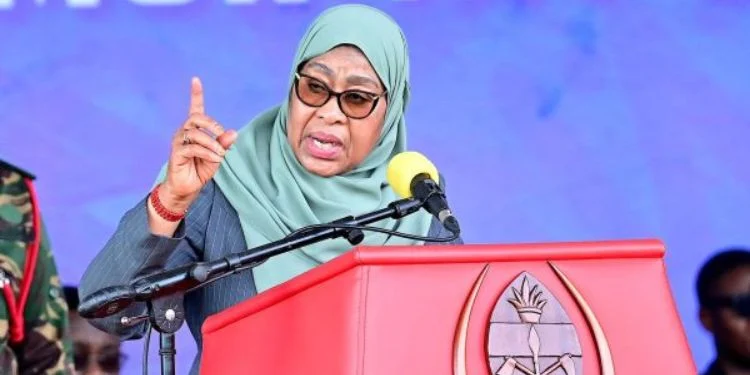
Tanzanians have been directed to observe Independence Day from home, with only essential workers expected at their workplaces, as authorities move to prevent planned demonstrations on December 9, 2025.
In a press address on Monday, Government spokesperson Mussa Azzan Zungu, relaying President Samia Suluhu Hassan’s message, said the directive is aimed at balancing national celebration with public order.
“Dr. Samia Suluhu Hassan wishes to extend her greetings to all citizens on the occasion of Tanzania Mainland’s Independence Day,” Zungu said.
“The government urges all citizens who have no emergency to spend the day resting. They should celebrate the day at home, apart from those whose work responsibilities need them to be at their work locations as directed,” he added.
Suluhu’s response comes amid planned nationwide protests demanding accountability for post-election violence and calls for political reforms, in the wake of a disputed general election in October 2025. Protesters are seeking justice and aim to honor the memory of hundreds reportedly killed by security agencies during a wave of violent crackdown against demonstrators.
Authorities have cited social media calls for protests as a source of concern. Police spokesperson David Misime warned in a statement on Friday that demonstrations during the Independence Day celebrations would be illegal.
“No identifiable person has so far submitted a formal notification for the planned demonstrations,” Misime said.
He added that due to "unlawful tactics that have surfaced," the proposed rally “no longer meets the legal requirements to be authorised” and announced a ban on the planned protests.
Human Rights Watch have condemned the wrongful arrests of protest organisers and opposition supporters, urging the government to release all those arbitrarily detained.
“The Tanzanian government is building on the alarming climate of fear that prevailed before the elections to deter further protests. The authorities should end their crackdown and respect the right of Tanzanians to peacefully express their views,” Senior Africa researcher at Human Rights Watch Oryem Nyeko said.
UN High Commissioner for Human Rights Seif Magango, on December 8, stressed the importance of protecting fundamental freedoms, including the rights to expression, peaceful assembly, and association.
Magango also requested the police to protect peaceful protesters during the demonstrations.
“We remind security forces that they must refrain from using force to disperse non-violent assemblies and make every effort to de-escalate tensions. We reiterate the requirements of international law: if unavoidable, any use of force, including less lethal weapons, must be restricted to the minimum extent necessary,” stated Magango.
Earlier, a coalition of 17 diplomatic missions, including the European Union (EU) delegation and several European countries, issued a joint statement on December 5, 2025, urging the Tanzanian government to address the violence and human rights abuses that followed the disputed October 29 general elections.
They called for the release of all bodies of deceased protesters to their families, the freeing of all political prisoners, and the provision of legal and medical support to detainees.
The UN’s demands include the immediate and unconditional release of all those arbitrarily detained and a government investigation into the post-election violence that fully adheres to international standards of independence.
However, during an address to elders in Dar es Salaam on December 2, 2025, Suluhu contended that the events of October 29 were not spontaneous protests but a “manufactured event” with a political agenda.
Suluhu defended use of excessive force on protesters, saying it was the only way to save the country from an “attempted coup.” she empasized the deployment was necessary to prevent protesters from toppling her administration, dismissing criticism from neighbouring countries as hypocritical.
She noted that those criticising her were fully aware of what had unfolded within their own borders.
“I heard people saying that we used a lot of force. What, then, is little force? Should we have just stood by and watched protesters overthrow our government instead of taking action?” she posed.
She argued that the same neighbours condemning Tanzania had recently faced similar unrest.
“These protests have not happened in Tanzania alone. We have also witnessed these protests in our neighbours. Many protesters took to the streets, but their government used a lot of force,” she said.
Samia accused the international community of applying double standards, asking why those who were “quick to lecture Tanzania” had not directed equal criticism elsewhere. She vowed that security agencies would continue pursuing those believed to have organised the violence, insisting that peace and order must be restored.