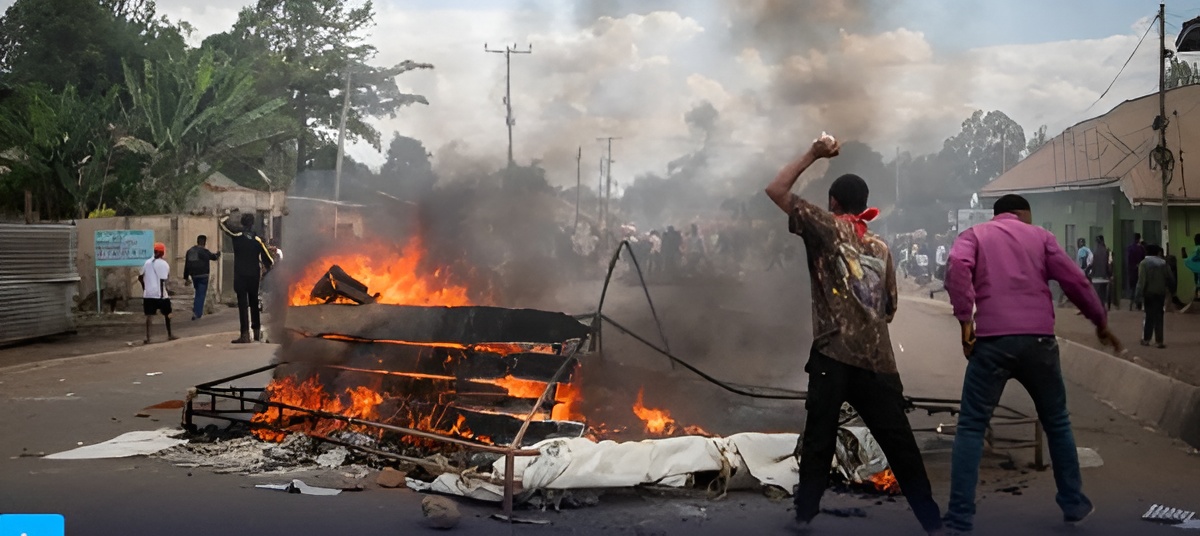
The Tanzanian government has accused unnamed actors of paying young people to ignite unrest ahead of the December 9 demonstrations, warning that the country cannot afford a repeat of the violence witnessed after the disputed general election.
Tanzania Prime Minister Mwigulu Nchemba slammed the alleged financiers, saying the funds could have been used to improve essential public services instead of fueling chaos.
His remarks came just a few hours before the planned nationwide protests.
“Open your eyes. Those sending you have been paid. You are being told to go and cause chaos while they remain with the money. We have seen young people receiving billions. Five billion shillings can build several health centres. Why is one young man given such money? He is only told to find others, give them petrol and tell them to go and burn property,” he said.
The prime minister warned that the government would not allow crime or violence to take root and urged citizens to protect the country from manipulation.
“Let us talk to each other. Do not take us back to such events. Do not do that again. Tell others as well. We cannot allow crime to rule our nation,” he said.
Tensions are high ahead of the planned anti-government demonstrations, which mark Tanzania’s Independence Day. Opposition groups leading the protests are challenging the legitimacy of the October general election, in which President Samia Suluhu Hassan reportedly secured nearly 98 per cent of the vote.
The United States has issued a security alert for its citizens, warning of potential curfews, internet shutdowns, roadblocks and travel disruptions. The US Embassy also suspended non-emergency travel for its staff and advised Americans to avoid large gatherings.
The unrest follows claims of post-election abuses. Human rights organisations and the UN Human Rights Office have reported credible information indicating that hundreds of people may have been killed during and after the polls. Opposition groups suggest the toll could be higher. The government has dismissed these figures as exaggerated and has not released its own data.
Police have declared the planned protests unlawful, citing the likelihood of disruption and damage to public property. Activists, however, insist the demonstrations will proceed, calling for accountability, transparency and political reform.
Earlier this month, President Samia suggested that the election-day unrest had been fuelled by foreign interests intent on destabilising Tanzania. She said Tanzania’s stability “has irritated outsiders” who “came to destroy this country after destroying their own.”
The damage to property and disruption of business, she noted, revealed “the magnitude of the plot” behind the violence.
Referring to videos widely shared on social media, she said the young people involved appeared to have been guided and coached. According to her, they were parroting and singing exactly what happened in Madagascar, to make it happen in the country, which she described as part of “a wide-ranging project” meant to overthrow the government.
She questioned whether the events could be viewed as genuine demonstrations.
“Why on the day of the election?” she posed, describing the unrest as “orchestrated violence with specific objectives.”