The position of Chief Executive Officer at Kenya’s Independent Electoral and Boundaries Commission (IEBC) has long been regarded as one of the most pressured public offices in the country.
The controversial exit of the former immediate CEO, Hussein Marjan, today February 3, 2026, illustrates the pressure that comes with the office.
Those who have held it often found themselves navigating political storms, legal scrutiny, and intense public expectations. From procurement scandals to disputed elections and reform demands, the office has repeatedly been thrust into the national spotlight.
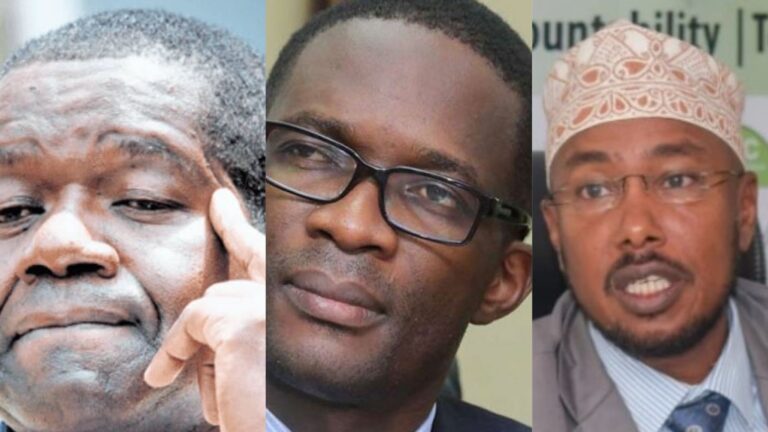
Three former holders – James Oswago, Ezra Chiloba, and Marjan – illustrate how the role has evolved into a political and legal battleground, with each tenure marked by controversy of a different kind.
Oswago and the ‘Chickengate’ scandal
James Oswago’s time as IEBC CEO became synonymous with the infamous “Chickengate” scandal, a corruption case that drew international attention. The scandal stemmed from investigations by the United Kingdom’s Serious Fraud Office, which uncovered a bribery scheme involving a British printing firm, Smith & Ouzman.
The bribes, allegedly paid to Kenyan electoral and examination officials, were codenamed “chicken.”
Oswago was accused of overseeing irregular procurement processes, particularly in the awarding of tenders for election materials. Among the most cited issues was the supply of ballot papers for the South Mugirango by-election, where proper procurement rules were said to have been bypassed.
He was later charged with willful failure to comply with procurement laws and abuse of office. Prosecutors alleged that he received KSh 2 million as an inducement linked to the controversial contracts. In December 2022, the Anti-Corruption Court found Oswago and his deputy, Wilson Shollei, guilty. Each was fined KSh 7.5 million or faced a four-year prison term.
The legal troubles did not end there. In October 2024, the High Court upheld their convictions, ruling that as accounting officers, they bore responsibility for procurement failures that contributed to the malfunction of voter identification kits during the 2013 General Election. Despite the rulings, Oswago has consistently maintained his innocence, arguing that public perception of the scandal differs from the specific legal findings in court.
How Chiloba was disgracefully ousted
Ezra Chiloba’s tenure between 2015 and 2018 unfolded during one of the most politically charged periods in Kenya’s history. He was at the administrative helm during the 2017 General Election — a poll that was later nullified by the Supreme Court over “irregularities and illegalities.”
The opposition, led by the late Raila Odinga, turned Chiloba into a central figure of blame, branding him the “coup plotter in chief” and accusing him of working in favor of the ruling party. Weeks of protests followed, with demonstrators demanding his resignation ahead of the repeat presidential election in October 2017.
Tensions were not limited to the political arena. Internal conflict within the Commission spilled into public view when then-Chairperson Wafula Chebukati demanded explanations from Chiloba over access to the results transmission system and concerns about the use of KIEMS kits.
Chiloba’s eventual exit was dramatic and drawn out. In April 2018, he was suspended via email to allow for investigations into procurement irregularities linked to the 2017 elections. The move triggered further turmoil, including the resignation of three commissioners who accused Chebukati of unilateral decision-making. After months of legal battles, Chiloba was formally dismissed in October 2018 for failing to appear before a disciplinary panel.
Despite the controversy, Chiloba later returned to public service, first as Director General of the Communications Authority of Kenya and later, in 2024, as Kenya’s Consul-General in Los Angeles.
Marjan: Reform demands and political pressure
Hussein Marjan’s resignation today, February 3, 2026, marks the latest chapter in the turbulent history of the IEBC CEO’s office.
Having served in both acting and substantive capacities for nearly nine years, Marjan’s tenure was shaped by political contestation, court battles, and an institution often operating without a full complement of commissioners.
His departure followed mounting pressure from the United Opposition, which listed his removal among its key reform demands. Leaders such as Kalonzo Musyoka and Eugene Wamalwa openly declared they lacked confidence in his ability to oversee the 2027 General Election, accusing him of mismanaging the 2022 polls and being too close to the executive.
Marjan also faced legal setbacks. In June 2025, the High Court found him in contempt for failing to settle a KSh 200 million debt owed to an advertising firm from the 2017 election period. During a prolonged vacancy of commissioners after 2023, he effectively ran a “crippled” Commission that lacked quorum for major decisions, drawing criticism over delays in by-elections and boundary reviews.
Disputes over election technology procurement and claims surrounding the handling of 2022 presidential results further kept him in the political crossfire — allegations he and the Commission denied.
His exit, like those before him, underscores how the IEBC CEO’s office remains deeply entangled in Kenya’s high-stakes electoral politics.
Moses Ledama Sunkuli Takes Over
Meanwhile, the Independent Electoral and Boundaries Commission has appointed Moses Ledama Sunkuli as its Acting Chief Executive Officer for a period of six months or until a substantive office holder is recruited.
The appointment follows the exit of Marjan Hussein Marjan and was announced by IEBC Chairperson Erastus Edung Ethekon. He said Sunkuli’s long service within the Commission and his experience in electoral operations would provide stability during the transition.
Sunkuli currently serves as Director of Electoral Operations and has been involved in the Commission’s core operational work for several years. The IEBC said the decision reflects a preference for institutional continuity at a time when the Commission is under close public scrutiny.
He was a key figure during the 2022 General Elections, particularly at the National Tallying Centre at Bomas of Kenya, where he was serving as the operations lead.
Sunkuli’s academic background includes a Bachelor of Education from Moi University, a Diploma in Business Management from the Kenya Institute of Management, a Bachelor of Commerce from the University of Nairobi, and a Master’s degree in Strategic Management from the same institution. He has also completed specialised training in democratic election management at the University of South Africa.