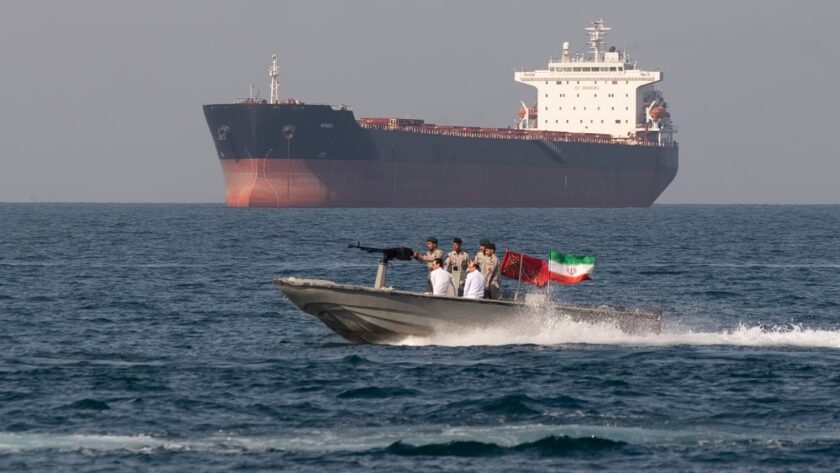
The joint US-Israeli military campaign against Iran has ignited one of the most serious threats to global energy security in decades, with the Strait of Hormuz — the narrow maritime corridor through which a fifth of the world’s oil flows daily — now sitting at the centre of a rapidly escalating crisis.
Iran’s Revolutionary Guards commander says that the Strait of Hormuz is closed and Iran is to set fire to any ship trying to pass, Iranian media reports. The move comes after supreme leader Ayatollah Ali Khamenei was killed in an Israeli strike, and the closure threatens to choke a fifth of global oil flows and send crude prices sharply higher.
The strait is the world’s most vital oil export route, connecting the biggest Gulf oil producers, such as Saudi Arabia, Iran, Iraq and the United Arab Emirates, with the Gulf of Oman and the Arabian Sea.
Earlier, the Revolutionary Guards said a fuel tanker, identified as the Honduran-flagged Athe Nova, was burning in the Strait of Hormuz after being hit by two drones, Iranian news agencies reported.
A Guards statement said the vessel was acting in “unison with America” and identified it as Athen Nova. VesselFinder and other tracking data providers showed the Athe Nova, a 96-meter tanker, was in the area shortly before the attack.
The Strait of Hormuz, a narrow maritime corridor connecting the Persian Gulf to the Arabian Sea, carries approximately 20 million barrels of oil per day — roughly 20% of global petroleum liquids consumption. Iran had hinted at closing the strait in retaliation for the strikes, with Iranian Revolutionary Guard Corps (IRGC) radio transmissions reportedly already warning ships that passage is not permitted, though a formal closure has not yet been declared.
Even without a physical blockade, Brent crude prices jumped approximately 10% to around $80 per barrel over the counter on Sunday — after closing at a seven-month high of $73 per barrel on Friday. Analysts warned that Brent could hit $100 per barrel as markets confront the threat of a sustained supply disruption.
Major shipping firms have suspended transits, and oil prices have surged sharply, raising fears of an unprecedented supply shock that could tip the global economy into recession. Iran, the fourth-largest oil producer in OPEC with output of over 3 million barrels per day, shares a coastline with the Strait of Hormuz — giving it a unique geographic lever over global energy flows that no other country possesses.
The Strait of Hormuz lies between Iran to the north and Oman and the United Arab Emirates to the south, linking the Persian Gulf with the Gulf of Oman and the Arabian Sea. Despite being only 33 kilometres wide at its narrowest point, with designated shipping lanes just 3 kilometres wide in each direction, it accommodates the world’s largest crude oil carriers and serves as the sole maritime exit for most Gulf oil exports.
According to the US Energy Information Administration (EIA), approximately 20 million barrels of oil and petroleum products — equivalent to about 20% of global petroleum liquids consumption — transited the strait every day in 2024. That volume represents more than a quarter of all seaborne oil trade globally, making the Strait of Hormuz, in the EIA’s own words, “one of the world’s most important oil chokepoints.”
The strait also plays a critical role in liquefied natural gas (LNG) trade. Around one-fifth of global LNG shipments moved through the corridor in 2024, with Qatar — the world’s second-largest LNG exporter — accounting for the vast majority of those volumes. The EIA estimates that Qatar ships approximately 9.3 billion cubic feet of LNG per day through the strait, alongside smaller UAE volumes, together representing roughly a fifth of all globally traded LNG.
Maritime insurers have halted voyages through the strait between Iran and Oman after Iran retaliated against U.S. and Israeli strikes, disrupting not only oil and gas shipments but also containerized trade linking Asia, Europe and the Middle East. The bottleneck threatens to ripple through global supply chains, affecting everything from energy markets to consumer goods.