The United States Department of the Treasury has sanctioned Rwanda’s armed forces and four senior commanders for allegedly backing the M23 rebels in the mineral-rich Democratic Republic of Congo (DRC) amid renewed fighting.
The US has accused the Rwanda Defence Forces (RDF) of violating the Washington Peace Accords, signed by President Paul Kagame and President Félix Tshisekedi late last year.
The peace accords were hailed as a key step toward ending the armed conflict in DR Congo and the wider Great Lakes region. However, some observers argued that the US-mediated agreement was linked to the region’s vast mineral resources.
According to a press release from the US Department of the Treasury, the Treasury’s Office of Foreign Assets Control (OFAC) imposed sanctions on the Rwanda Defence Force (RDF)—the military of Rwanda—and four of its senior officials.
“The RDF is actively supporting, training, and fighting alongside the March 23 Movement (M23), a US- and United Nations (UN)-sanctioned armed group responsible for human rights abuses and a mass displacement crisis in the Democratic Republic of the Congo (DRC),” the press release issued on Monday, March 2, stated.
The US Department of the Treasury alleges that the RDF supported M23 as it seized territory in eastern DRC, including the provincial capitals of Goma and Bukavu, along with strategic mining sites.
In a statement released on Monday, Rwanda’s government said it regrets what it described as “one-sided sanctions.”
“The sanctions issued today by the United States, unjustly targeting only one party to the peace process, misrepresent the reality and distort the facts of the conflict in eastern Democratic Republic of Congo,” said the Office of the Government Spokesperson.
Rwanda’s government also accused the DRC of violating the ceasefire. The statement added: “Consistent and indiscriminate drone attacks and ground offensives constitute clear violations of ceasefire agreements by the DRC and continue to cost many lives.”
In recent months, fighting has intensified in North Kivu and South Kivu provinces between DRC armed forces and M23 rebels.
According to the US government, M23’s offensives would not have been possible without the active support and complicity of the RDF and key senior officials.
“President Trump is the Peace President, and the Treasury will use all tools at its disposal to ensure that the parties to the Washington Accords uphold their obligations,” said Secretary of the Treasury Scott Bessent.
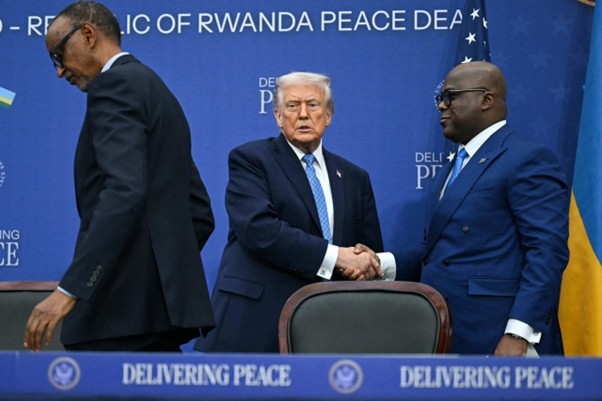
Last year, President Donald Trump hosted DRC President Félix Tshisekedi and Rwandan President Paul Kagame to sign the Washington Accord for Peace and Prosperity, also known as the Washington Accords. The agreement was expected to bring lasting peace and end the armed conflict in the volatile region. However, fighting has continued in both North Kivu and South Kivu.
The US Department of the Treasury further stated that, as a result of the sanctions, all property and interests in property of the designated individuals that are in the United States or in the possession or control of US persons are blocked and must be reported to OFAC.
Kinshasa welcomed the announcement. For President Felix Tshisekedi, it validated years of claims that Rwanda was undermining Congolese sovereignty. In Congo’s telling, this is a straightforward matter of territorial integrity. However, in Rwanda, the narrative feels anything but straightforward.
To understand the reaction here, you have to step back from the diplomatic language and listen to the undercurrent. Rwanda’s leadership, and many ordinary citizens, see the conflict not as an expansionist venture, but as a continuation of unfinished security threats dating back decades.
The presence in eastern Congo of the FDLR, a militia linked to perpetrators of the 1994 genocide against the Tutsi, is not an abstraction in Rwanda. It is invoked in classrooms, in memorial ceremonies, and in political speeches. It is memory layered onto geography.
Rwandan officials argue that the Congolese army, known as the FARDC, has at times operated alongside militias hostile to Rwanda. They insist their military posture is defensive, a response to cross-border insecurity rather than an attempt to redraw maps. Whether that claim satisfies outside observers is another matter, but inside Rwanda, it resonates deeply.
What complicates this moment is that only months ago, optimism, cautious, but real, flickered in Washington. In December 2025, Presidents Tshisekedi and Paul Kagame met under U.S. auspices and signed a framework agreement intended to halt the spiral.
The deal required mutual concessions. Congo pledged to dismantle support networks for armed groups threatening Rwanda. Rwanda committed to disengagement measures and respect for Congo’s territorial integrity.
A joint oversight mechanism was set up to verify compliance. Diplomats involved at the time described the atmosphere as tense but pragmatic, an agreement born less of trust than of exhaustion.
However, the calm proved fragile. Fighting resumed within weeks. Each side accused the other of violating the spirit, if not the letter, of the accord. Now, with sanctions layered onto the dispute, that fragile architecture faces its sternest test.
In Kigali, the sanctions are viewed not only as punitive but as asymmetrical. Officials privately question why pressure appears concentrated on Rwanda when, in their view, Congo’s own commitments remain unfulfilled.
There is also a palpable sense of reputational injury. Rwanda has invested heavily in presenting itself as a pillar of stability, a country that rebuilt from catastrophe through discipline and security vigilance. To be cast internationally as a destabilising actor cut sharply against that self-image.
Walk through Kigali’s orderly streets, and the disconnect is striking. Cafés are full, construction cranes dot the skyline, and daily life carries on with characteristic efficiency. However, beneath the surface, policymakers speak of being misunderstood.
They argue that Western capitals simplify a conflict that is historically tangled and locally combustible. “Security for us is existential,” one government adviser remarked recently. “It is not a geopolitical game.”
None of this erases the suffering across eastern Congo, where civilians continue to bear the brunt of displacement and violence. Nor does it resolve the core dispute over M23’s support networks. United Nations investigations over the years have painted a complex picture of shifting alliances and regional entanglements that defy easy moral binaries.
What the sanctions ultimately achieve will depend less on the symbolism of designation lists and more on what happens next behind closed doors.
If they push Kigali and Kinshasa back toward rigorous implementation of the Washington framework, they may yet reinforce diplomacy. If they harden narratives of grievance on both sides, they risk entrenching the very instability they seek to curb.
For now, the region hovers in that uncomfortable space between confrontation and compromise. The accord between Tshisekedi and Kagame was never built on warmth; it was built on calculation.
Sanctions alter that calculation. Whether they bring the parties closer to compliance or further from trust is a question that will define the next chapter in one of Africa’s most enduring conflicts.