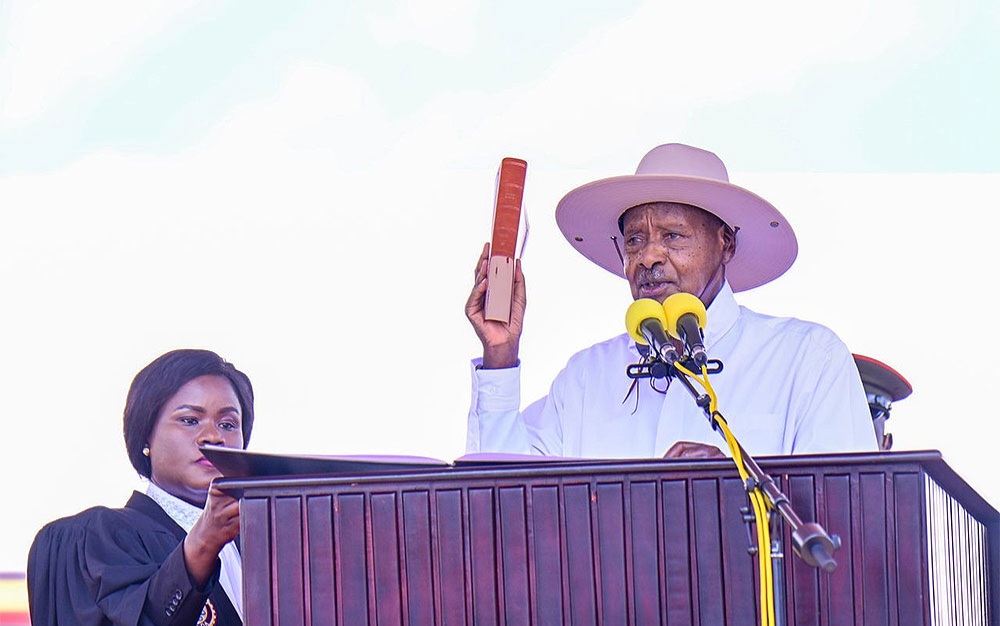
Uganda's President Yoweri Kaguta Museveni was on Tuesday, May 12, sworn in for a seventh elective term at Kololo Ceremonial Grounds, extending a tenure that began in 1986 to at least 45 years by 2031. The inauguration follows his January 15 election victory and comes after the Supreme Court formally cleared the way, dismissing the last legal challenge to the result.
The Electoral Commission declared Museveni winner with 7,946,772 votes, representing 71.65% of valid ballots cast. His main challenger, National Unity Platform leader Robert Kyagulanyi Ssentamu, known as Bobi Wine, polled 2,741,238 votes, or 24.72%. Turnout was 52.5% of the 21.65 million registered voters. Nathan Nandala Mafabi of FDC came third with 1.88%, followed by Gregory Mugisha Muntu, Frank Bulira Kabinga, Robert Kasibante, Mubarak Munyagwa, and Joseph Mabirizi. The five minor candidates combined received fewer votes than the 275,353 ballots ruled invalid.
The January election was contentious, conducted under a nationwide internet shutdown, with opposition candidates alleging harassment, arrests, and restricted access to media. Bobi Wine rejected the outcome, citing electoral irregularities, intimidation, and restrictions during the campaign period, and claimed he escaped a military raid on his home after the vote. The government and Electoral Commission said the poll was free and fair. On March 2, the Supreme Court allowed former candidate Robert Kasibante to withdraw his petition, ruling that "there being in existence no valid legal challenge… Yoweri Kaguta Museveni Tibuhaburwa… is the duly elected President of Uganda.”
Ahead of today's ceremony, Kololo had been sealed under a heavy security ring since Monday, with major traffic diversions across Kampala. The event, declared a public holiday, ran from 8:00 a.m. to 2:00 p.m. and drew about 30 heads of state among them South Sudan’s Salva Kiir, Kenya’s retired President Uhuru Kenyatta, Somalia's President and representatives from several other nations.
The theme was "Protecting the Gains, Making a Qualitative Leap into High Middle-Income Status.” Presidency Minister Milly Babirye Babalanda cited GDP growth from UGX 128.5 trillion in 2019 to over UGX 226 trillion in 2025, along with expanded electricity generation and road infrastructure, as gains to be protected.
Museveni, 81, first took power after leading the National Resistance Army to victory in 1986. Term limits and the age cap of 75 were removed by Parliament in 2005 and 2017, allowing him to run again. With this term, he joins Equatorial Guinea’s Teodoro Obiang and Cameroon’s Paul Biya among Africa’s longest-serving leaders.
The NRM frames the inauguration as "continuity and stability,” while critics argue the election underscored shrinking democratic space.
As Kampala locks down and dignitaries gather, Museveni’s seventh swearing-in cements his place as Uganda’s dominant political figure for nearly four decades. The question for the next five years is whether the promised “qualitative leap” to middle-income status can match the length of his rule.