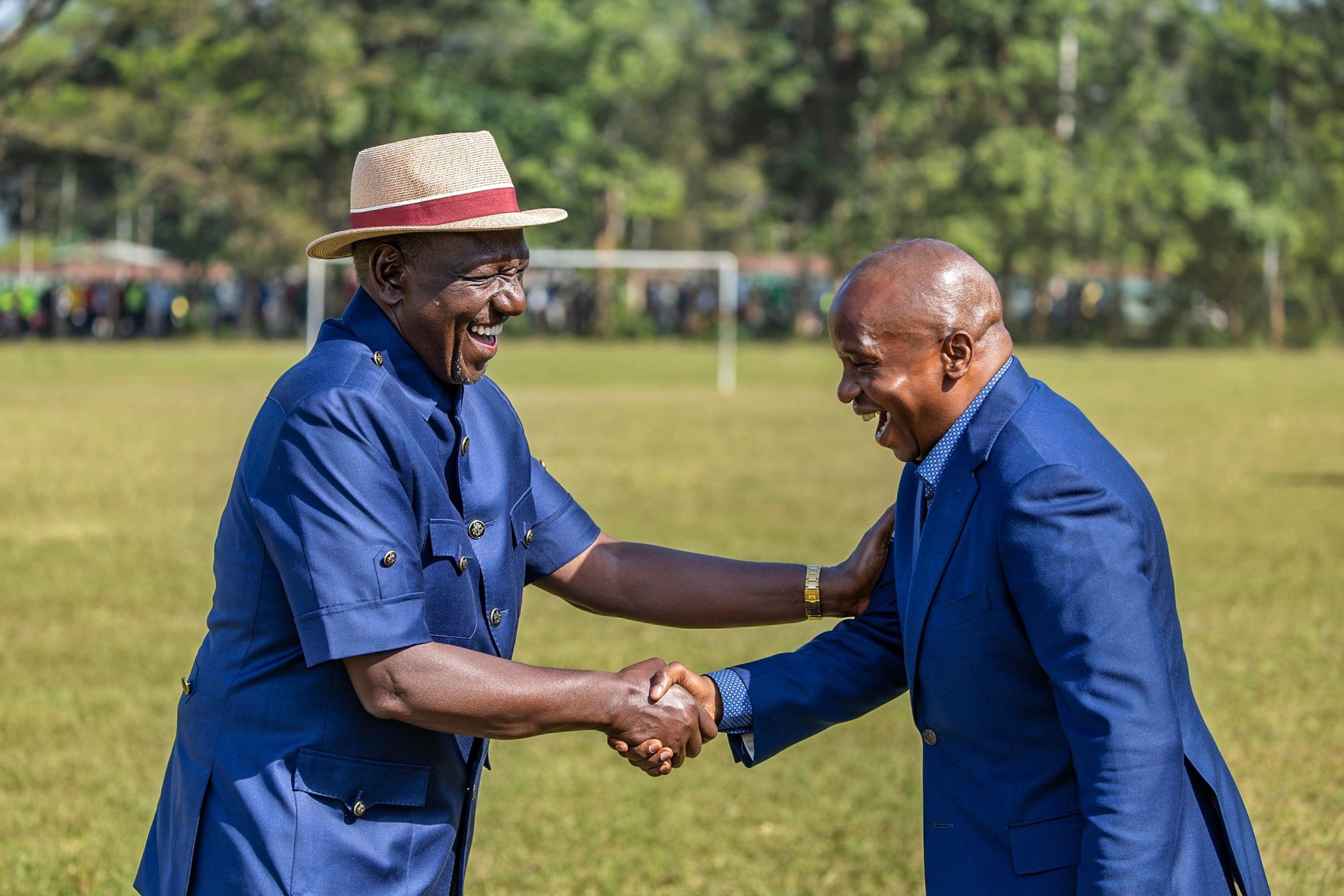
Deputy President Kithure Kindiki has decisively consolidated his position as the undisputed favorite to share the ticket with President William Ruto in 2027, a comprehensive national survey reveals.
As the political establishment grapples with shifting alliances and a deeply volatile electorate, the data indicates that the President's core supporters are overwhelmingly demanding continuity in the executive, firmly rejecting alternative candidates associated with the broad-based government experiment.
The stakes underlying this selection are critical to the survival of the current regime. Facing severe economic headwinds and a hemorrhaging of support in key geographic regions, the incumbent administration cannot afford a fractured ticket. The choice of a running mate will dictate the administration's ability to secure essential voting blocs, maintain internal coalition discipline, and present a coherent vision to an increasingly skeptical public. The unequivocal backing for Kindiki signals a strategic retreat to familiar, tested political loyalties over high-risk political realignments.
The empirical evidence supporting Kindiki's dominance is overwhelming. According to the latest exhaustive study released by TIFA Research, a staggering 59 percent of respondents who currently support the President's re-election bid identified the Deputy President as their absolute preferred running mate. This commanding lead effectively neutralizes any internal debate regarding the structure of the 2027 ticket, demonstrating that Kindiki has successfully translated his tenure in the security docket and the deputy presidency into an unassailable political fortress within the ruling camp.
The research, conducted through rigorous face-to-face household interviews between May 2 and May 11, 2026, engaged 2,013 randomly selected adults across all 47 counties. This methodology ensures that the findings reflect a truly national perspective rather than localized sentiment. The pollsters noted that the electorate views Kindiki as the most politically acceptable and stabilizing deputy option. In a political environment characterized by radical uncertainty and economic anxiety, the ruling base is explicitly prioritizing the safety of the known over the disruption of the novel.
The Rejection of the Broad-Based Experiment
Perhaps the most profound revelation of the survey is the outright rejection of candidates emerging from the recently formed broad-based government arrangement. The data lays bare the failure of opposition-linked figures to gain any meaningful traction with the President's primary support base. Homa Bay Governor Gladys Wanga, despite her high national profile, managed to secure only 12 percent support. Even more striking is the dismal performance of veteran political heavyweights Oburu Odinga and Hassan Joho, who each languished at a mere 3 percent.
This stark statistical reality confirms that the political honeymoon of the unity government has entirely failed to permeate the grassroots level of the ruling party. The report explicitly observes that "ODM-associated leaders attract relatively limited support for the running mate position." This highlights a deep-seated ideological and historical resistance among the President's loyalists to sharing executive power with former adversaries. The base is sending a clear, unambiguous message: political cooperation in parliament must not translate into a compromised presidential ticket.
With the Democracy for the Citizens Party rapidly eroding the administration's traditional dominance in the Mt. Kenya region, Kindiki's elevation becomes a matter of absolute strategic necessity. He represents the administration's most viable mechanism for retaining a critical mass of voters in the highly contested Eastern and Central economic corridors. His ability to project authority while maintaining fierce loyalty to the administration has cemented his status as the indispensable political anchor.
For President Ruto, the TIFA survey provides both a mandate and a limitation. The overwhelming preference for Kindiki removes the political headache of managing a contentious running mate selection process. However, it also restricts his strategic flexibility. By binding himself to the traditional base, the President limits his ability to construct an entirely new national coalition to replace the voters currently bleeding away to insurgent opposition parties.
As the campaign machinery begins to mobilize for 2027, the Ruto-Kindiki ticket appears structurally inevitable. The challenge for this pairing will be immense. They must defend a highly criticized economic record, counter a rapidly consolidating opposition, and convince a disillusioned public that they deserve a second mandate.