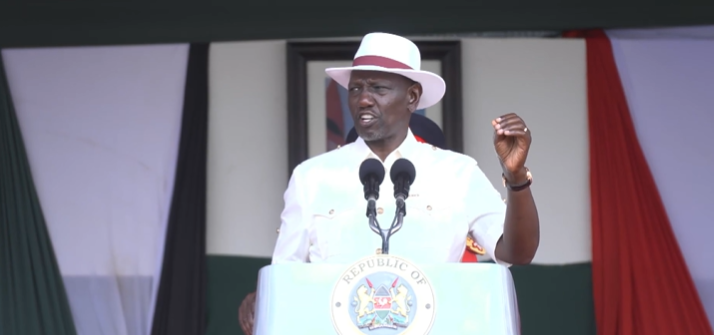
President William Ruto on Monday explained why Kenya has not reopened its border with Somalia, citing persistent security threats and political instability in the neighboring country as the main obstacles to restoring formal cross-border movement and trade.
Speaking during the North Eastern Media Roundtable at Wajir State Lodge, Ruto said he had expected the border to reopen by now but emphasized that the government must balance economic interests with the safety of citizens.
“You know, it is my wish. I really thought I would have opened those borders by now,” he said, adding, “But unfortunately there is always a delicate balance between security and commerce, and we must protect both.”
The Kenya-Somalia border has remained largely closed to formal traffic for years following repeated attacks by Al-Shabaab militants. While informal trade and movement continue in some areas, official border posts have stayed restricted due to the risk of extremist infiltration and smuggling.
Ruto said Kenya has invested heavily in border security infrastructure and personnel to protect communities in North Eastern and beyond. He also noted that Kenyan troops remain deployed in Somalia under regional peace and security missions, working to stabilize the country and prevent attacks from spilling across the frontier.
“We have had challenges with our border with Somalia because of the things that you all know,” Ruto stated, referring to the threat posed by Al-Shabaab.
He added that without improved stability on the Somali side, reopening official crossings would expose Kenya to unacceptable security risks.
Beyond direct security threats, Ruto pointed to a structural problem, the lack of a reliable international funding mechanism for operations in Somalia. He said that over the last two years there has been no coherent, predictable plan supported by the international community to sustain peacekeeping and stabilization efforts.
“Today we do not have a predictable funding model that is supported by the international community,” Ruto said.
That funding uncertainty, according to Ruto, has slowed down timelines for joint security operations and for the confidence-building measures that would make a border reopening viable.
The president also highlighted Somalia’s internal political challenges as a second key factor. He said efforts to build consensus among Somalia’s federal and regional actors remain critical for strengthening governance and improving security coordination. However, disagreements over ongoing political processes have made it harder to achieve the level of stability needed for broader regional cooperation.
Ruto said Kenya continues to engage with Somali stakeholders and supports dialogue aimed at unity and inclusive governance. He stressed that a stable and secure Somalia would benefit both countries by creating an environment that supports legitimate trade, investment, and the movement of people.
“Security and political stability remain closely linked and must be addressed together before significant policy changes can be implemented along the border,” he noted.
Despite the security rationale, Ruto acknowledged the economic downside of keeping the border closed. North Eastern counties and Somali border communities depend heavily on cross-border commerce in livestock, food, fuel, and other goods. Formal reopening would boost tax revenue, create jobs, and integrate the region more fully into national and regional markets.
Ruto reaffirmed Kenya’s commitment to regional integration through the East African Community, COMESA, and the African Continental Free Trade Area. He said cross-border trade has the potential to transform livelihoods on both sides of the frontier and contribute to wider economic growth in the Horn of Africa.
“We’re still looking at opportunities to see how we can open the border but that is a delicate balance that we must always keep in check to make sure that we do not do one and lose the other,” he said.