President William Ruto on Wednesday accused KANU Chairman Gideon Moi of using the Standard Media Group to run “extortionist propaganda” against his administration, declaring he would not bow to what he termed as blackmail aimed at advancing personal interests.
In a strongly worded statement issued on June 24, 2026, the Head of State said the Standard newspaper’s sustained criticism of his government was driven by ulterior motives and would not sway policy decisions.
“Gideon Moi, your Standard Media’s five days a week extortionist propaganda headlines on me and my administration’s transformative track record will get you nothing and nowhere,” Ruto said.
“Blackmail to yield to your greed? Never. Kenya belongs to all Kenyans, not you alone. Try eight days a week. Do your worst.”
The President’s remarks mark a sharp collapse of the political rapprochement that had seemed to take shape in late 2025 after years of rivalry between the two leaders.
On October 8, 2025, Ruto and Moi held what was billed as a reconciliatory meeting at State House in Nairobi. The talks came shortly after Moi withdrew from the Baringo Senate race, fueling speculation that a broader cooperation deal was in the works.
Two days later, on October 10, 2025, Ruto traveled to Kabarak in Nakuru County for a meeting with KANU delegates. Both camps described the engagement as a working arrangement and a break from past hostility. A follow-up meeting on October 27, 2025, again at State House, brought together Moi and leaders from Baringo County.
Reports at the time suggested Moi was being considered for a Cabinet position, with some allies referring to him as an “incoming Cabinet Secretary.”
Despite the optics of unity and repeated discussions about government roles for Moi and his allies, no formal appointment was announced. By mid-2026, State House had not confirmed any Cabinet slot for the KANU leader, and the working relationship quietly unraveled.
Sources close to both sides indicated that disagreements over policy direction and political expectations derailed the arrangement, though neither party had publicly addressed the breakdown until Ruto’s statement today.
The Standard Media Group, in which the Moi family holds a significant stake, has intensified scrutiny of the Kenya Kwanza administration in recent months. The newspaper’s coverage has focused heavily on the cost of living, new tax measures, rising public debt, and the pace of government project implementation.
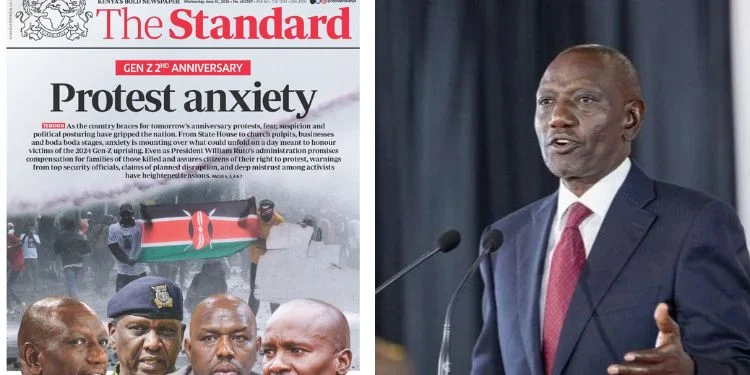
Today’s edition, June 24, carried the front-page headline “Protest Anxiety,” capturing national tension ahead of the planned Gen Z anniversary protests set for June 25. The demonstrations are intended to commemorate Kenyans killed during the June 25, 2024 anti-Finance Bill protests and the smaller anniversary marches on June 25, 2025.
The cover featured images of President Ruto, Interior Cabinet Secretary Kipchumba Murkomen, Inspector General of Police Douglas Kanja, and Deputy President Kithure Kindiki placed alongside photos of protesters waving the Kenyan flag.
The story detailed government assurances on security preparedness, warnings from police about potential unrest, and public unease over how authorities plan to manage the day.
That headline is only the latest in a string of critical reports. On June 23, 2026, a televised special titled “The Gallery of Ruto’s Lies: Kenyans Furious as Ruto’s Promises Turn Into Empty Projects” aired, questioning the status of key pledges made since 2022.
Similar coverage ran on June 21 and 22 under the theme “Exposed: Kenyans Furious as Ruto’s Promises Turn Into Empty Projects,” with footage of stalled or incomplete infrastructure.
Throughout May 2026, the Standard highlighted political headwinds for the President, reporting on May 3 about waning support in the Mt Kenya region, and on May 17 and May 19 about challenges in Western Kenya, coupled with criticism over fuel prices and household expenses.
The administration has also come under fire over immigration controls. Investigations published in late February and March 2026 alleged that a figure linked to Sudan’s Rapid Support Forces had obtained a Kenyan passport, raising questions about vetting and accountability within the immigration department.
On June 15, 2026, another investigation alleged the existence of an illegal network that helped foreigners acquire Kenyan identity documents through bribery.
The escalating coverage has drawn repeated complaints from government officials who argue that some media houses are biased, while press freedom advocates maintain that the Constitution protects robust scrutiny of public officials. Article 34 guarantees the freedom and independence of the media, while Article 33 protects freedom of expression, including the right to seek, receive, and impart information.
The Standard Media Group responded to the President’s latest statement with a jibe, indicating that the "Bold Newspaper" was just getting started. The dispute unfolds against a backdrop of heightened public attention on governance, the economy, and security.