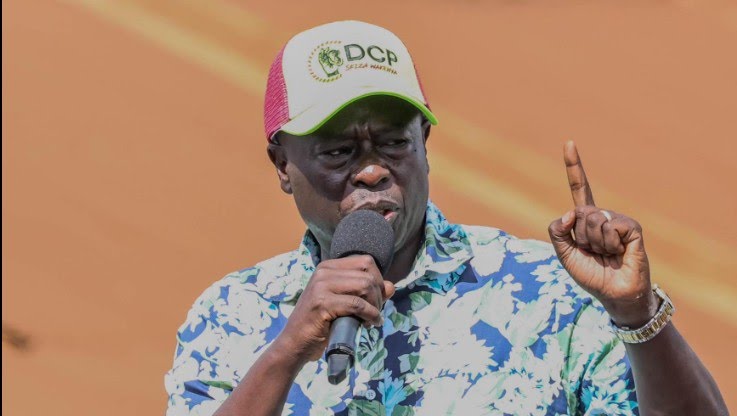
Former Deputy President Rigathi Gachagua has accused President William Ruto’s administration of suppressing media freedom and intimidating journalists ahead of the 2027 General Election, claiming some reporters and editors have been marked for a crackdown over critical coverage.
Speaking to the media on Tuesday, Gachagua said journalists covering corruption, abuse of the rule of law, misuse of public resources and other sensitive issues were living under fear and threats from state agencies. He alleged the government is preparing to weaken media houses through financial pressure and other measures before the polls.
“We have had a bad pattern in Kenya that, ahead of general elections, journalists and bloggers get targeted by unpopular regimes that fear the power of the people at the ballot. Some journalists or bloggers either disappear, are silenced, compromised, or killed altogether,” Gachagua said.
He described the current pressure on the press as shameful, saying those stifling the media are attacking an institution that helped build freedom of expression in Kenya.
“Journalists covering corruption stories, abuse of the rule of law, wanton looting of public resources and other beats and who have refused to be silenced, intimidated, or corrupted by the state live under perpetual fear, intimidation and daily threats from the state machinery,” he said.
Gachagua, who is the leader of the Democracy for the Citizens Party (DCP), accused President Ruto of attacking the independence of the Standard Media Group after the outlet published stories critical of the government.
“It is saddening and painfully unbearable that on June 24 and 25, 2026, President Ruto, on his official X account, launched a barrage of scathing attacks on the independence of the Standard Media Group. This was after a series of uncomfortable stories about this regime, and more painfully to him was a story on William Ruto Gallery of Lies,” he said.
He warned that such actions amount to an attack on freedom of expression.
“Ruto, the media does not live under your muscle privilege. If you think the media is your enemy, you are mistaken. Wait for August 10 next year,” he said.
The former Deputy President also raised concerns over threats against journalists attached to MediaMax Limited. He said some had been subjected to intimidation and abuse, and named several journalists he claimed had faced threats from political figures and security agencies.
Gachagua said the government was planning to shut down some media houses, weaken others through reduced government advertising, and interfere with internet access ahead of the 2027 elections.
“We are aware and informed of Ruto's plans to shut down some media houses, cripple others through the government advertising agency financially and slow down and eventually shut the internet on the 10th of August 2027,” he said.
He insisted that media freedom is a constitutional right, not a government concession.
“Press freedom is not a privilege granted by the state, but a right recognised under our Constitution. Articles 33 and 34 of our Constitution give the right to freedom of expression and freedom of the media, respectively,” Gachagua said.
The DCP leader also criticised media restrictions in Uganda, arguing the situation reflects a wider challenge to press freedom in East Africa.
“I strongly condemn the closure of NTV Uganda, Spark TV, and Daily Monitor by Uganda's military chief, General Muhoozi Kainerugaba, who is the son of Kaguta Museveni. He is a close confidant of Ruto, and by association, Ruto is part and parcel of this shutdown,” he said.
Gachagua urged journalists, media houses and editors to remain firm and protect their independence, saying the media remains a key institution for citizens ahead of the next election.
“I want to assure journalists wherever they are that they are my full support, and I will be there for them at this very difficult time,” he said.
He argued that the government’s difficulties are not caused by the media but by economic hardship, corruption, poor service delivery and failure to meet public expectations.
“The problem is not the media, it is fake promises, failure, lies, a failing economy, failed systems, poor service delivery, corruption, abuse of the rule of law, abductions, extra-judicial killings, and total failure of government,” Gachagua said.
He called on media organisations, the Kenya Editors Guild (KEG) and international bodies that protect journalists to defend press freedom.
“Do not be cowed, do not be threatened or intimidated. Stand firm and speak the truth for the people of Kenya,” he said.