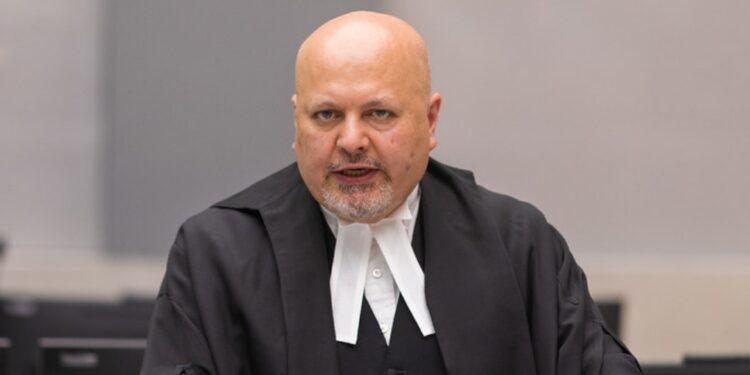
NEW YORK — The Assembly of States Parties (ASP) to the International Criminal Court (ICC) has voted to remove Chief Prosecutor Karim Khan from office, marking the first time in the court’s history that its elected prosecutor has been dismissed through disciplinary proceedings.
ASP President Päivi Kaukoranta announced the decision on Friday at UN Headquarters in New York, saying 82 of the ICC’s 125 member states voted in favour of removal.
“The assembly has decided by a majority of 82 states parties that the elected official, Prosecutor Karim Khan, committed serious misconduct and a serious breach of duty ... and to remove the elected official, Prosecutor Karim Khan, from office under Article 46 paragraph 2B of the Rome Statute,” Kaukoranta said.
Kaukoranta said the case related to an internal workplace complaint of prohibited conduct by an elected official against a subordinate staff member.
She called for respect for the dignity and privacy of all those involved, noting that complaints of misconduct, investigations and disciplinary proceedings are deemed confidential matters.
The decision brings to a close more than two years of scrutiny over allegations of sexual misconduct made against Khan by a staff member. Khan has consistently denied any wrongdoing.
“I have consistently and unequivocally denied any sexual misconduct and any sexual relationship of any kind, consensual or otherwise, with the individual concerned. I repeat those denials and stand firmly that I have not committed any acts as alleged,” he told Julisha Media.
Khan is now formally relieved of his duties as chief prosecutor of the world’s only permanent international criminal court. He had voluntarily stepped aside in May 2025 to allow investigations to proceed and was officially suspended by the Bureau of the ASP in June 2026, when it referred his disciplinary case to the full assembly for a vote.
Khan came into office in 2021 as the ICC’s third prosecutor with high expectations. A veteran British lawyer with decades of experience in international criminal law, he inherited an institution often criticized for the slow pace of its cases. He pledged to make the Office of the Prosecutor more efficient, improve cooperation with member states, and focus more directly on delivering justice to victims.
During his tenure, the court accelerated investigations into atrocities committed in Ukraine, continued work in Darfur, and advanced several long-running investigations in Africa and the Middle East. His office also sought and obtained arrest warrants for high-ranking officials in the Israeli government, including Prime Minister Benjamin Netanyahu, in relation to the war in Gaza. That move drew global attention and placed the court at the center of intense geopolitical debate.
The allegations against Khan first reached the court’s Independent Oversight Mechanism on May 3, 2024, when a third party reported claims of harassment involving the prosecutor. According to the IOM’s annual report, the alleged victim declined to confirm or deny the allegations and did not file a formal complaint at that time. As a result, the oversight body did not open a formal investigation but recommended undisclosed protective measures.
The claims entered the public domain in October 2024 after anonymous social media accounts circulated details and identified the alleged victim. On October 28, 2024, Khan formally asked the IOM to open an investigation into both the allegations and what he described as a campaign of disinformation targeting his office. He said the accusations had emerged amid broader attacks against the ICC following several politically sensitive investigations. He pledged full cooperation while maintaining his innocence.
Because no formal complaint had been lodged when the IOM first approached the alleged victim, the oversight body concluded it lacked sufficient grounds to launch a formal investigation under its procedures. The ASP then commissioned an external inquiry by the UN Office of Internal Oversight Services to ensure what Kaukoranta described as a “fully independent, impartial and fair process” conducted under a victim-centred approach.
In May 2025, Khan took a temporary leave of absence while the inquiry proceeded. The two deputy prosecutors assumed day-to-day leadership of the OTP. Investigators interviewed witnesses, reviewed electronic communications, and examined evidence over several months, collecting more than 5,000 pages of material. The OIOS submitted a 150-page report to the ASP President, who referred it to the 21-member Bureau of the assembly.
The case entered a new phase in March 2026 when an independent panel of three judges appointed by the ASP Bureau reviewed the OIOS findings to determine whether they amounted to misconduct or a breach of duty. The panel included Judges Leona Theron of South Africa’s Constitutional Court, Paul Lemmens of Belgium, and Seymour Panton of Jamaica.
After nearly three months of review, the judges announced on March 9, 2026 that “the factual findings by OIOS do not establish misconduct or breach of duty under the relevant legal framework.” The conclusion was unanimous.
However, the Bureau was not satisfied with that review and reached a preliminary determination that the material warranted further examination. Over the following months, both Khan and the complainant were invited to submit additional written observations and evidence. The alleged victim was also given an opportunity to respond before the Bureau decided whether to pursue disciplinary proceedings.
In June 2026, the Bureau formally announced that it had found Khan had committed serious misconduct and suspended him from his duties. It then referred the matter to the full Assembly of States Parties for a final decision.
Friday’s vote marks an unprecedented moment for the ICC. Never before has the ASP, the court’s management oversight and legislative body, been called upon to determine the future of a sitting prosecutor through its governance and disciplinary framework.
With Khan’s removal, the court now faces the task of appointing new leadership at a time when it is handling some of its most politically sensitive cases. The deputy prosecutors will continue to lead the Office of the Prosecutor on an interim basis until member states elect a successor.
The ASP emphasized that the integrity of the court depends on upholding the highest standards of conduct for all its officials, including those at the most senior level. At the same time, it urged that the process not distract from the court’s core mandate of investigating war crimes, crimes against humanity and genocide.