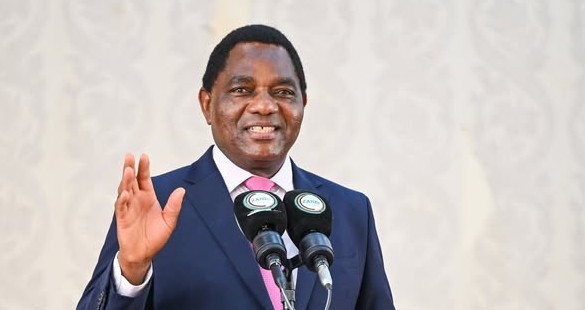
Zambia's President Hakainde Hichilema has officially commenced his second and final five-year term after a decisive victory in the August 13 general election, extending his stewardship of the Southern African nation that began in 2021.
The Head of State took the solemn oath of office alongside his Vice-President, Mutale Nalumango, during a grandiose inauguration ceremony staged at the 60,000-capacity National Heroes Stadium in Lusaka on Tuesday. The event drew mammoth crowds of jubilant supporters, diplomats and a host of regional dignitaries, including Kenya's President William Ruto, who were present to witness the constitutional transition.
Hichilema swore to defend the Zambian Constitution, uphold the rule of law and diligently serve all Zambians without discrimination or favouritism.
In a measured, reconciliatory and statesmanlike inaugural address, Hichilema sought to douse political tensions and heal a deeply polarised nation, pledging to be a President for all Zambians irrespective of political persuasion, tribe or region.
He emphasised that those who cast their ballot for him and those who supported rival candidates remained equal citizens under the law, bound by a common destiny and entitled to equitable development.
He called for magnanimity, restraint and national cohesion, imploring Zambians to put the bruising electoral contest behind them and rally behind his administration's socio-economic transformation agenda.
"Our purpose remains clear, to uplift the lives and improve the well-being of every Zambian citizen. This is the promise of the heart that the Grow Zambia agenda holds. We pledge to serve you with integrity and accountability, as we did in our first term," he declared to thunderous applause.
According to official tallies released by the Electoral Commission of Zambia (ECZ), Hichilema secured a commanding 60 per cent of the presidential vote, while his closest challenger, former Leader of Opposition Brian Mundubile, garnered 38 per cent.
Mundubile, however, flatly rejected the outcome, citing alleged systemic irregularities, manipulation of result transmission and lack of transparency in the tabulation process.
"The integrity of our presidential election is at stake following information alleging that GEN 20 forms were collected from districts and may have been subjected to interference or alteration," Mundubile asserted on August 17.
His claims found partial resonance with the European Union Election Observation Mission, which raised red flags over the credibility of the tabulation exercise. In its preliminary report, the mission noted that electoral officials at many constituency centres failed to immediately record announced results on tally sheets as prescribed by law.
The EU observers further documented protracted and unexplained breaks in the announcement of results, with returning officers seemingly waiting for directives from the ECZ headquarters in Lusaka before declaring outcomes, a move they said undermined transparency and public confidence.
Mundubile had intended to contest the results through a constitutional petition but was unable to lodge his case after the courts were abruptly closed on the last day for filing election challenges. Judicial authorities attributed the closure to heightened security concerns following the disputed poll.
The post-election period has since been engulfed in political turbulence and a severe security crackdown. A day after the election, heavily armed security forces raided a property linked to Mundubile in Lusaka, in an operation that left a former cabinet minister dead and several opposition operatives in custody.
The state accused the opposition of hatching an armed insurrection to subvert the will of the people, allegations the opposition has dismissed as fabricated, malicious and politically instigated to silence dissent.
Mundubile and his running mate, Makebi Zulu, subsequently went into hiding before being apprehended and taken into police custody. They have since been arraigned and formally charged with treason, a non-bailable offence, and remain incarcerated pending trial, casting a dark shadow over an otherwise celebratory inauguration.
Despite the simmering tensions, Hichilema's supporters hailed his second-term mandate as an endorsement of his first-term record, which they credit with stabilising the economy, securing a landmark debt restructuring deal, taming inflation and restoring Zambia's standing with international investors.