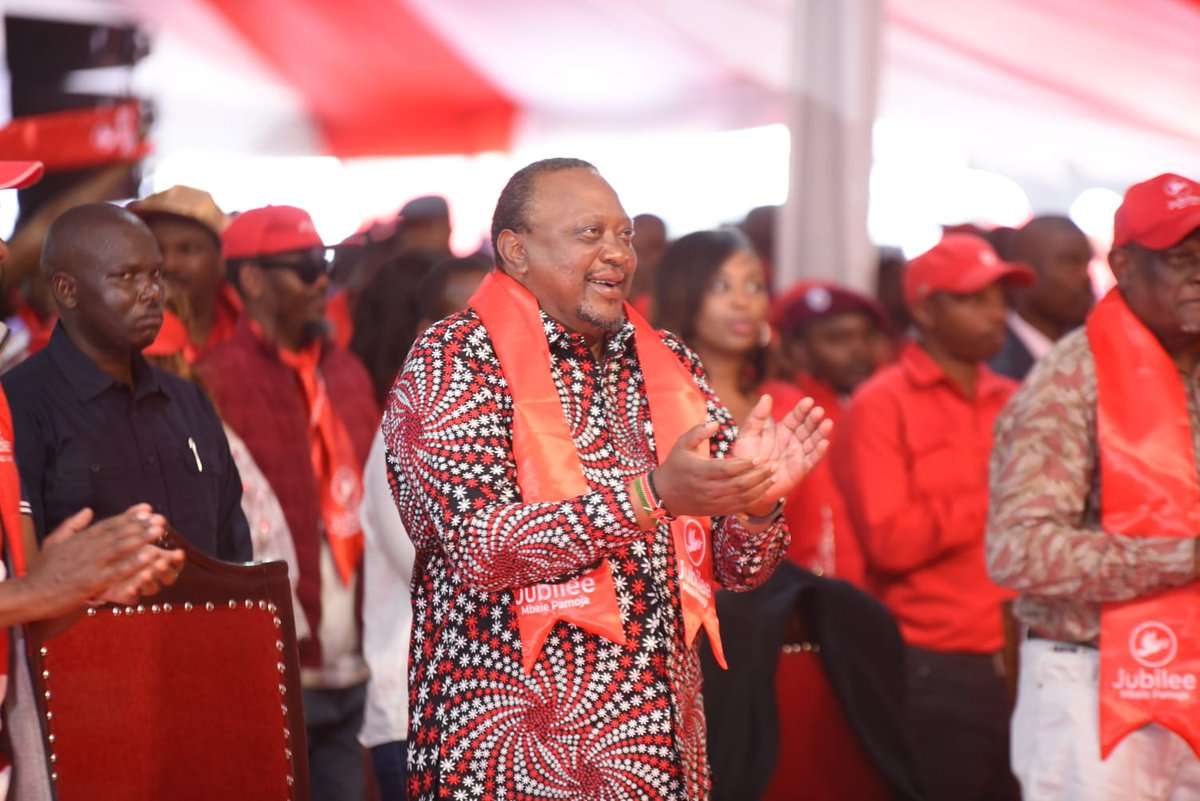
Former Head of State Uhuru Kenyatta has signaled his intention to vacate the Jubilee Party leadership after the High Court affirmed the constitutionality of a statute that bars ex-presidents from retaining party positions beyond half a year after exiting State House.
In a communique released Tuesday from the Office of the Fourth President, spokesperson Kanze Dena stated that Uhuru had taken note of the verdict with deference to the courts and is prepared for a transparent, legal and constitution-compliant transfer of power.
"Uhuru Kenyatta has received this ruling in a spirit of profound respect for the judiciary. He notes that the court's ruling is not a restriction on his political life; it is a reaffirmation of our democratic maturity," Dena stated.
She added that the former Head of State believes true influence is measured not by titles but by public confidence earned over time.
The announcement came a day after Justice Lawrence Mugambi delivered judgment in Petition E532 of 2024, lodged by activists Peter Odhiambo Agoro, Paul Muiruri Kiguathi and Damon Onyango Osawa. The trio contended that Section 6(1) of the Presidential Retirement Benefits Act infringes on equality, freedom of association and political rights.
Justice Mugambi disagreed, sustaining the provision that a former president cannot occupy a party office more than six months after retirement.
He however stressed that the law does not eject retired presidents from parties nor silence their political voice.
"A reading of Section 6 (1) is clear... it does not forbid the retired President from being a member of a political party, what it restricts is taking up a leadership role in the political party for more than six months after retiring," the judge observed.
The Attorney General had defended the clause, arguing that political rights under Article 24 can be regulated where the limitation is rational and proportionate in a democratic state.
"Political rights are subject to the limitations contemplated under Article 24 of the Constitution," the AG submitted.
The court concurred, noting rights under Articles 27, 36 and 37 are not absolute and may be curtailed by law if justifiable.
"Article 36 and 37, including Article 27 upon which the Petition is premised, are not absolute and may be limited by law to the extent that the limitation is reasonable and justifiable in an open and democratic society," Mugambi ruled.
He explained that the 2003 legislation was crafted in the aftermath of Daniel arap Moi's 24-year rule to discourage former presidents from controlling politics through proxies.
The bench also dismissed the case for want of personal injury, holding that the petitioners had not demonstrated how the statute prejudiced them directly.
Uhuru has led Jubilee since its birth in 2017 and stayed on after handing over power in September 2022. That continuity sparked a bruising internal battle.
In May 2023, a rival wing announced his seat vacant, citing the six-month clause, and fronted nominated MP Sabina Chege as interim leader. Two centres of power emerged, each claiming authority to call meetings, sack officials and write to the Registrar of Political Parties. Uhuru's camp dismissed the takeover as unconstitutional.
The Political Parties Dispute Tribunal sided with the Chege group, and Registrar Anne Nderitu recognized Chege and EALA legislator Kanini Kega as leader and secretary general respectively.
The tide turned in June 2025 when court orders nullified the resolutions that had enthroned the Chege faction, restoring Uhuru.
The row was not merely legal. In 2024, Uhuru's retirement office complained of budget freezes and attempts in Parliament to strip some benefits, which allies viewed as pressure over his opposition role.
According to his office, the prolonged stay was not defiance but a consequence of contested ownership that needed judicial clarity.
"With the court's guidance, that path is now clear," the statement said, affirming Uhuru's absolute willingness to ensure the transition is done openly, lawfully and strictly per the party constitution.
The former president described the moment as a fresh start for Jubilee, anchored on legality, internal democracy and mentorship of younger leaders as the party eyes 2027 under Azimio.